
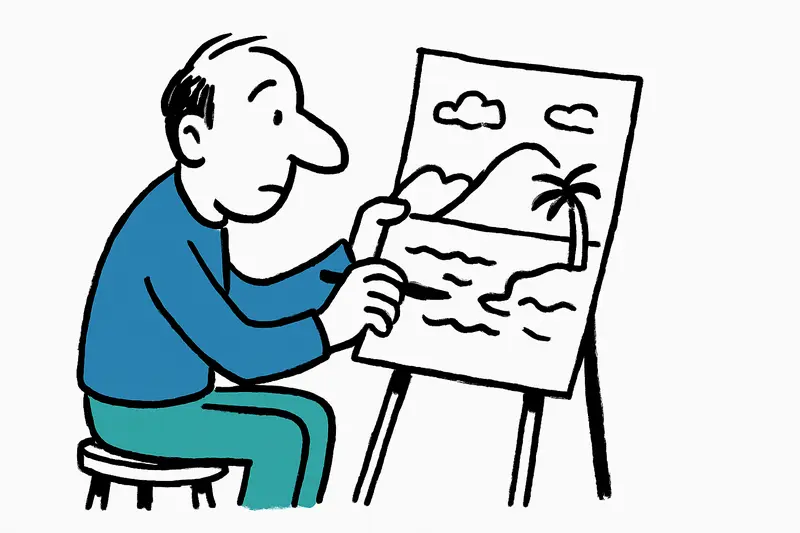
The Painter Who Invented Himself: How a Young Viennese Drew Mallorca
A hundred years ago a 19-year-old draftsman arrived in El Terreno. His diary and sheets, long known under the pseudonym Francis Caron, are now among the liveliest descriptions of Mallorca before mass tourism. The artist's true identity has finally been clarified.
The Painter Who Invented Himself
On a warm September morning, when the cathedral bells hang over the Passeig Mallorca and the seagulls cry above the Cala de Sa Calatrava, one sometimes finds a sheet of paper in one's hand on which the island looks as unaffected as it once was. A hundred years ago a young man from Central Europe came here, rented a room in El Terreno and began to draw, observe and record. His works later appeared in a book under an English pseudonym. Only now can the puzzle be pieced together.
The stranger was barely twenty and brought the rigor of the Vienna Academy to his lines. In the shady streets of Palma, by the scent of freshly baked ensaimadas in a bakery on Calle Alfonso, he found subjects for fine etchings: simple farmhouses, the curved lines of promenades, women lowering baskets from balconies, men in espadrilles. His observations read like the notes of a fellow resident: not distant, but practiced in everyday life.
A Book, Many Names
The drawings and diary entries appeared in 1939 under the title "Majorca. The Diary of a Painter" and under the name Francis Caron. For decades the author remained a shadow: a charming pseudonym, more mystery than person. Anyone walking through El Terreno back then might have seen a lanky young man in a worn suit watching the boatyard with a critical eye or sitting with a pencil on the promenade. Yet the one who had gathered these scenes was long not recognized as the artist who had already worked in Vienna and elsewhere.
The Unmasking
The search for traces began with the images themselves. Some etchings reappeared in early portfolios; other motifs were found in printed materials and exhibition catalogues of the late 1920s and 1930s. In the end everything converged: the man behind the pseudonym was Franz Heinrich Taussig, born in 1906 in the region around Prague and trained in Vienna. An immigration document from the USA listing both names provided the decisive confirmation: Caron and Taussig were the same person.
From Drawing Board to Workshop of Invention
Taussig's life took unusual turns. In the years after Mallorca he worked as a graphic artist and illustrator in several European cities. National Socialism forced him to flee; via stops in Paris and London he finally reached overseas. There he largely set aside the painter's brush and turned to technical inventions and patents. Under another name—a Spanish-sounding alias—he became part of a different world: the inventor, no longer only the painter. He died in the USA in 1989.
Why This Matters for Mallorca
This is not just a pleasant name in an art biography. These sheets are windows into an island that has changed: Sunday gestures, the language in the plaza, prices for rooms and cafeteria meals that today sound almost unbelievable. The images do not show postcard idylls, but an everyday life formed by small, concrete actions. That is what makes them valuable for us on Mallorca: they offer a direct encounter with people, smells and ways of working that otherwise would sleep only in archives.
A Local Observation of Everyday Life
When I walk along the Passeig in the morning today, I see vendors calling out their wares as before, elderly women exchanging a few words, a child rattling by on a Vespa. These scenes would certainly have pleased the young Taussig. He was not only a spectator; he learned Mallorquí, wore espadrilles and ate with the people. It is precisely this closeness that gives his drawings warmth and authenticity.
A Call to Preserve Visual Heritage
The story of Taussig reminds us how fragile visual evidence is: prints can be misattributed, books disappear, names change. That is why it is valuable when research and archival work reassemble images and complete biographies. For museums, collectors and local archives on the island this means: preserve, catalogue, make accessible. Every sheet can become a bridge that connects present and past.
That a young Viennese a century ago not only consumed Mallorca but settled in is an invitation to us: look closely, listen, keep the small stories. Such finds nourish our understanding of the island more than any stereotypical brochure.
Outlook: Those who wish to see the original sheets or diary entries can find them today in various collections and archives; the unmasking of the author should be a reason to pay renewed attention to the small exhibitions in libraries and cultural centers. For Mallorca, the investigation of such biographies means: more context, more memory, more reasons to tell one's own history.
Frequently asked questions
Who was the painter behind Mallorca's early sketches and why did he use the name Francis Caron?
Where did Taussig live in Mallorca and what did he capture in his drawings?
What is the book Majorca: The Diary of a Painter and its connection to Taussig?
How was Taussig unmasked as the author behind Francis Caron?
What happened to Taussig after his Mallorca years?
Why are Taussig's Mallorca drawings significant for today's visitors or historians?
Can I see the original Taussig sheets or diary entries today?
What do Taussig's Mallorca drawings show about everyday life, like people in the streets or markets?
Similar News
Released with Conditions: The Plus Ultra Suspicion and a Mallorcan Finca as Residence
A Dutch entrepreneur, sought in connection with the Plus Ultra case, was extradited to Spain after his arrest in Germany...
Haute Nuit in Puerto Portals: Fashion, Art and Indulgence by the Water
On October 2 the Lobster Club in Puerto Portals will be transformed into a stage for curated fashion, art and culinary e...
Magaluf: Watchtower Alarm – Lifeguards Pull Unconscious Beachgoer from the Water
After a drama in the late afternoon, two lifeguards at Magaluf beach rescued an unconscious 44-year-old man. He was stab...
Turquoise in the City: How dangerous is the color play of the Sa Riera?
The Sa Riera in Palma suddenly turned turquoise — a pretty motif, but behind the effect lies a discharge of saline waste...

Jeckliner at Sunnesching: Cologne spirit sets sail from Palma
In September 2027 the Mein Schiff 2 briefly becomes a floating carnival stage: four days with Cologne bands, comedy and ...
More to explore
Discover more interesting content

Can Cap de Bou

Townhouse Lleo 72
