
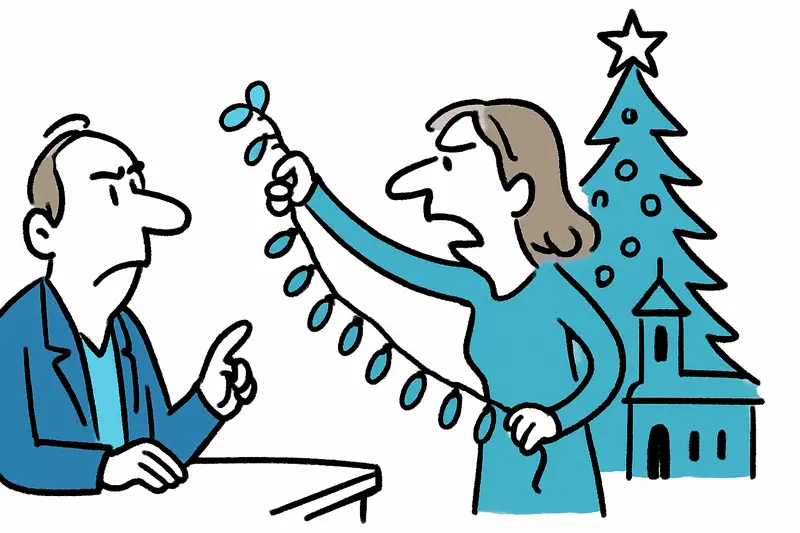
Lights moved from the Borne: Palma shifts the Christmas switch-on — a good idea, but at what cost?
Palma moves the Christmas lights switch-on from Paseo del Borne to Plaza España. Security and more space are the arguments — but the €1.9 million budget, artificial snow and the question of fair distribution raise further concerns.
Why the Christmas lights won't be switched on at the Borne this year
This year the big switch-on of the Christmas lights in Palma will no longer take place on the Paseo del Borne, but on Plaza España, as reported in Palma switches on Christmas lighting — change of venue, sparkle and the cost of the lights. The justification is solid: safety. Too many people, too little space, and emergency access routes that would not be optimal in a critical situation. That sounds reasonable in a city where every inch at night still attracts people — from the dozen voices that flow through the Borne to the quiet clatter of a bus schedule at the plaza.
The central question: protection or spectacle — and who pays for it?
The city cites more space and better access as arguments. That is the official line — and it is important. More details about the move are in Christmas Lights in Palma: Why Plaza España Is in the Spotlight This Time. But the decision raises a bigger question: Is the relocation purely a safety measure or also a signal of budgetary priorities? The city is investing around €1.9 million in the lights and decorations, slightly more than last year. For this amount LEDs, projections, artificial snow and a staging by the Trui Theatre will be set up. It sounds nice, but it also smells like public money that might be urgently needed elsewhere: park benches, playgrounds, street lighting in quieter neighborhoods.
What has been underdiscussed in the public debate
First: energy and the environment. LEDs are more efficient than old decorative lamps, but projections and installations still require power — and artificial snow is another point of consumption. Is there an accounting of how much additional consumption will result and whether CO2 offsetting or night shutdowns are planned? Second: cost sharing. The lights are supposed to hang in around 200 streets. Will households in residential neighborhoods be charged a share, or will the city cover it centrally? Third: citizen participation. Who decided which neighborhoods will get which motifs? The view from Passeig del Born changes not only spatially but socially: tourist mile versus neighborhood.
The event: family-friendly, but choreographed
The start is scheduled for Palma switches on the lights – the Christmas show moves to Plaza España, with an approximately 35-minute production by the Trui Theatre: music, light and a short stage piece 'Dance of the Stars', followed by a countdown. Good: the time is family-friendly; many parents can still come with small children. Good also: the symbolic switch will be triggered this time by residents of a social institution — an inclusive detail that deserves applause.
Between crowd control and decentralization: opportunities instead of crushes
Moving to Plaza España can be more than just fleeing the crush. If the city uses the opportunity to rethink the celebration in a more decentralized way, real gains can be made: rotating switch-on events in the districts, small local switch-ons on different evenings, clear time windows to avoid large crowds. That way the magic remains without tens of thousands gathering at a single point and the police taking over the atmosphere. The large crowd has already prompted discussions documented in Palma after the crush: Where should the 2026 Christmas lights switch-on be held?. A small parade of light switch-ons through the neighborhoods, accompanied by local choirs or school ensembles, would spread the money and the mood more widely.
Concrete proposals and solutions
1. Budget transparency: an open breakdown of what the €1.9 million is spent on — technology, personnel, security, cleaning; 2. Make the energy balance visible: meters on central installations, a CO2 balance and a promise to invest part of the costs in energy savings or compensation projects; 3. Decentralized switch-on dates: instead of a single big event, several smaller events in the 200 streets — this reduces crowding and strengthens neighborhoods; 4. More sustainable effects: less artificial snow, more local artists, Christmas markets with Mallorcan products and a portion of the budget for neighborhood measures.
A small personal glance
On Saturday I will stand at the edge of Plaza España — with a scarf, maybe a thermos of coffee, and the curiosity of a resident who has followed the noise at the Borne for years with a frown. The lights will look beautiful, the audience will clap, children will reach for artificial snow. And somewhere between the countdown and the draught the real question will remain: are we using the lights to make Palma more beautiful — or mainly to show how big our show is?
Conclusion
The move is factually justified and offers opportunities. But it also brings political and ecological questions that have so far been too little discussed. If the city now shows the courage for decentralization, transparency and sustainable compromises, a safety decision could become an opportunity for a more inclusive and wiser Christmas season in Palma.
Frequently asked questions
Why is Palma switching on the Christmas lights at Plaza España instead of the Borne?
When do the Christmas lights in Palma usually get switched on?
How much is Palma spending on Christmas lights this year?
Are Palma’s Christmas lights energy efficient?
Is the Christmas light switch-on in Palma suitable for families with children?
Will all of Palma’s neighborhoods get Christmas lights this year?
What is happening at Plaza España during Palma’s Christmas light switch-on?
Will Palma’s Christmas lights be more sustainable this year?
Similar News

Suspicion of Date-Rape Drugs in Palma: Trial, Questions and the Gaps in the Protection System
A German man is on trial at the Palma court accused of rape; prosecutors suspect date-rape drugs were involved. What is ...
Raid at Playa de Palma: When Homemade Bars Become a Problem
Between September 11 and 13 police at Playa de Palma seized 18 speakers and issued 24 charges. Who draws the line betwee...
Burglary in Llubí: Arrest Raises Questions About Security in Mallorca's Countryside
A 21-year-old was arrested in connection with a burglary in Llubí. Cash, jewelry and electronics worth around €40,000 we...

Lost Trust: How a Phone Theft in Peguera Exposes Police Responsibilities
A 90-year-old holidaymaker is robbed in broad daylight in Peguera. His passage through police stations and taxi receipts...
When many security screeners suddenly fell ill: Who protects the passenger?
Short-notice sick reports at a large security company led to long queues at Cologne/Bonn airport. A reality check for tr...
More to explore
Discover more interesting content

Can Cap de Bou

Townhouse Lleo 72
