
Eviction at Plaça d’Espanya: Who Protects Personal Belongings?
After a protest camp was cleared, Stefanie Knabe has made serious allegations: her ID card and other belongings have gone missing. Palma must clearly explain how property left behind is handled during evictions like this.
Eviction at Plaça d’Espanya: Who Protects Personal Belongings?
A cleared tent camp is not just a question of how public space is used. It is also a question of what happens to the belongings left behind. Following the eviction of the protest camp at Palma’s Plaça d’Espanya, German activist Stefanie Knabe has made a serious allegation: her ID card and other personal belongings were taken away. It is not yet clear what can be confirmed. That is precisely why the process needs to be explained transparently.
A complaint, and many unanswered questions
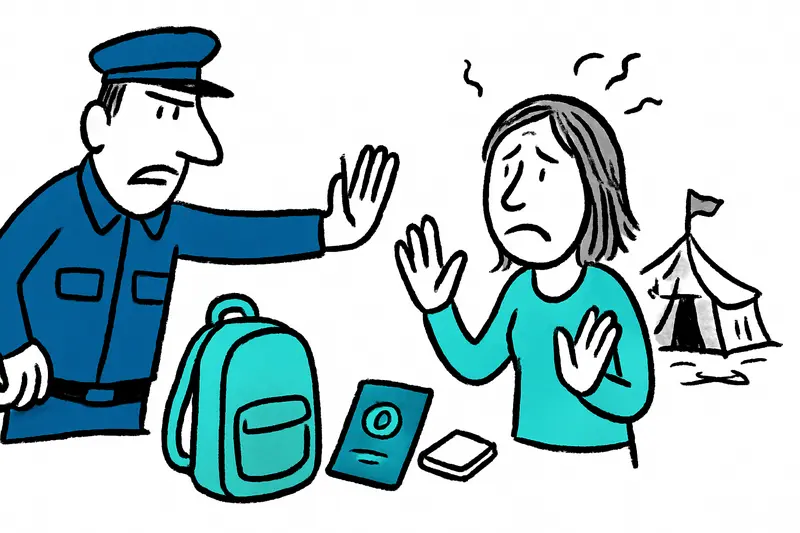
Knabe says she was not at her sleeping place during the eviction. A vehicle belonging to the municipal cleaning company Emaya then removed the site along with the belongings there. She lists books, plants and a sofa made from wooden pallets among the items. Her ID card is also said to be missing. These are her claims—not established facts. The allegations should neither be treated as proven prematurely nor dismissed with a shrug.
According to her account, she contacted the city and also reported the matter to the National Police. Losing an ID card is particularly distressing because it is needed to file a complaint or resolve personal matters. It is not a replaceable item. At the same time, it is essential to distinguish clearly between what happened: Was something collected, stored, disposed of or actually stolen? Without clear information about where the belongings went, that remains an open question.
The camp had stood in the central square for 37 days, drawing attention to the strained housing situation. It was cleared in early November. The city had justified the measure by citing rules on public order and the use of public spaces. A municipality must be able to enforce such rules. But the legality of an eviction does not automatically answer the second question: how are people’s belongings and personal documents protected when they are not there?
What gets lost in disputes over public spaces
The debate is often reduced to two opposing sides: order in the square on one side, and protest and housing shortages on the other. A practical, matter-of-fact part of the issue gets lost in the process. Who decides on site whether an item is rubbish or someone’s property? Is an inventory made? Is there a collection point, a deadline for retrieval and a contact person who can be reached? And how is it recorded when something later cannot be found?
These are not minor details. People living in temporary accommodation cannot always sort their belongings into boxes and stand by during an eviction. Books, plants or a piece of handmade furniture may seem cumbersome to outsiders. An ID card, however, is immediately important. A process focused only on clearing the space can easily overlook the people whose belongings are there.
Everyday life at Plaça d’Espanya is rarely quiet: buses pull in, people move between the station, stops and shopping streets, and wheeled suitcases rattle across the ground. In this busy heart of Palma, a tent camp can quickly look like an obstruction or a political statement—sometimes both. Precisely because of this, an eviction in such a place needs a process that does not get lost in the bustle. That is true whether or not one supports the camp.
A clear process is possible
Palma should publicly explain which agencies were involved in the eviction and what steps they followed when handling belongings left behind. This should include a documented inventory, separate storage for items clearly identified as personal belongings, and an easy-to-find contact point. ID cards and other sensitive documents require particularly careful safekeeping. If any belongings have already been disposed of, the city should be able to state when and on what grounds.
Those affected can also help clarify what happened by providing as detailed a list as possible, including information about the location and time, and requesting written confirmation that their complaint has been received. This does not replace an investigation by the relevant authorities, but it provides a basis so that the matter does not come down to one person’s word against another’s. The city, in turn, should not expect one person to navigate several agencies alone, especially when the missing document itself makes the matter harder to resolve.
Based on the information available, it is not possible to determine whether Knabe’s belongings were confiscated, stored or disposed of. That is precisely the point: an eviction can be politically controversial and still be properly documented. If Palma’s administration wants to earn public trust, it does not have to confirm every allegation. But it must be able to explain what happened to the belongings. A cleared space does not mean the matter has been handled properly.
Frequently asked questions
Was ist bei der Räumung des Protestcamps auf Palmas Plaça d’Espanya passiert?
¿Qué pasó con las pertenencias del campamento desalojado en la Plaça d’Espanya de Palma?
Wurde bei der Räumung auf Palmas Plaça d’Espanya tatsächlich ein Personalausweis mitgenommen?
¿Por qué desalojaron el campamento de la Plaça d’Espanya en Palma?
Was kann ich tun, wenn persönliche Sachen bei einer Räumung auf Mallorca verschwinden?
¿Qué puedo hacer si desaparece mi documento de identidad durante un desalojo en Mallorca?
Wie melde ich einen verlorenen Personalausweis auf Mallorca?
¿Cómo debería actuar un ayuntamiento con las pertenencias de un campamento desalojado?
Similar News

When Illness Makes the Headlines: Where Mallorca Needs Boundaries in Celebrity News
Health concerns affect the people living with them first—not the audience. A reality check on how Mallorca should talk a...
Capsized Freighter off Ibiza: Why the All-Clear Is Not Yet Certain
The freighter Med Emre has capsized northwest of Ibiza, with around 7,000 tonnes of diesel on board. The disappearance o...

Carry-On Luggage on Mallorca Flights: Why Pillow Tricks Can Get Expensive at the Gate
Stuffing extra clothes into a pillow, neck cushion or jacket sounds like a free solution. But at Palma Airport, what mat...
Mercat de l’Olivar in Palma: When the Market Is Both a Neighborhood Hub and a Stage
Since 1951, Mercat de l’Olivar has supplied Palma with food. As it celebrates its 75th anniversary, the question is how ...

Violence in Mallorca: What Visitors Should Know
Visitors can also seek help after an assault in Mallorca. Here’s what matters now, which services are available, and whe...
More to explore
Discover more interesting content

Can Cap de Bou

Townhouse Lleo 72
