
Palma under Bombs: Who Remembers, Who Represses? A Reality Check
Palma under Bombs: Who Remembers, Who Represses? A Reality Check
Palma was the target of widespread air raids during the Spanish Civil War. Why are so few names known, and why is a scholarly inventory only appearing now? A look at victims, gaps in memory and concrete steps for the island.
Palma under Bombs: Who Remembers, Who Represses? A Reality Check
Why have the victims of the air raids in Palma remained almost invisible for so long?
Key question: How could it happen that a city which today is teeming with tourists in high season knew only fragmentary names of its citizens who died in the bombardment of the Civil War for almost a century?
The facts are harsh and clear: in Palma alone 79 people fell victim to the air raids, 97 across the island; among them 32 women and 17 minors. Concrete fates, like that of Maria Massanet Vidal, who died on 20 August 1936 in Plaça Camp d’en Serralta, or the families shattered in May 1937 at Plaça Pes de Sa Palla and in Calle Velázquez, make the scale tangible. These names have now been brought together in a scholarly inventory, a work honored by the island council with the literature prize for the best study 2025.
Critical analysis: There are good reasons to praise historical research. But questions also press: Why did it take so long for relatives and victims to be named? What role did a politically more convenient memory culture play that preferred to cultivate some narratives and avoid others? Part of the answer lies in the political constellation after the war. Another part lies in the decision about which stories are deemed worthy of remembrance. Because the perpetrators at the time were said not to be the insurgent Francoists but the Republican air raids, these dead became entangled in a complicated web of blame and silence.
What is missing in public discourse: first, an open, documented list of all victims, accessible and maintained. Second, an honest discussion about responsibilities instead of a shortened narrative that slips between "civilian victims" and a scapegoating of the "French", a debate that should follow a model like Palma after the Protest: How Freedom of Expression and Everyday Life Can Be Balanced. Third, a memory-policy infrastructure on the island: not mere entries in specialist books, but visible signs in public space, teaching materials for schools and a digital database with source references, and visible signs in public space, as controversies over the removal of trees have shown in When Palma's Trees Fall Silent: Felled Pines and Lost Trust.
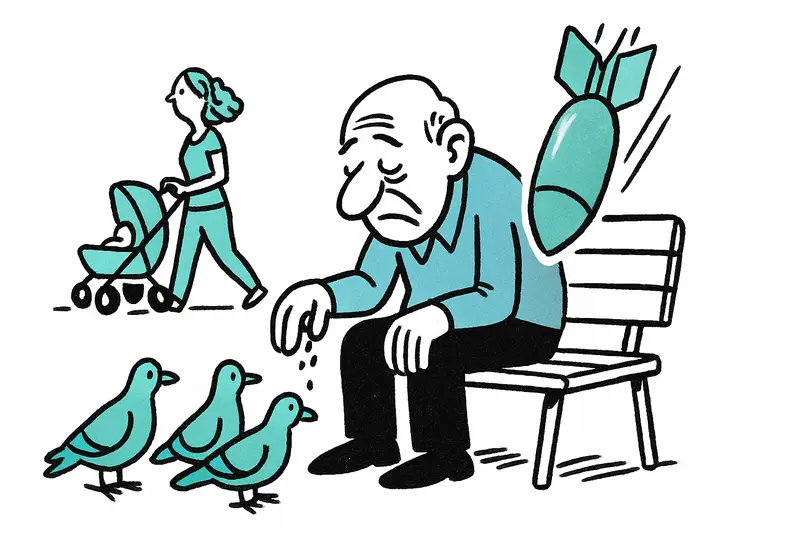
Everyday observation from Palma: Today, anyone strolling through the Santa Catalina neighborhood smells olive oil, hears the clatter of coffee cups and sees young parents with prams. On the Plaça de Sant Antoni an elderly man sits on a bench feeding pigeons. Hardly anyone would suspect that bomb fragments once tore houses apart right here. This coexistence of everyday life and past terror makes the invisibility of the victims all the more striking.
Concrete solutions: 1) Compile and publish a public, verified list of victims online, with source references, as accessible as possible. 2) Install commemorative plaques at documented attack sites with explanatory text in Catalan, Spanish and English. 3) Foster cooperation between researchers, municipal councils and schools: a curriculum module that links local stories with European memory. 4) Fund oral history projects to preserve the last eyewitness interviews. 5) Establish an annual day of remembrance on the island when communities actively inform and commemorate.
A practical first step would be to place small, unobtrusive markers at known attack sites: a date, a name, a short contextual line. Not as a political declaration, but as an invitation to read, and to avoid the pitfalls of replacement and loss discussed in Demolition in Palma: When Reconstruction Replaces the Original. It costs little and signals publicly: something happened here, these people will no longer be passed over.
An additional institutional step: the island council and the city administration should jointly commission a digital archive that consolidates documents, photos and official lists. Scholarship has made the start; the administration can broaden this resource. Schools can develop local projects from this material: a student archive, walks with eyewitnesses, creative works that keep memory alive.
Punchy conclusion: Memory is not a luxury, it is a democratic foundation. If Palma enters history as an early example of systematic air attacks on civilian centers, the city must also make visible the names of those who died then. Not to reopen old wounds, but to carry the bitter lessons of the past into the present. The air that today vibrates over the Plaça de Sant Antoni should not cast the mantle of oblivion over those who were prevented from arriving here under the bombs.
The book "Mallorca en llamas" has made a small stain in the cityscape visible. Now it is up to politics and society to turn that into a lasting, open memory.
Frequently asked questions
What is the weather like in Mallorca in spring?
Can you swim in Mallorca outside the summer months?
What should I pack for a trip to Mallorca in the shoulder season?
Is Mallorca a good destination for hiking in spring or autumn?
What is Palma de Mallorca like in the cooler months?
When is the best time to visit Mallorca for warm weather without peak crowds?
Is it still warm in Alcúdia, Mallorca in autumn?
What can you do in Mallorca when the weather is not ideal for the beach?
Similar News
More water than last year: Mallorca's reservoirs breathe easier
September rain refilled the Tramuntana's reserves: overall fill around 35 percent, Cúber at 40.42 percent, Gorg Blau at ...
Three Luxury Hotels in Banyalbufar: Lots of Money, Many Questions
A Danish investor plans three exclusive accommodations in Banyalbufar — including the historic Son Valentí. The announce...
2.1 tonnes of cocaine on sailing yacht off Spain's coast – a reality check for the coastguard
A 14-metre yacht was seized with 2.1 tonnes of cocaine. Who monitors the ports, how does the international hunt succeed ...
Heat Bonus in Mallorca: 100 Euros Extra for Outdoor Staff at MarSenses
MarSenses pays employees who worked outdoors in August an extra €100 as recognition. Lighter uniforms, reduced hours for...
Renovating in Mallorca: What You Really Can Do Without Neighbour Consent
Many think they can do whatever they want in their apartment. That's partly true — but only as long as structural elemen...
More to explore
Discover more interesting content

Can Cap de Bou

Townhouse Lleo 72
