
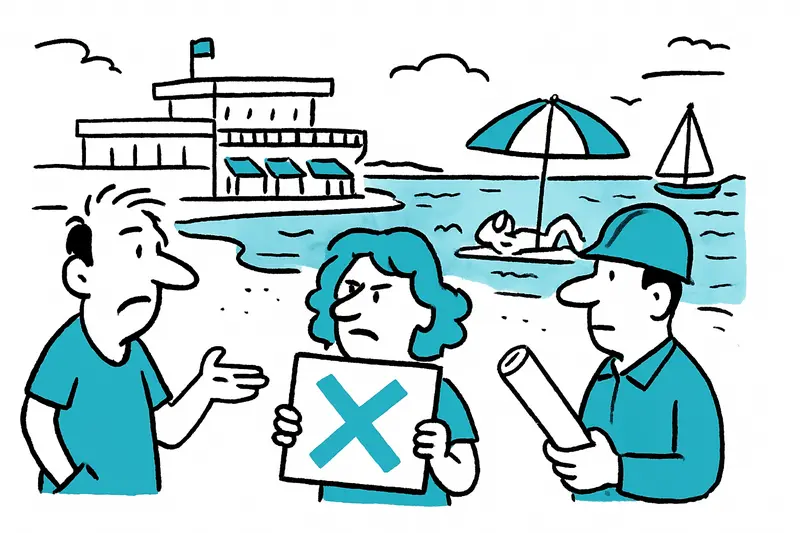
What Is Being Lost at Palma's Beach — and What We Demand
What Is Being Lost at Palma's Beach — and What We Demand
The port authority awards the Anima Beach site to the Puro Group. Demolition, rebuilding, accessible toilets and repair of the breakwater are planned. But is that enough?
What Is Being Lost at Palma's Beach — and What We Demand
Key Question
Who does the coast belong to when a popular beach club is demolished and leased to an operator for 14 years: the guests, the neighbors, or the public space?
Summary of the Facts
The Balearic Port Authority (APB) has awarded the site at Punta del Gas in Palma to an operator, a process described in a report on the re-tendering of the beach bar at Punta del Gas. The plan foresees the demolition of the current building and the construction of a new building with a basement for storage, refrigeration and technical equipment. The design includes accessible toilets with direct access from the promenade, new planting, a redesigned terrace, renewal of water, sewage, electricity, air-conditioning and fire protection installations, and a photovoltaic system. The breakwater and the immediate platform are also to be repaired; ramps, stairs, a small stand, pergolas and a bicycle parking area are part of the plans. The investment totals €1.75 million, and the concession is limited to a maximum of 14 years.
Critical Analysis
At first glance, accessible toilets and more greenery sound positive. But several things remain unclear: a 14-year concession is not short — enough time to change the character of the place permanently — and yet not long enough for some major investments. €1.75 million sounds like a lot, but for demolition, new construction including a basement, technical renewals, cold rooms, photovoltaics and work on the breakwater, that budget seems tight. Who will cover follow-up costs, who is responsible for maintenance and cleaning of the public toilets? And above all: does the existing building really need to be completely replaced, or could a phased modernization with fewer intrusions into the coastline be more sensible?
What Is Missing from the Public Debate
The debate so far has focused on the change of operator and the level of investment, as outlined in Palma awards beach concessions 2026–2029. Hardly discussed are: a binding plan for coastal protection during construction, noise limits for evening hours in the peak tourist season, transparent rules for pricing (will beach access disappear behind high prices?) and working conditions for staff. Also rarely mentioned: an independent post-completion audit that measures the actual ecological balance (energy, wastewater, material choices).
Everyday Life at Punta del Gas — a Scene
Early in the morning you see fishermen at the edge of the platform, the rattle of a local bus on the Passeig promenade, retirees with their dogs and a few tradespeople drinking coffee and discussing building plans. In the evening the promenade fills with families eating ice cream and German visitors looking for the sunset and a cocktail. Exactly these routines could change if the promenade becomes narrower or the new venue expands its evening operations.
Concrete Solutions
1) Publicly accessible cost breakdown: APB and the operator must provide a realistic, detailed calculation — construction costs, maintenance, operation and expected profits. 2) A socio-ecological specification as part of the concession: free, clean public toilets, noise and light protection requirements, mandatory maintenance of planting and energy efficiency standards. 3) Plan construction phases so that coastal access is not completely closed; temporary access routes with minimal intervention. 4) Short control intervals: independent audits after 1, 5 and 10 years, with transparent publication. 5) Proof of employment contracts: binding commitments to fair wages and training opportunities for staff. 6) Neighborhood participation: a local committee with residents, the port authority and the operator to act as a mediation body in case of conflicts.
Conclusion
A modern beach club can be an improvement — if it does not appropriate the last free stretches of promenade and shift the burden of maintenance and coastal protection onto the public. Decision-makers should consider more than marketing: clear figures, binding requirements and a mechanism for residents and users to have a say. Otherwise there is a risk of ending up with a stylish place that only the well-off can afford — a trend highlighted by Palma Cuts Sunbeds — What Will Happen to Our Beaches? — while the buses with the old habits continue to run, without anyone checking whether the coast will still be the same tomorrow.
Frequently asked questions
When is the best time to visit Mallorca for sunny beach days?
What should I pack for Mallorca considering the climate and activities?
Are Mallorca beaches good for swimming with kids?
What should I expect from Mallorca's weather and sea conditions for outdoor activities?
How can I get around Mallorca without renting a car?
What are some must-do experiences in Mallorca besides the beach?
Is Mallorca suitable for a budget traveler, and how can I keep costs reasonable?
What safety tips should I keep in mind when swimming or enjoying the sea in Mallorca?
Similar News

More water than last year: Mallorca's reservoirs breathe easier
September rain refilled the Tramuntana's reserves: overall fill around 35 percent, Cúber at 40.42 percent, Gorg Blau at ...
Three Luxury Hotels in Banyalbufar: Lots of Money, Many Questions
A Danish investor plans three exclusive accommodations in Banyalbufar — including the historic Son Valentí. The announce...
2.1 tonnes of cocaine on sailing yacht off Spain's coast – a reality check for the coastguard
A 14-metre yacht was seized with 2.1 tonnes of cocaine. Who monitors the ports, how does the international hunt succeed ...

Heat Bonus in Mallorca: 100 Euros Extra for Outdoor Staff at MarSenses
MarSenses pays employees who worked outdoors in August an extra €100 as recognition. Lighter uniforms, reduced hours for...

Renovating in Mallorca: What You Really Can Do Without Neighbour Consent
Many think they can do whatever they want in their apartment. That's partly true — but only as long as structural elemen...
More to explore
Discover more interesting content

Can Cap de Bou

Townhouse Lleo 72
