
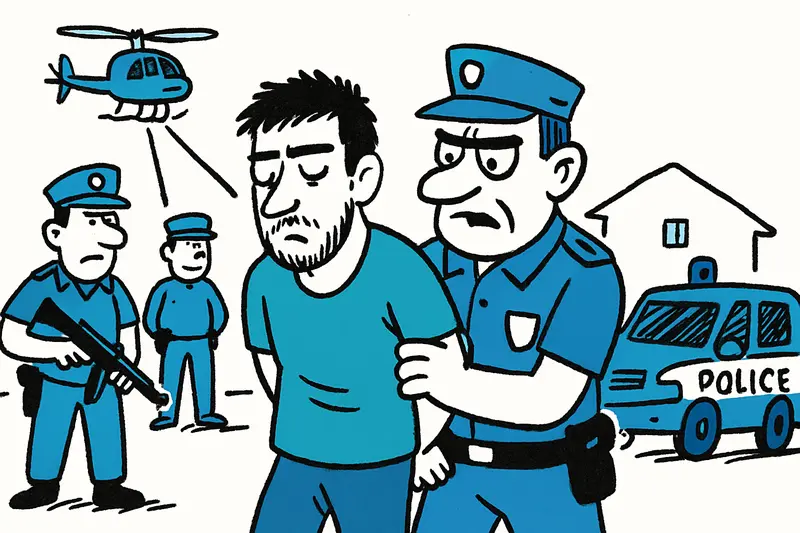
Major raid in Son Banya: What does a morning with helicopter lights change?
Around a hundred police officers stormed Son Banya, five arrests, including a 24-year-old suspected leader. A major operation — but is that enough to address deeper problems?
Major raid in Son Banya: A dawn full of loud questions
Around 6:30 a.m. on Thursday, a helicopter ripped open the otherwise sluggish morning hours in Son Banya. Floodlights bathed the huts, dogs barked, doors banged. Around one hundred officers from the National Police and the Guardia Civil — supported by drug enforcement, the organized crime unit and Palma's municipal police — searched five flats and secured several selling points. The operation felt like a signal: action is being taken again, as reported in Raid in Son Banya: Suspected Leader in Pretrial Detention — and What Now?. But the central question remains: how much calm does such a morning really bring to a neighborhood that has been burning for decades?
Arrests and initial findings
According to investigators, five people were arrested during the raid; the wider context is discussed in Major raid in Palma and Son Banya: How extensive is the network behind the 17 arrests?. Notably, the name of a 24-year-old man known in the scene as 'El Vito' was mentioned; he is attributed a leadership role. Four sales points were identified as active dealing locations. Seizures of various drugs took place; the police have so far given no detailed information on the scope and types — a judge has temporarily restricted the release of information, so many details remain behind closed doors.
What the police report does not immediately reveal
Neighbors described the morning vividly: an older man stayed on the steps with his coffee cup in hand, children peered from behind the fabric curtain, and the damp morning air smelled of the sea and petrol. Several residents report a noticeable change in recent months: younger men have increasingly taken charge, and families have moved away. Informants from the settlement speak of a shift in the market: more visible cocaine dealing instead of the previously dominant hashish and marijuana trade. A price of around 60 euros per gram of cocaine is being mentioned. In addition, alcoholic drinks were reportedly served in some huts — an indication of the diversification of income sources.
Why this operation is more than a headline — and yet not enough
Large-scale police actions have a signaling effect. They can disrupt networks, temporarily remove suspects from circulation and briefly halt sales. But Son Banya is not an empty space that can simply be cleaned up by the police. Old structures crumble and new actors move in. The raid hits a moment in an ongoing process: who fills the gap depends on economic pressures, social control and infrastructure — and on how quickly authorities follow up with long-term measures.
Key question: How can short-term successes of police measures be linked with long-term social solutions so that Son Banya does not only find calm for a few days?
Aspects that are often overlooked
First: the gag order imposed by court orders is understandable for ongoing investigations, but it makes public oversight and debate about effectiveness and proportionality more difficult. Second: when drug types change — more cocaine, less hashish — that signals market adaptation, not just escalation. This is an economic phenomenon, not purely a moral one. Third: the presence of alcohol sales shows a diversification strategy; such income sources often combine with other problems like public intoxication and potential for violence.
Concrete opportunities and proposals
In the short term, coordinated policing makes sense. But to have lasting impact, accompanying measures are needed:
- More social work on site: Mobile teams visible day and night build contacts with residents and provide information for targeted prevention.
- Job and education offers: Programs that pull young people out of illegal income structures are cheaper in the long run than constant repression.
- Securing housing: Reliable prospects for families prevent entire neighborhoods from being hollowed out and taken over by criminal structures, as reported in Police stop new drug shacks in Son Banya — residents briefly breathe a sigh of relief.
- Harm reduction and health services: Instead of only criminalizing, health services, substitution programs and low-threshold counseling centers should be available.
- Transparency in investigations: Where possible, the judiciary should allow transparent communication so the public can understand the actions and build trust.
An interim conclusion
The morning with helicopter and searchlight brought short-term calm and took some responsible people out of circulation. Yet Son Banya remains a place where police alone are not enough. The old man with the coffee cup, the barking dogs and the dusty paths remain even after the helicopter has flown away. For many residents, relief comes with a healthy dose of caution: "We just want to be able to sleep again," a neighbor said at the edge of the operation. Whoever wants to enable that sleep permanently must look beyond the raid — and invest in the hours, conversations and offers that no searchlight show for the cameras creates.
Frequently asked questions
Why did police carry out a major raid in Son Banya early in the morning?
What happened during the police raid in Son Banya?
How much does a police raid change the situation in Son Banya?
Has drug dealing in Son Banya changed recently?
What do residents in Son Banya say after a police operation?
What other problems are linked to the drug scene in Son Banya?
What long-term measures could help Son Banya in Mallorca?
Why was the police information about the Son Banya raid limited?
Similar News
After Being Admitted to Hospital Again: Heinz Hoenig and the Questions We Should Ask in Mallorca
Long-time Mallorca resident Heinz Hoenig was admitted to hospital again. A clear “what next?” is missing from the covera...
Yellow Alert: Is Mallorca Prepared for the Next Rain Band?
Aemet has issued a yellow alert for the south, southwest and the island's interior. Thunderstorms and heavy rain are for...
Kegel brothers trial postponed: Why Mallorca must wait for a verdict
The trial of 13 German holidaymakers will not begin until May 2028. The long wait raises questions — for victims, defend...
Chaos on Palma's Runway: Why the Summer at the Airport Was So Disrupted
This summer laid bare where Palma airport is faltering: only just over half of departures were on time and seven percent...
Cocaine Offer on Ham Street: Why the Open Trade Should Ring Alarm Bells
In the middle of Pare Bartomeu Salvà a tourist was offered a packet of cocaine as part of a sunglasses deal. A short int...
More to explore
Discover more interesting content

Can Cap de Bou

Townhouse Lleo 72
