
Red warning on the mainland, yellow to orange here: What do the storms reveal about preparedness and risk?
Red warning on the mainland, yellow to orange here: What do the storms reveal about preparedness and risk?
Torrential rains caused severe damage on the Spanish mainland; a man died in Catalonia. Why was the mainland hit harder — and what does this mean for Mallorca? A critical look with concrete proposals.
Red warning on the mainland, yellow to orange here: What do the storms reveal about preparedness and risk?
A reality check after heavy rains in Catalonia and Valencia – and a view from everyday life in Mallorca
Guiding question: Why are the consequences on the Spanish mainland so much worse than here on the island, and what must authorities, businesses and people do differently now?
Last night, heavy precipitation turned parts of the Mediterranean coast on the mainland into accident-prone zones: near Barcelona a driver was recovered dead after his car was swept away by a quickly rising riera; the body was found about 500 meters from the vehicle. Fire department deployment numbers show the scale: in Catalonia rescuers responded to around 270 operations by morning; in Valencia there were also hundreds of deployments and local measurements of more than 50 liters per square meter, with up to 81 liters reported. Campsites in Sitges were flooded; about 270 guests left one site as a precaution, and no injuries were recorded. In Barcelona there were disruptions to metro and rail services, and Valencia airport was temporarily affected. Classes were suspended in parts of Valencia, Andalusia and Murcia. Authorities urged people to avoid flood-prone areas and to heed warnings such as ES-Alert.
Critical analysis: Topography plays a major role on the mainland. Rieras — dry stream beds that can swell within minutes during heavy rain — are particularly treacherous; they react faster than larger river systems. Add to that narrower valleys, more sealed surfaces in towns, and sometimes missing or clogged drains. Many coastal towns and urban areas on Mallorca are also vulnerable, but the past hours show: the combination of intense showers and tightly channelled streams produces far more localized flooding on the continent. The warning chain worked: ES-Alert was used, police and fire services were on duty. Nevertheless, the event had a fatal outcome — and that raises questions about the effectiveness of specific protective measures, a point examined in Severe weather on Mallorca: When it really becomes critical — and what's still missing.
What is missing in the public debate: first, the simple danger to drivers. Many people underestimate the force of flowing water and try to cross flooded roads; this often ends tragically. Second, the condition of smaller infrastructure: clogged sewers, bridges that are too narrow, lacking markings at rieras and streams. Third, there is often no public language for local risks — municipal borders do not stop water, but responsibilities for prevention often end at those borders.
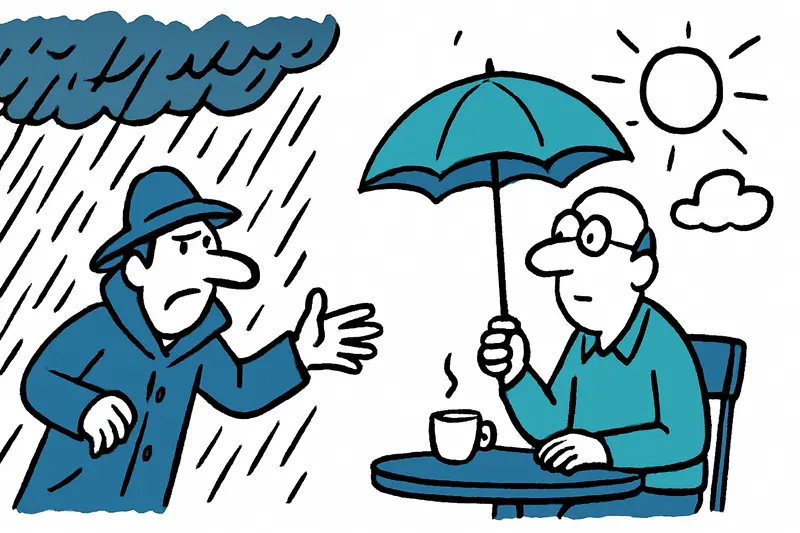
Everyday view from Mallorca: This midday on Passeig Mallorca in Palma, between palm trees and the light traffic, people with umbrellas still sit at cafés; the thermometer shows around 23°C and the sky is only thinly clouded. That is reassuring, but you can also feel the tension here: a few days ago the island was under an orange warning, as reported in Orange alert in Mallorca: Why the rain exposes our weaknesses — rain and storms are not abstract headlines, they affect everyday life, a contrast documented in Two Mallorcas in One Day: Why Heavy Rain Affects Us More Than We Think. In the countryside you see farmers checking drains and residents stacking sandbags at access roads to old houses. Small actions, often voluntary, make a difference.
Concrete solutions — immediately implementable and effective in the medium term:
For authorities: Prioritised cleaning of rieras, streams and urban drains before the autumn period; transparent maps of acute flood zones communicated in multiple languages and via ES-Alert; mandatory evacuation and reception plans for campsites and marinas. In addition, road alignments at known weak points should be better marked, temporary closures must be able to be put in place more quickly, and school closures should be prepared more clearly.
For rescue services and infrastructure operators: Faster coordination between autonomous regions during cross-border weather events; deploy mobile pumps and emergency generators specifically where stations and airports are at risk; conduct regular exercises with campsite operators and organizers of larger events.
For the public: Do not drive through flooded roads; do not park cars in riverbeds or underground garages; families should have a simple emergency plan (meeting point, flashlight, charger). Those living in risk areas should digitally back up photos and necessary documents and keep local emergency numbers handy.
What is needed in the medium term: more green infrastructure to improve infiltration, targeted renaturation of rieras where possible, and investment in modern early warning systems with sensor-based water-level measurements. Such measures cost money, but they pay off against the risk to human lives and the high follow-up costs.
Pointed conclusion: The storm on the mainland held up a mirror: warning systems and responses work up to a point, but local weaknesses in infrastructure and preparedness can be fatal. On Mallorca we feel the proximity of danger on a sunny afternoon when people nonetheless become cautious. If municipalities, rescue services and consumers alike use this as a wake-up call, the risk for the future is reduced. In short: not only weather forecasts are decisive, but what we do with them.
Frequently asked questions
What is the best time to visit Mallorca for warm weather and outdoor activities?
Can you swim in Mallorca year-round?
What should I pack for a trip to Mallorca?
What are the best ways to get around Mallorca without a car?
What are the must-see beaches near Palma?
Are there family-friendly activities in Alcúdia or Port de Sóller?
What’s the best way to enjoy Serra de Tramuntana scenery?
Is Mallorca safe for travelers?
Similar News
Beach party or public order issue? Police clear Playa de Palma after illegal parties
During checks at Playa de Palma in mid-September several speakers were seized and dozens of fines issued. How can the co...

Caro Robens: 15 kilograms lighter — and again in the crossfire of online comments
Bodybuilder Caro Robens, who lives in Mallorca, has lost 15 kilograms. Her success on Instagram was met with applause — ...
Meager Industry in Mallorca: How the Island Can Be More Than Just Tourism
The industrial sector in Mallorca is shrinking, productivity is falling and firms remain tiny. The key question: can the...
Pre-Nit de l'Art: Galerie Mensing invites to a special evening with Tom Boston
Before the big art night, Galerie Mensing opens its doors: pop art, champagne, a DJ and a hand-signed print by Tom Bosto...
Sea view and more seats: Cappuccino Grand Café reopens in Port d'Andratx
After a long renovation, the Cappuccino Grand Café on the Port d'Andratx harbor promenade has quietly reopened. Larger t...
More to explore
Discover more interesting content

Can Cap de Bou

Townhouse Lleo 72
