
From the sand to the surface: Roman merchant ship off Can Pastilla is being salvaged
From the sand to the surface: Roman merchant ship off Can Pastilla is being salvaged
An approximately 1,700-year-old merchant ship with around 300 amphorae was uncovered off Can Pastilla in 2019. Starting March 9, the multi-month salvage begins — a moment for Mallorca's culture and research.
From the sand to the surface: Roman merchant ship off Can Pastilla is being salvaged
Amphorae, a ritual coin and a piece of everyday life from the 4th century – close to Platja de Palma
If you stroll along the Passeig these days, you hear the seagulls screeching above the parasols, smell coffee from the cafés on the beach and see fishing boats rocking on the shimmering water. Just a few hundred steps further, barely two handbreadths above the seabed, another story began many centuries ago: a Roman merchant ship lay there, hidden under sand, until a storm in 2019 revealed its cargo.
The site, known as Pecio de Ses Fontanelles, lies very close to the coast of Can Pastilla – roughly 65 meters from the shoreline. Archaeological teams found an unusually well-preserved wreck from a period that can be dated to rulers like Constantine and Licinius I. On board: around 300 amphorae, many still sealed, with painted inscriptions that help trace origins and goods. Unusual everyday items also turned up: two shoes, a bow drill – so far the first of its kind recovered in Spain – and a coin that was likely placed as a small ritual before the launch.
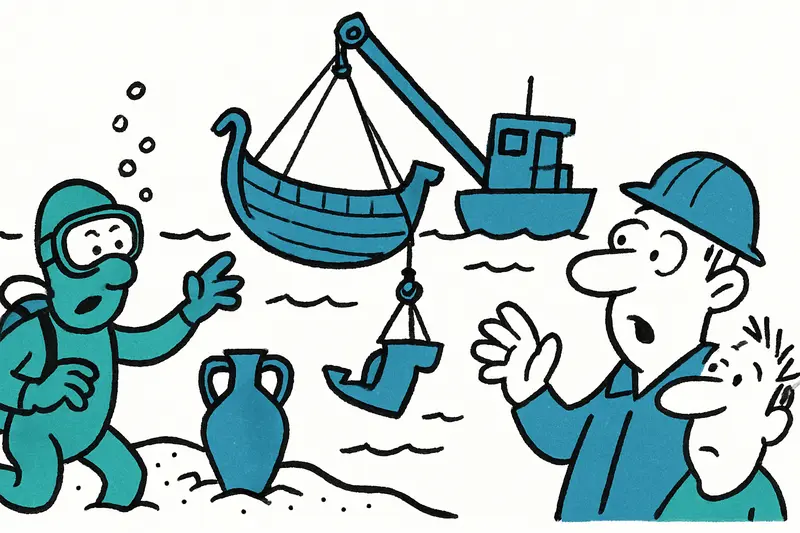
Starting March 9, the Roman wreck will be raised piece by piece. The work off the coast will take several months; teams expect about four months, depending on weather and maritime conditions. Unlike some spectacular recoveries, the wreck will not be lifted intact: the ship no longer has an intact keel, so the timbers will be carefully segmented and brought to the surface in parts, a staged recovery approach. Underwater, archaeologists, divers and historians work hand in hand; on land there will be a temporary field camp for conservation and documentation tasks.
A consortium of different research institutions accompanies the project: the University of the Balearic Islands, the universities of Cádiz and Barcelona and the National Museum of Underwater Archaeology are involved. The island council has informed authorities, associations and neighborhood groups in advance so that residents know what is happening at the sea and sensible observation areas can be observed.
What happens to the recovered material is already prepared: the timbers and finds will be transferred to a specially equipped desalination basin in the Castillo de San Carlos. There begins a months-long process in which salt is drawn out of the wood and the material is stabilized. Only after that are exhibition plans realistic – visitors should then be able to see the results of the work.
For everyday life at Platja de Palma the project means something tangible: people here can experience archaeology live. Signs with QR codes are planned off the coast that lead to film and informational material. Children from coastal schools will be able to see the wreck for educational purposes; diving schools and specialists will be closely involved so that access is controlled and the protection of the site is ensured.
Such a treasure makes the island not only richer historically. For Mallorca the undertaking can bring new impetus to research and attract visitors in quieter months. Anyone sitting on the promenade today can imagine how traders loaded their goods here 1,700 years ago – a small bridge between the bustle at the sea and the quiet, patient work of the conservators.
Perhaps the greatest prospect of this project is not only exhibiting a wreck: but the opportunity to bring the public closer to archaeology, to involve schools and to give the island a story that can be touched, seen and learned. For people who like to sit by the water and watch the activity, the coming time will therefore be particularly exciting.
Outlook: From mid to late in the salvage period there will be opportunities to view the conserved objects at the Castillo de San Carlos. Those who prefer to watch the live activity on the beach will find from March 9 a calm, well-organized field camp off Can Pastilla – and the chance to see a piece of Roman everyday life brought to light from the sea.
Frequently asked questions
What was found in the Roman shipwreck off Can Pastilla in Mallorca?
Why is the Roman wreck off Mallorca being lifted in parts instead of all at once?
Can you see the Roman ship salvage work from Platja de Palma?
What happens to the Roman shipwreck after it is brought up near Can Pastilla?
When did the Roman shipwreck off Can Pastilla in Mallorca come to light?
Is the Roman wreck off Can Pastilla important for Mallorca archaeology?
Will there be ways to learn about the Roman wreck if you are not a diver?
How long will the salvage of the Roman wreck off Can Pastilla take?
Similar News

Fewer Airlines, Fewer Destinations: What Palma's Winter Flight Schedule Means for Mallorca
Analysis shows: Winter at Son Sant Joan Airport will be quieter, with significantly fewer airlines and destinations. Who...
German tourist dies in Sa Calobra – a reality check for emergencies on Mallorca's beaches
A 40-year-old tourist died at the Torrent de Pareis. The emergency call, a doctor who happened to be present, a defibril...

Deadly Tractor Accident in Bunyola: What Needs to Be Done Now
In a work accident on an estate near Bunyola, a roughly 40-year-old man lost his life. His wife and a small child were o...
Head-first dive into the shallow part of Cala Fonoll: An accident and the unresolved question of responsibility
A young tourist dove into Cala Fonoll and was seriously injured. Key question: Why are clear warning signs missing at da...

Mistaken identity with fatal consequences: Brutal assault in S'Aranjassa — what's missing in the follow-up?
At S'Aranjassa a visitor to a finca was tied up, beaten and thrown out of a van. Three men have been arrested, including...
More to explore
Discover more interesting content

Can Cap de Bou

Townhouse Lleo 72
