
Roundabout in Sant Agustí: When Alcohol, Aggression and Traffic Collide
Roundabout in Sant Agustí: When Alcohol, Aggression and Traffic Collide
An incident at the roundabout near Sant Agustí shows that police presence is often not enough. A sober analysis of dangers in public spaces, available support and clear steps to make such scenes rarer.
Roundabout in Sant Agustí: When Alcohol, Aggression and Traffic Collide
Key question: How well is our infrastructure prepared to protect people in acute crises — the surroundings, other road users and the person affected?
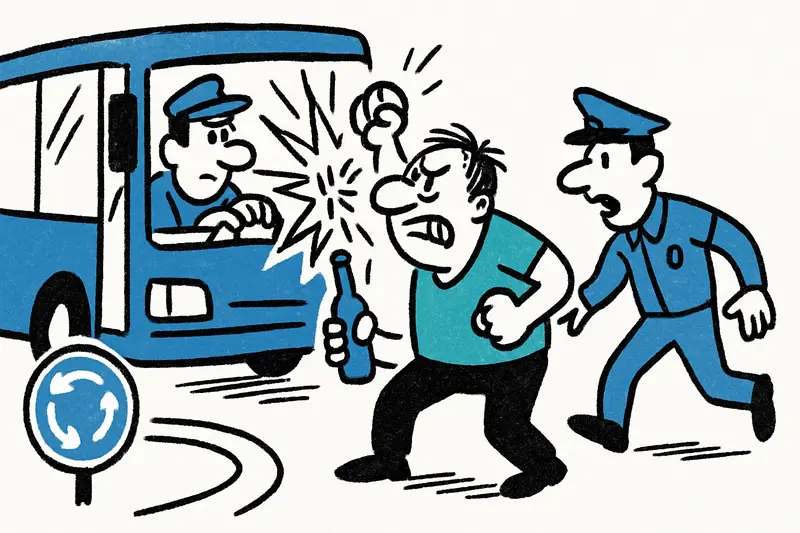
On an early evening in January — after work, with cold air and the sound of bus brakes — a man at the roundabout near the municipal sports centre in Sant Agustí entered a state that threatened pedestrians and drivers. An EMT line bus could not pass the roundabout because the 48-year-old man stood in front of the vehicle and struck the windshield with his fists. Police units arrived, requested support and removed the person from the carriageway.
That is the sober sequence of events. The question behind it is more complex: Was it pure aggression under the influence of alcohol? Was it a mental-health crisis that could have been defused by other means? Are our procedures — from first contact to aftercare — sufficient to resolve such incidents safely, humanely and sustainably?
A critical view reveals several problem areas. First: immediate danger prevention. The priority of the responders to quickly restore traffic safety was correct. When buses are blocked, there is a risk of congestion, accidents and escalation. Second: on-site de-escalation. Police officers are trained, but everyday situations sometimes require specialised teams — for example officers with additional training in psychological first aid or mobile social workers who could arrive on scene faster than an additional patrol car.
Third: the protection of public transport employees. Bus drivers are often alone behind the glass, caught between timetable pressure and escalating aggression. There is a lack of clear action guidelines, technical aids and sufficient support systems so that drivers do not feel abandoned.
What is often missing in public debate are two things: transparency after the incident and the perspectives of those affected. The police reminder that disturbances of public service can have criminal consequences is important. But equally important would be information on how people acting in an acutely endangered state are handled — whether after being secured they receive a medical examination, alcohol or drug tests and, above all, a psychological assessment, as highlighted by a nighttime accident in Sóller involving alcohol and no driver's license.
An everyday scene to illustrate: Whoever walks along Avinguda de Sant Agustí on a Tuesday evening hears the rattle of buses, the murmur of young people at the kiosk and sometimes, if the wind is wrong, the sizzle from small cafés. In such moments precarious encounters arise too — an exchange of words, an opened schnapps, a step too far. The immediate reaction of bystanders swings between help, gawking and looking away. All of that influences the course of a situation.
Concrete proposals that should follow from this incident are manageable and practical: 1) expansion of de-escalation and mental-health training for local police and bus staff; 2) establishment of a fast reporting and intervention pathway that networks social services with the police; 3) better protective measures and emergency communication systems on buses; 4) clear aftercare protocols — medical, psychological and legal — that are communicated transparently; 5) strengthened prevention work in neighbourhoods with low-threshold programmes to counter alcohol excesses in public spaces.
It does no good to dismiss individual incidents merely as "rioting." This is about everyday risks: traffic flow, the safety of employees, protection for vulnerable people — and other episodes, such as the aggressive driver case in Bendinat, show how quickly situations can escalate and endanger bystanders.
In Mallorca we are proud of our neighbourhoods and short distances — which is also an advantage for preventive measures: mobile teams, communication campaigns and local meeting places work better when you know the neighbourhoods.
Conclusion: Rapid police action was necessary in this case. But if we want future escalations to be rarer, we need a second step: more prevention, better networking between authorities and social services and concrete protective mechanisms for bus drivers and passersby. Otherwise, once the excitement subsides only a vague memory of a scene at the roundabout remains — and the chance to make a change is lost.
Frequently asked questions
What should I do if I see someone behaving aggressively in traffic in Mallorca?
How common are alcohol-related disturbances in public places in Mallorca?
Are bus drivers in Mallorca protected if a passenger or bystander becomes violent?
What happens after police remove someone from a public road in Mallorca?
Is the Sant Agustí roundabout a difficult traffic spot in Mallorca?
What should local authorities in Mallorca do to de-escalate public incidents more effectively?
What can bystanders do during a public disturbance at a bus stop in Mallorca?
Why is aftercare important after a violent incident in Mallorca?
Similar News

Palma Gets a Welcoming Park: Tirador Goes Greener — and a Café Is Coming
A new green project in Es Fortí/Camí de Jesús will transform the old Voltadora into a city park with an experience fores...
Why the End of "Los Últimos Mohicanos" Is More Than the Closing of a Bar
With squealing tires and one last glass, an icon on the Palma–Manacor expressway closes. Why the demise of this German b...

Protest camp on Plaza España: Who asks for solutions to the right to housing?
Around 30 activists set up a tent camp on Palma's Plaza España to push for stronger tenant rights. Our analysis asks: Ar...
In the Name of a Gang: Alleged Extortion in El Molinar and What It Reveals About the Protection of Sex Workers
A man is accused of posing as a member of the Hells Angels and extorting two women at accommodation in El Molinar. The s...
When Chile Meets the Mediterranean: A New Flavor at Can Bordoy
At Can Bordoy in Palma's old town, Chilean chef Jhonatan Maldonado combines Patagonian seafood with Mediterranean island...
More to explore
Discover more interesting content

Can Cap de Bou

Townhouse Lleo 72
