
Feared roundabout at Son Rossinyol is being rebuilt — is Palma facing a year of gridlock?
The heavily used roundabout north of the Son Rossinyol business park in Palma will be significantly enlarged. Construction starting in September is intended to ease traffic in the long term — but longer jams are likely until completion. Why the project is necessary and what real alternatives exist.
Feared roundabout at Son Rossinyol is being rebuilt — is Palma facing a year of gridlock?
Key question: Can the announced reconstruction be organized so that the island does not sink into months of traffic jams?
From September, a major reconstruction will begin on the northern edge of the Son Rossinyol business park, a project that is already causing iritated car horns in Palma. The island council has confirmed the works: the roundabout, which is passed by around 46,000 vehicles daily and is considered particularly tricky by many, will be given significantly more space. The diameter is to increase from 55 to 85 meters, a new direct access to Son Sardina will be created, a parking area is planned on the Camino de Passatemps, and land will be prepared for a future municipal road. In addition, the exit from the Camí dels Reis towards Son Espases hospital is to be redesigned so that vehicles no longer have to enter the roundabout.
The math is simple: more space, more capacity, smoother traffic in the long term. But between calculation and reality lie asphalt, construction traffic lights and summer heat. The works are expected to last about a year, so completion is anticipated by the end of 2027. That means a whole traffic season with extra strain — at a time when commuters, delivery traffic and tourists already cause heavy congestion.
Critical analysis: What sounds good can become a stress test during the construction phase. A larger roundabout requires construction zones, detours and temporary traffic regulations. If today's direct passage disappears or is reduced to one lane, access to the business park will quickly turn into a backlog. Residents of Son Sardina and users of the Camí dels Reis could be doubly affected: construction traffic plus lost shorter connections.
What is largely missing from the public debate so far are clear details on construction phases, night work, coordination with Son Espases hospital and signage for heavy goods traffic. Who will bring the articulated trucks to their destinations without detours when the usual routes are narrowed? And how will public transport be adapted so buses are not permanently stuck in queues?
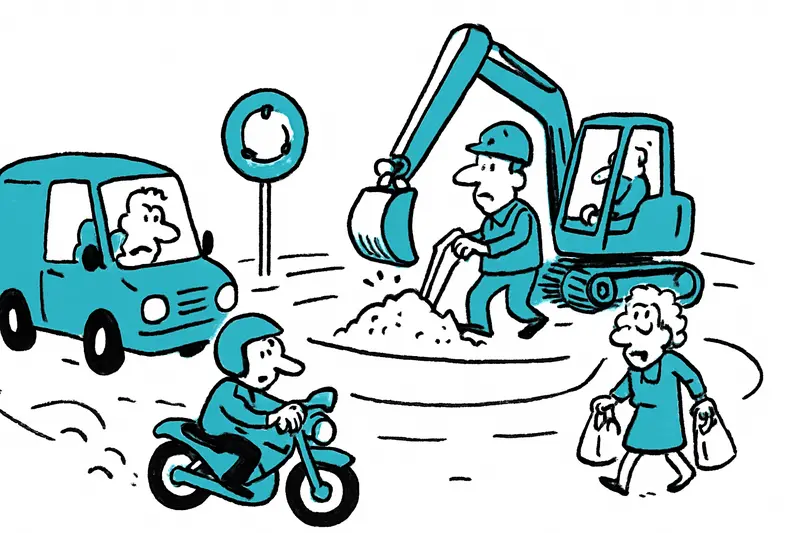
An everyday scene from Palma: It's 5 pm, the sun still hangs heavy over the Paseo Marítimo, crates of beer are loaded into delivery vans, and a caravan of rental cars, delivery vehicles and commuters has formed at the roundabout. The air conditioning wheezes, a motorcyclist curses softly, an elderly woman hurries across the central island with shopping bags — and suddenly everything stops. We will see such sequences more often this autumn unless planning is forward-looking.
Concrete solutions can be identified and implemented: first, the site could be divided into clearly delimited phases that each affect only individual access points. Second, as much work as possible should be carried out at night or in the early morning hours to relieve daytime traffic. Third, a park-and-ride should be set up immediately on the planned area at Camino de Passatemps, connected with strengthened bus and shuttle services to Son Sardina and the city center.
Fourth, there must be coordinated communication: digital panels at the approaches, warnings in navigation services and clear detour signs. Fifth, hospital accesses must not fall victim to improvised traffic chaos — a prioritized, lane-specific routing towards Son Espases is necessary. Sixth, a temporary adjustment of delivery windows for businesses in the industrial park is worthwhile so that lorries do not push through during peak hours.
Practical measures that show quick effect: limited construction areas with their own traffic light cycles, temporary one-way streets for local traffic and speed-reduced transition zones for pedestrians. In addition, the island administration should promptly analyze bus routes and offer additional capacity at peak times. All this costs money but saves commuters time and nerves — and reduces the risk of accidents at an already sensitive point.
Conclusion: The reconstruction of the roundabout can be a gain for Palma if the project does not only focus on the final solution but also takes the intervening months seriously. Without a stringent construction strategy, coordinated traffic management and a visible relief plan, long queues, frustrated residents and compromised emergency routes are likely. Those who plan now must show that good infrastructure is not only evident after completion, but above all in how well the transition period is managed.
The island has announced the measure, the facts are clear. The question remains: Will prudence arrive with the excavator? Or will we have to get used to a new soundscape of horns, compressed air and construction radio?
Frequently asked questions
How will the Son Rossinyol roundabout reconstruction affect traffic in Palma this autumn?
What measures are planned to reduce disruption during the Son Rossinyol roundabout rebuild?
Will the reconstruction affect access to Son Sardina or Son Espases hospital?
When will the Son Rossinyol roundabout project start and how long will it last?
What should drivers in Palma do to navigate around the Son Rossinyol works?
Could a park-and-ride and better bus service really ease traffic at Son Rossinyol?
What are the risks if the reconstruction lacks a clear plan?
How can residents stay informed about the Son Rossinyol reconstruction in Palma?
Similar News
More space to the island: Eurowings brings 'Premium BIZ Seat' to some Mallorca aircraft
Eurowings is equipping parts of its A320neo fleet with the new 'Premium BIZ Seat' from manufacturer Geven. From December...
Deceased main defendant: What does it mean for victims of the alleged fraud network in Mallorca?
The alleged mastermind of an international fraud case in Mallorca has unexpectedly died. For at least 40 victims, his de...
"Tourism kills" on the ministry facade: What do such slogans achieve?
Graffiti on the headquarters of the Balearic tourism ministry in Palma have rekindled the debate about tourism. What do ...
Dead Tourist in Valldemossa: Who Bears Responsibility When Streetlights Become Dangerous?
On the afternoon of August 17 a tourist in Valldemossa was killed by a falling streetlight after a bus grazed the fixtur...
TV tip: Tim Raue discovers Mallorca's cuisine
German top chef Tim Raue is touring Mallorca: in a new episode of his travel series he tries focaccia in Palma's old tow...
More to explore
Discover more interesting content

Boat Tour with BBQ along Es Trenc Beach

Private transfer from Mallorca Airport (PMI) to Pollensa
