
Roundabouts in Mallorca: Why the 500-Euro Trap Still Snaps Shut
Roundabouts in Mallorca: Why the 500-Euro Trap Still Snaps Shut
Drivers who use Palma's roundabouts incorrectly risk fines of up to €500 and six penalty points. Key question: is it missing signage or poor driving discipline? Our reality check with a real-life scene and practical solutions.
Roundabouts in Mallorca: Why the 500-Euro Trap Still Snaps Shut
Key question: Do drivers understand the rules — or are they being fined at roundabouts?
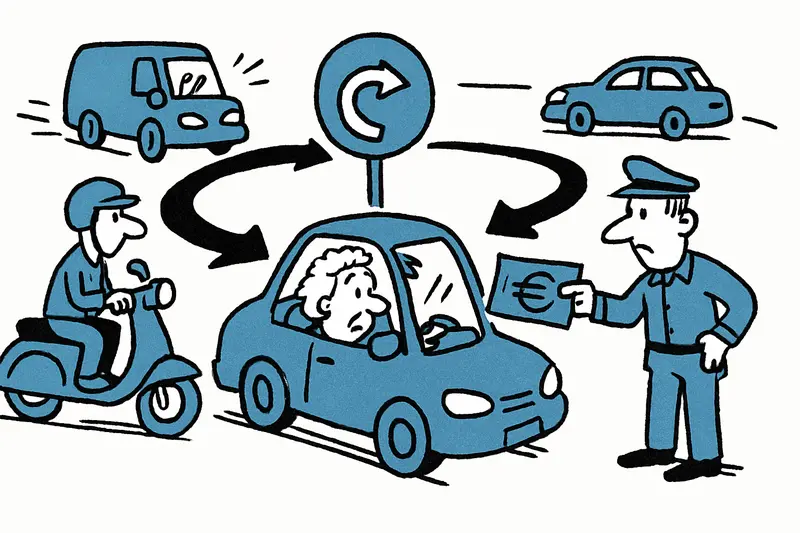
I am standing on a rainy Tuesday afternoon at the roundabout on Avenida Jaime III in Palma. A delivery van is honking, a scooter weaves between cars, a rental car with German plates signals late — and an older driver hesitates when entering. This scene is not an exception; it shows how closely misbehaviour, uncertainty and enforcement come together at the island's roundabouts.
Fact: the traffic authority (DGT) has expanded monitoring at roundabouts since early 2025. Certain manoeuvres such as failing to give way when entering, changing lanes without signalling or leaving the roundabout from an inner lane can, under Spanish traffic law, lead to heavy sanctions. In serious cases fines rise to up to €500, and six points can be deducted from the driving licence.
Why does this happen so often in Mallorca? My analysis shows three reasons: first, the mix of locals, commuters and tourists in rental cars — many do not intuitively understand the local right-of-way rules. Second, the built reality: some roundabouts have unclear markings or multiple lanes without clear guidance. Third, driving behaviour itself: sudden lane changes, approaching at too high a speed and not using indicators are part of everyday life. This trend is also reflected in Why Mallorca Remains Dangerous for Bikers — and What Could Really Help.
In public debate two narratives appear, but neither is sufficient: politicians and some commentators often call for tougher enforcement — while tourist pages warn broadly about "traps" for holidaymakers. What is missing is a sober look at causes and practical solutions that combine drivers' rights and road safety.
What is often missing: clear information and simple infrastructure
Many roundabouts on the island were designed for lower traffic volumes (see Millions for Mallorca's Roads: Many Construction Sites, Few Guarantees). Since the increase in cars and large delivery vehicles, the markings sometimes look like they were pasted on afterwards. On a short stretch between Son Espases and the industrial area I often hear the screech of brakes: drivers slow down too late or cut the corner because they try at the last second to move into the outer lane. Someone who does not understand a foreign term or who receives no GPS prompt reacts hastily. A recent plan for a new campus junction highlights these same design and information challenges at a local level, as discussed in University Access Roundabout: More Safety — But Is It Enough?.
Concrete proposals — so there are fewer crashes and lower costs
1) Better, consistent markings: clear lane guidance, conspicuous directional arrows and marked lane separators to make leaving from an inner lane safe. 2) Speed and approach: consistent speed reductions before larger roundabouts and visible warning signs, not hidden behind the last wall. 3) Information campaigns in multiple languages: flyers at rental car stations, short explanatory videos on island council websites and QR codes at main roundabouts. 4) Cooperation with rental car companies and navigation providers: brief notices when the vehicle is started and audible warnings when a user enters without signalling. 5) Targeted enforcement combined with warnings: instead of immediate heavy fines, issue warnings first for recurring misunderstandings — as long as there is no concrete danger.
These measures are not radical. They cost far less than constant fines and bring quick visible improvements — both for road safety and for drivers' trust.
Everyday scene as a test
Imagine the same roundabout again: a road worker installs a new, conspicuous sign, a young woman with a rental car scans a QR code, signals in time and calmly moves into the outer lane. No honking, no emergency braking. That is not a pipe dream but an achievable goal — if politicians, road builders and car rental companies work together.
Conclusion: the €500 trap exists because rules, infrastructure and information do not always align. Visitors or residents should know the basics: vehicles inside the roundabout generally have priority in Spain, indicators should be used in good time, and inner lanes should not be exited without first safely moving into the outer lane, and for broader advice on calmer, safer driving across the island see Mallorca's Curves without a Racing Heart: Staying Safe on the Tramuntana & Co.. Equally important is that the island needs clearer markings, understandable guidance and targeted public outreach so enforcement is perceived not as a rip-off but as a contribution to fewer accidents and more relaxed driving on Mallorca.
Frequently asked questions
What are the main roundabout rules drivers should know in Mallorca?
Can you really get fined at roundabouts in Mallorca?
Why do so many drivers struggle with roundabouts in Mallorca?
Are roundabouts in Mallorca harder to use in rental cars?
What should you do before entering a roundabout in Mallorca?
What makes the Avenida Jaime III roundabout in Palma difficult for drivers?
Why are some Mallorca roundabouts being monitored more closely now?
What improvements could make Mallorca roundabouts safer?
Similar News
Who Bears the Burden? Mallorca Between Tenant Protection and Landlord Fears
Madrid's new housing decrees strengthen tenant rights — but on Mallorca concern is growing: will the law drive small lan...
On the Edge: What Mallorca's Airport Loses If a Major Low-Cost Carrier Falters
The company that operates numerous connections from Palma to France and domestically is negotiating with creditors to re...
Ballermann star Frenzy wins 'Villa of Temptation' and donates prize money to Mallorca animal rescue
Ballermann singer Frenzy won the German reality show and donated the remaining prize money — around €14,080 — to an anim...
70 Trees Removed on Avenida Jaume I: What's Happening in Santa Ponça?
On October 1 the final redevelopment phase on Avenida Jaume I in Santa Ponça begins: 70 trees and old streetlights are t...

When a Boundary Is Crossed: The Case of Isi Glück and the Responsibility of Venue Operators
The singer from Mallorca reports an assault backstage in Halle. A clear guiding question, analysis of missing protective...
More to explore
Discover more interesting content

Can Cap de Bou

Townhouse Lleo 72
