
So Close to the Sailors: Through the Copa del Rey Bay by Speedboat
So Close to the Sailors: Through the Copa del Rey Bay by Speedboat
If you really want to feel the Copa del Rey, you have to get down to the water—or hop straight into a press RIB. Impressions from Palma Bay: engines, salt spray and the king on board.
So Close to the Sailors: Through the Copa del Rey Bay by Speedboat
What the regatta feels like when you're in the middle of it rather than just watching
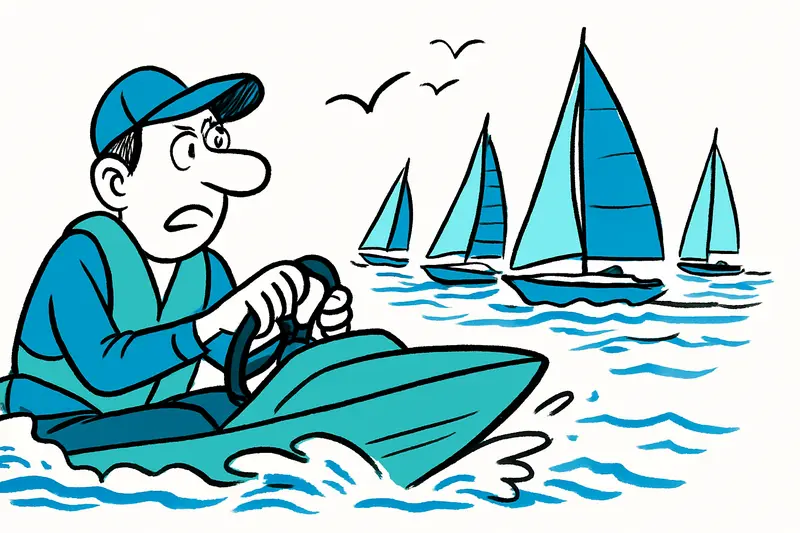
It smells of diesel and sunscreen, somewhere a coffee machine hums in the café on the Passeig Marítim, and a cluster of seagulls circles above the bay. On the water everything is different: engine noise, a pounding bow, and behind it—sail tensions you can almost see. On an opening regatta day in early August I was out in the press speedboat, barely above the waterline, to experience how big these boats really feel at speed.
The racing areas are divided into 'Alpha' and 'Beta', and our main target was the Alpha zone, where, among others, the ORC-A yachts start. These ships typically measure between about 11.5 and 15 meters and give a clear signal in the wind: speed meets elegance. When several of them run parallel with spinnakers flying, the picture is a combination of color and propulsion that's hard to forget.
On the press boat the engine was revved more often than was comfortable. Waves hit the bow, spray ran like a fine veil over faces, and the photographers on board were constantly searching for the optimal position. The aim is the yellow turning buoys—widely visible, over two meters high—where maneuvers are decided. Whoever arrives there first and sails the tightest lines often has the advantage.
Particularly noticeable was a boat sailing in Palma for the first time: the successor to the well-known Aifos, used among others by the Spanish royal household, as noted in Princess Leonor sails in Palma — more than a summer greeting?. It was not hidden in an escort; it was clearly visible among the other yachts. It was also notable that no conspicuous Guardia Civil escort boat was observed in the immediate vicinity—something several fellow passengers noticed.
The entry list shows the range at the Copa del Rey: alongside local crews were teams from Germany—with boats like 'Halbtrocken 4.5' and 'Red Bandit'—as well as vessels from Switzerland, France, Brazil and the USA. Besides ORC A, this week also features the classes ORC 0, ORC B, ORC C and the Clubswan 42; additionally there is a women's regatta with 15 teams.
When the yachts close up on a tack, it gets tight on the water; you feel it physically in the RIB: the jolt when a boat takes the spray away, the small, decisive commands on board, sometimes in Spanish, sometimes in English or German. There's something theatrical about it, but above all a lot of sport. Before the pandemic the big Maxi 72 yachts could also be seen here, almost 25 meters long; and for several years the GC32 foiling boats made headlines with their spectacular flying maneuvers. Today the fleet is a bit more compact, but by no means less exciting.
For Palma and the people along the waterfront the regatta means more than just pretty pictures: hotels, boat owners, rigging workshops, harbor cafés—they all benefit, and at the same time the event recalls the island's long sailing tradition, a topic explored in Barcolana in Trieste: What Mallorca's Coasts Should Learn Now.
Young sailors who test the wind at Moll Vell in the morning or later take a look from the harbor wall see sport and craftsmanship at once and may find new role models, as in With Wind, Waves and an Espresso from the Bilge: A Sunday with a Skipper from Cala d'Or.
A normal summer day in Palma—warm, the scent of pines on the coast, the clatter of mooring lines—gains a special edge through competition. If you don't want to go out on the water yourself: from the Paseo Marítimo, on the harbor wall at Moll Vell or from the terraces of the Real Club Náutico there is a good view of start and finish areas. Approved escort boats and official RIB tours offer an alternative for those who want to feel the adrenaline without press accreditation.
The Copa del Rey runs until Saturday, 8 August 2026, and anyone walking along the bay these days can easily stumble into the world of regattas: a jolt over the water's surface, a furled sail, applause on the mole—and the quiet promise to be even closer next time.
Frequently asked questions
When is the best time to visit Mallorca for nice weather and fewer crowds?
Can you swim in Mallorca year-round or is it seasonal?
What are family-friendly activities to do in Mallorca?
What is the best way to get around Mallorca on a budget?
What should I see in Palma de Mallorca's old town?
Is the Serra de Tramuntana good for hiking?
What’s the best way to reach Sóller from Palma?
What should I pack for a Mallorca trip?
Similar News

When Shopping Weighs Heavier: Mallorca Demands a Tax Pause on Food and Fuel
Rising prices are putting pressure on households and agriculture. The Balearic Islands are calling for temporary tax rel...

Almost 70 Euros for Just Under Three Hours of Parking: The Trap at Son Sant Joan
A short work errand at the airport ended with a surprisingly high parking bill. Why the two-hour tariff limit raises so ...
Goodbye Megayachts: Why Palma's Port Is Now Focusing on Small Luxury Liners
Four smaller luxury liners berthed in Palma at the same time recently — around 1,600 passengers on board, plus about 2,0...

Fear in the Sa Teulera Forest: Youth Groups Harass Cruising Zone in Palma
In the wooded area of Sa Teulera, those affected report verbal attacks, property damage and intimidation. How safe is th...
Axa opens first health center in Palma: €3 million, 650 m² and more local access for La Vileta
In the heart of La Vileta, Axa has opened its first own health center in Mallorca. On around 650 square meters and with ...
More to explore
Discover more interesting content

Can Cap de Bou

Townhouse Lleo 72
