
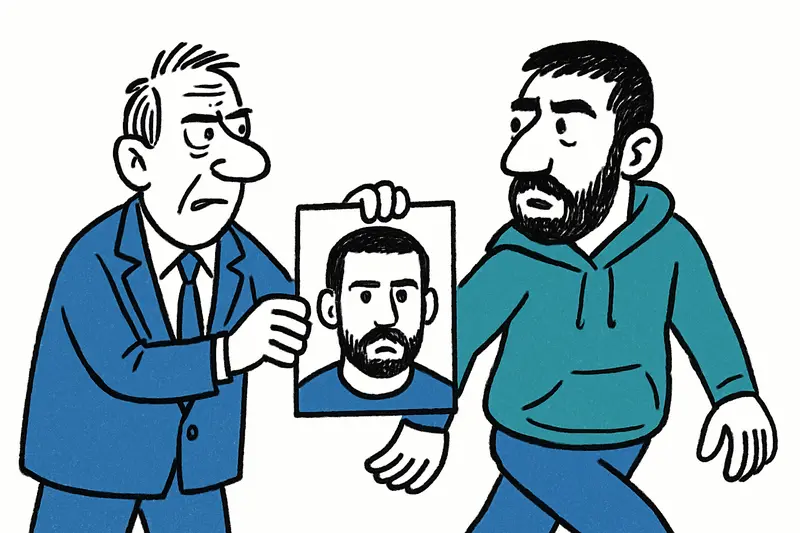
Mallorca's Most Wanted: The Trail to Sami Bekal — How a Case from Palma Became an International Manhunt
A young man from Palma, now sought internationally: Who is Sami Bekal, how plausible are the allegations — and why is the manhunt making people on Mallorca nervous?
Manhunt and questions: Who is the man Europe is searching for?
On the Paseo Marítimo, on a windless afternoon, people speak quietly. In between, the clatter of terrace dishes, the calling of seagulls and the distant hum of a tour boat can be heard. One name comes up again and again: Sami Bekal. Born in 1997 in Palma, moved as a child to Rotterdam — the origin here acts like a cue that makes neighbors pause briefly. What began as a biography has now become an international manhunt. The central question remains: Who is this man really — a victim of circumstance or the alleged coordinator of a criminal network?
What the investigations claim
Authorities are leveling serious accusations. Bekal is accused of being involved in planning an attack, acting as a contact person and organizing logistics: vehicles, money flows, procurement of a weapon. Mallorcan most wanted: investigators suspect Sami Bekal hid abroad, Europol has offered a reward, and the search is being conducted across national borders. In addition to the attack allegation, there are indications of drug trafficking and contacts with the so-called Mocro-Mafia as well as the Italian mafia in the files.
The details now known paint a picture of mobility: routes that are said to run via Morocco, Qatar, South America and Turkey to Iran. Investigators speak of an escape that may have begun as early as November 2023 — shortly before the attempted attack on a politician in Madrid. Whether the sequence of stops is exactly as reported is part of ongoing checks.
The difficult pieces of the puzzle
What is often overlooked here are the limits of investigative work in international cases. Fluency in languages, protected state environments, forged identities, encrypted communications, and cash-based transactions — all of this makes finding someone complicated. On Mallorca many feel that although the authorities follow every lead, a sense of helplessness remains. A young man from Palma suddenly appearing in large, dark networks is hard to reconcile with everyday life at the harbor, where fishermen mend their nets and families stroll.
Investigators rely on court orders, witness statements and digital traces. One detail that occupied the teams was the alleged getaway vehicle, later found burned in Málaga. Such clues connect local scenes with transnational structures — but connection does not always mean definitive proof.
What rarely appears in public debate
One point that gets less attention is the role of social fractures in migration biographies. Young people who grow up between cultures are neither automatically at risk nor especially protected. Equally rarely discussed is how our public spaces — ports, short-haul flights, tourist traffic — can be abused to disguise movements.
Another blind spot is resources: investigations across several continents consume personnel and time. On an island like Mallorca, where the police balance everyday crime, tourism and imported cases (see Detención en Mallorca tras órdenes de detención europeas: ¿Qué tan segura es la isla como escondite?), the question of priorities becomes acute. More international cooperation would be necessary, yet it often stalls because of bureaucratic hurdles.
Concrete opportunities and solutions
There are ways to make the manhunt more effective and the community safer. First measure: better, faster data matching between Europol, national authorities and regional police. Financial forensics must be strengthened — money flows often reveal networks. Second: low-threshold reporting channels in multiple languages on the islands so people in neighborhoods or at the harbor can pass on tips anonymously and without fear.
Local prevention also helps: programs that reach young people with migration backgrounds and offer perspectives build resilience against recruitment. At the policing level, targeted control of sealanes and improved exchange about travel movements make sense. Practically, increased cooperation with travel service providers and monitoring at transfer points like Algeciras or Málaga would help — without undermining fundamental rights.
Why Mallorca's neighbors should remain alert
The story has a local side: Bekal is considered Mallorcan-born, and such cases raise questions about responsibility, integration and risk. For many on the island the idea is frightening that someone from here could allegedly be involved in major criminal patterns. The police continue to ask for tips — photos, observations, unusual payments — and emphasize: every smallest piece of information can help.
On the Paseo, when the afternoon sun flickers and the waves lap quietly, curiosity mixes with concern. Investigators follow the trail. Society's task remains to stay vigilant without falling into blanket suspicion. Anyone who knows something should report it — to Europol or the Spanish National Police. It's not just about a wanted name, but about trust in the everyday life of our island.
Frequently asked questions
Why is Sami Bekal linked to Mallorca?
What is known about the case involving Sami Bekal?
How did the search for Sami Bekal become international?
Why are cases like this hard to solve in Mallorca and beyond?
Was there a suspected getaway vehicle in the Sami Bekal case?
What can people in Mallorca do if they think they have information?
Does the Sami Bekal case say anything about safety in Mallorca?
Why is the Paseo Marítimo in Palma mentioned in the coverage of this case?
Similar News
When the Old Town Sleeps — and Some Remain on the Street
At night Palma's Old Town grows livelier, its alleys filling with visitors. At the same time, more and more people are l...

After Accident in the Tramuntana: Mourning — and the Question of Rally Safety
The death of Klaus Rader at the Rally 550 Challenge Mallorca has shaken island residents and participants. His wife aske...
Does Pedro Sánchez Have Better Odds in New Elections? A Reality Check from Mallorca
Sánchez weathers setbacks, forms tactical coalitions — but is that enough in new elections? A critical look with an ever...

Ses Salines Celebrates Art: ArtinSal Turns the Village into a Gallery
More than 70 artists, open houses, music on the Plaça Sant Bartomeu and the Església Vella as an exhibition space: Artin...
More than five tons of waste from the sea: Who cleans up when plastic keeps washing ashore?
In September, response boats in the Balearics recovered over 5.3 tons of waste from the sea and coasts — almost half of ...
More to explore
Discover more interesting content

Can Cap de Bou

Townhouse Lleo 72
