
Scratching at Bellver: A Verdict — and Many Open Questions
Scratching at Bellver: A Verdict — and Many Open Questions
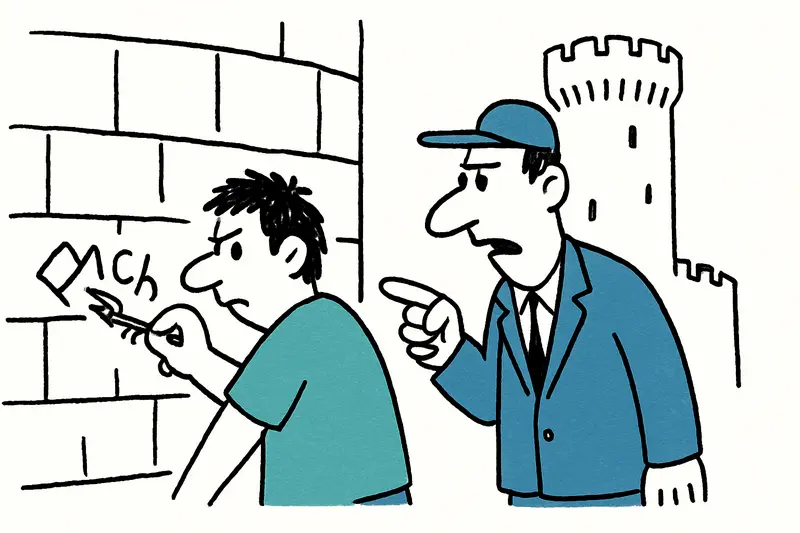
A tourist scratched “Pocho x 100” into the sandstone of the south tower of Castell de Bellver. The court fined him and ordered payment for repairs. Why is that not enough, and how can we better protect our monuments?
Scratching at Bellver: A Verdict — and Many Open Questions
A tourist day ends in court, the castle remains wounded
The image is simple: groups of visitors stroll up the hill, children run around the circular layout of the castle, the wind carries the scent of pine and a distant horn sounds from the bay. At this very spot, on the south tower of Castell de Bellver, the sequence "Pocho x 100" was scratched into the soft sandstone with a key in October 2024. The man, 36 years old and from Colombia, was stopped, pleaded guilty and received a fine of €1,080 plus roughly €1,150 for the repair.
Key question: Is a single criminal sanction enough to protect a monument like Bellver in the long term, or does it only mean the next visitor will have fewer inhibitions? Similar doubts arose after the Suspended Sentence After Abuse in Palmanova: A Verdict That Raises More Questions.
The court ruling is clear and necessary: damage to property is no triviality, especially at historic sites. This mirrors debates after the Acquittal in Inca: Why the Verdict Raises More Questions Than It Answers.
The act itself is symptomatic. The inscription "Pocho x 100" reads like a tag from the graffiti scene — an identity mark that looks grotesque outside its urban context on a medieval castle. Often there is no deep political motive behind such signs, but rather the desire to be visible: I was here. That does not explain why someone would use a key on sandstone, but it helps to understand that simple deterrence alone does little against the urge to leave traces.
What is often missing from the public debate is the everyday perspective of visitors and staff: the guards at the entrance juggle tickets, questions in English and German, lost bags, school groups. Along the paths there are signs in several languages, but they are often small, faded or overlooked. On a rainy afternoon I saw a group of teenagers by the south tower laughing and taking selfies — the distance to the fabric of the monument seemed negligible to them. Supervision is labor- and cost-intensive; municipal budgets are limited.
Critical analysis: The problem is not purely legal. It is an interplay of visitor numbers, insufficient interpretation, lack of immediate sanctions on site and a material that is easily damaged. Sandstone is soft; restoration is expensive and time-consuming (UNESCO guidance on conservation). Once scratched, a mark often remains visible even after repair. That weakens the cultural offering for those who come to Bellver as a place of historical learning.
What is missing in the discourse: short-term measures are discussed, long-term strategies rarely. We need a debate about visitor management, about education instead of only punishment, about allocating resources for heritage protection and about the responsibility of tour operators and platforms that bring masses of visitors. The role of social networks, which sometimes reward such acts, is also seldom addressed. Similar practical questions about costs and enforcement arise in other local rulings, for example in Judges in Palma strengthen passenger rights — a win with open questions.
Concrete solutions: First, visible multilingual information stations at entrances that briefly explain why sandstone is sensitive and what the consequences of damage are. Second, clearly visible but aesthetically integrated signs combined with short audio pieces via QR codes — this reaches young people looking at their phones. Third, training for supervisory staff with clear procedures for responding to observed vandalism and the possibility to impose fines on the spot. Fourth, targeted barriers at especially vulnerable spots and technical measures such as unobtrusive surveillance that deter effectively without creating a museum-like atmosphere. Fifth, a restoration fund financed by visitor contributions, fundraising and partnerships with local businesses so that damage can be repaired quickly and professionally. Conservation charters from bodies such as the International Council on Monuments and Sites (ICOMOS) outline principles for such interventions.
Another proposal concerns language and culture: information campaigns should not only provide facts but foster understanding. Explain why a tag on a castle is not the same as graffiti on a concrete wall. Collaborations with street-art artists could create alternative, permitted spaces in Palma so that the need to leave visible traces is acknowledged without vandalizing historic fabric.
Everyday closing image: On a December morning I see retirees on the benches of Plaza Juan Carlos I, a couple discussing the view, a father explaining to his son why you don't touch the wall. These small teaching moments help. The court has done its job, but protecting Bellver is a daily exercise — with more eyes, more explanations and clear procedures.
Conclusion: Punishment matters, deterrence is necessary. But heritage protection is more than jurisprudence. It requires education, design and visitor management that inoculates sites against small but lasting damage. Otherwise, after each verdict all that remains is the blunt smell of repair mortar, and history loses a little of its face.
Frequently asked questions
Why is Castell de Bellver so easy to damage?
What happens if someone vandalises a monument in Mallorca?
Is Castell de Bellver worth visiting if I only have a short time in Palma?
What should I know before visiting Castell de Bellver?
How can Mallorca protect historic sites better against vandalism?
Are there practical rules for visiting Bellver with children?
Why do some people scratch or tag historic places in Mallorca?
What kind of visitor management does Bellver need?
Similar News

"Expensive chaos" and many open questions: What clients can do when a lawyer suddenly stops responding
Several clients complain that a well-known German lawyer in Mallorca has been unreachable for months. Key question: What...

TV tip: 'The Last Problem' — Mallorca as the setting of a classic crime
A classic whodunit on Mallorca: A new miniseries set in spring 1959 brings storm, an isolated hotel and a dense web of s...

Nipping Sea Creatures: Why Bathers in Cala Major and Elsewhere Should Be Cautious
In Cala Major, bathers have reported being nipped by small fish. What is behind it, how can problems be avoided — and wh...

Forced eviction in Santa Catalina: When a 65-year-old slept in her car and showered on the beach — a question of responsibility
The story of Pilar López from Santa Catalina represents a problem affecting many Mallorcans: How can an island with a bo...
New traffic rules from October 1: What Mallorca visitors and locals need to know
From October 1, 2026, Spain will implement far-reaching changes to traffic regulations. Important for Mallorca: greater ...
More to explore
Discover more interesting content

Can Cap de Bou

Townhouse Lleo 72
