
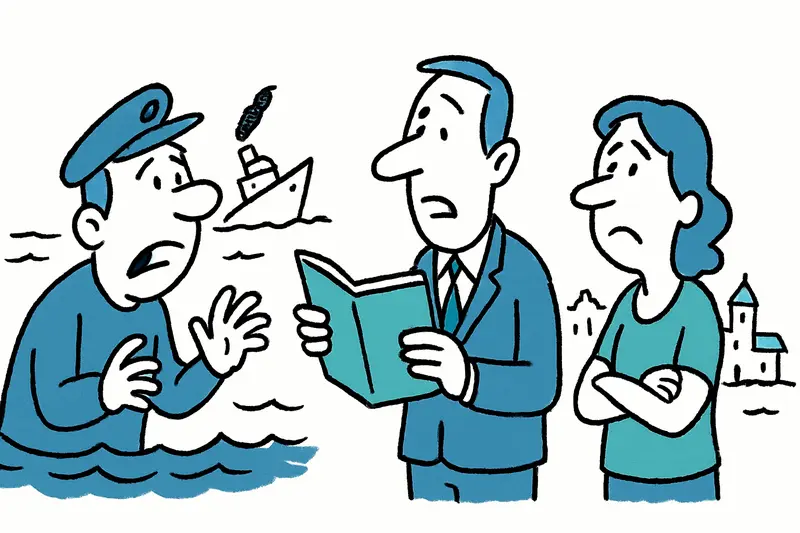
When a Ship in Distress Needs Shelter: Who Bears the Risk?
When a ship is in distress, finding a safe place matters. But coastal communities should not have to accept a port choice made behind closed doors—especially around Mallorca, where clear rules and open information are essential.
A safe harbor is not a simple answer
When a damaged ship needs shelter, a technical question can quickly turn into a political dispute: Which port can take it in—and who must bear the consequences? Around the Balearic Islands, this is no abstract debate. The sea connects islands, ports, and coastal communities; a problem at sea rarely remains the sole concern of specialists in a control room.
The obvious answer sounds simple: the ship should go wherever it can be safest. But “safe” means more than a calm berth. Factors include water depth and access, available equipment, space for salvage operations, weather conditions, and the ability to contain any leaking substances. A port that looks suitable on a map is not necessarily a suitable place to carry out the work.
This is where the part the public often sees only at the margins begins. Authorities have to weigh risks under time pressure. Port operators need to know which facilities are actually available. Residents wonder whether drinking water, fisheries, beaches, or their own health could be affected. And the crew on board is not a footnote in a debate about ports; its members may themselves be in danger.
The key question should not be: Who says no first?
In an emergency at sea, a port or region saying no is not automatically irresponsible. A location may be unsuitable, for example because it lacks the necessary infrastructure or a maneuver there would create additional risks. Conversely, a refusal should not be the end of the explanation. If several places turn the ship away, it must be clear what criteria are guiding the decision and which alternative is genuinely safer.
That is the blind spot in many public discussions: the debate quickly turns to jurisdiction and political approval ratings. Less visible are the practical questions: What damage could occur? Which protective measures are available? Who will monitor them, and who will cover the costs if something goes wrong? Without answers, a complex safety decision becomes a contest in passing the problem along.
Word choice also matters. Promising “no danger” when a ship is damaged would be a bold assurance; describing an “imminent catastrophe” can be just as misleading when the situation is still unclear. A regular, understandable situation update would be more useful: what experts have assessed, what remains uncertain, what work is planned, and what the next decision depends on. No dramatic, nonstop barrage—but no information blackout for the public either.
On an island, the sea is not a distant backdrop
You can feel it in everyday life, even on a gray day in Palma. Traffic streams along the Passeig Marítim, seagulls squabble over a waste bin, and the water outside is part of the view, not just an area on a map. In smaller coastal towns, the sea is part of the walk to the bakery, the harbor basin, and the conversation at the bar. When people hear about possible pollution, they do not start by thinking in terms of jurisdiction charts. They think of the cove where they swim, their boats, and the season that so many people depend on.
That does not mean every concern is proof of a specific danger. But it does mean authorities must take the local perspective seriously. A brief statement full of technical terms may be factually correct and still leave the real question unanswered: What does this mean for people on the coast—today, tomorrow, and during the salvage operation?
What needs to work better in the next emergency at sea
First, criteria for potential places of refuge should be published in advance. They should cover minimum technical requirements, available emergency equipment, and clear responsibilities. These plans need regular review; a port is not suitable simply because it once appeared in a table.
Second, the incident command and regional authorities should establish a joint information center. It should provide clear situation reports with timestamps and a clear distinction between confirmed facts and open questions. If the assessment changes, the reason should also be explained. This is not a luxury for communications teams; it is part of an effective emergency response.
Third, environmental monitoring before, during, and after the operation must be transparent and easy to understand. Measurements should be taken at appropriate locations, and the results should be made publicly available. Just as important is a plan setting out who will trigger which protective measures if an incident occurs. Otherwise, the coast is left watching an operation that directly affects it.
Fourth, costs and responsibility should not be sorted out only after the salvage operation. Operators, insurers, and the relevant authorities must say early on who is responsible for securing the vessel, unloading it, repairing it, and covering any damage. Precisely because these operations are rare, clear preparation matters more than improvisation when it counts.
A port may be the most sensible solution in a crisis and still leave questions unanswered. The right decision is not the one that makes everyone involved happy. It is one based on clear safety grounds, with coastal communities kept informed and no one allowed to move risks out of sight. That should be the standard in Mallorca: safety first—and transparency right behind it.
Frequently asked questions
What happens when a damaged ship needs shelter near Mallorca?
Can a port in Mallorca refuse to take in a ship in distress?
Does a damaged ship near Mallorca mean the beaches are unsafe?
How can residents get reliable updates about a ship emergency in the Balearic Islands?
How is the sea monitored during salvage work near Mallorca?
Who pays to secure or repair a damaged ship near Mallorca?
Why does a ship emergency matter to coastal communities in Mallorca?
What role does the crew have in deciding where a damaged ship goes?
Similar News

Eviction at Plaça d’Espanya: Who Protects Personal Belongings?
After a protest camp was cleared, Stefanie Knabe has made serious allegations: her ID card and other belongings have gon...

When Illness Makes the Headlines: Where Mallorca Needs Boundaries in Celebrity News
Health concerns affect the people living with them first—not the audience. A reality check on how Mallorca should talk a...
Capsized Freighter off Ibiza: Why the All-Clear Is Not Yet Certain
The freighter Med Emre has capsized northwest of Ibiza, with around 7,000 tonnes of diesel on board. The disappearance o...

Carry-On Luggage on Mallorca Flights: Why Pillow Tricks Can Get Expensive at the Gate
Stuffing extra clothes into a pillow, neck cushion or jacket sounds like a free solution. But at Palma Airport, what mat...

Mercat de l’Olivar in Palma: When the Market Is Both a Neighborhood Hub and a Stage
Since 1951, Mercat de l’Olivar has supplied Palma with food. As it celebrates its 75th anniversary, the question is how ...
More to explore
Discover more interesting content

Can Cap de Bou

Townhouse Lleo 72
