
Sisyphus on the Beach: How Palma Fights Sand Daily on the Ballermann Promenade
Sisyphus on the Beach: How Palma Fights Sand Daily on the Ballermann Promenade
The retaining wall at Playa de Palma is gone — along with a protection that used to slow wind and waves. Emaya clears sand daily, but is that enough? A reality check with scenes from the Paseo about what's missing and how things could be improved.
Sisyphus on the Beach: How Palma Fights Sand Daily on the Ballermann Promenade
Key question: Are buckets, brooms and the city cleaning crews' diggers enough, or does Playa de Palma now require a different, faster response before a nuisance becomes a lasting coastal change?
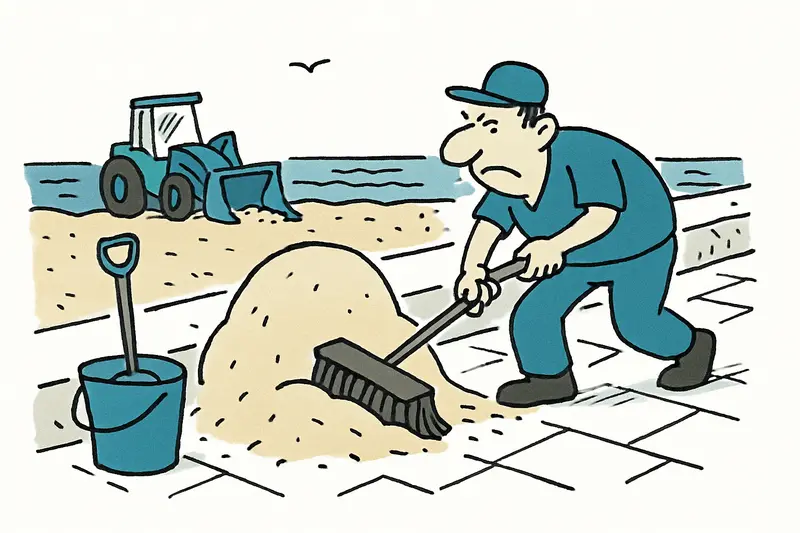
Early in the morning, when the first delivery vans arrive at the promenade and coffee steams in the cafés, you can see them: men and women in orange vests from the municipal utility Emaya, scraping the fine, light sand off the sidewalks with shovels, small loaders and hand brooms. Again and again. Day after day. The sounds of the sweepers mix with the cry of a seagull and the distant roar of the sea. Local residents shake their heads: sand creeps into shoes, into shop displays, even into front doors.
In short: the problem is not new, but its urgency has increased. The small boundary wall that used to mark the edge between beach and paseo is missing in many places — removed during major restructuring works on Playa de Palma. Without this barrier the wind hits the beach unimpeded, especially during strong bora and storm winds. The result: sand is blown onto the promenade, streets are drifted over, residents and businesses complain, Price shock at Playa de Palma: Who pays for the beach?, and the sea itself seems to be getting closer because sand is being lost.
The situation is doubly problematic: in the short term it's a matter of cleanliness and comfort for locals and merchants. In the medium term it's about coastal protection and beach stability. If more sand is carried inland or washed out to sea with every storm, the dynamics of Playa de Palma change — and that can lead to construction and planning costs that exceed the daily cleaning hours.
What's missing from the public debate? Three things: first, a clear timetable that goes beyond a vague "next year." The city has announced plans to build a new wall; but details on the design, materials, foundations to withstand rising water levels or a concrete start date are lacking. Second, discussion about temporary solutions: there is little talk about which provisional protective measures would make sense until a final solution is in place. Third, openness about how the redesign of the entire coastal area will be made climate-proof — that is, how to plan for stronger waves and more frequent storms.
The daily scene at the Playa is typically Mallorcan: around 9 a.m. a delivery van parks on the Paseo, hand-knotted nets hang from lampposts, and an older café owner sweeps sand out of his doorway. Tourists arriving late marvel at the sandbank on the sidewalk and take photos. Teenagers climb over the remaining walls, and two dog owners briefly argue about the best route to avoid sand in the paws. A saleswoman in a small souvenir shop blows sand out of a box of postcards — these are images you see here again and again.
The current method — manpower, shovels and small excavators — is important because it relieves immediate problems. But it is Sisyphean: as soon as wind and surge come together, it starts all over. That's why complementary measures are needed that not only treat symptoms but reduce causes.
Concrete proposals that can be implemented quickly: 1) Temporary windbreak rows made of wooden slats or sand fences in particularly exposed sections, which can be installed within a few days. 2) Targeted beach nourishment where the beach has already shrunk significantly, combined with a monitoring campaign to document the sediment budget. 3) Rapid-construction elements instead of a monolithic wall: modular protective panels installed offset, which can be expanded or repositioned as needed and do not require extensive foundations. 4) Planting wind-resistant coastal vegetation behind the dune where possible to help bind the sand. 5) Better coordination between the port authority, municipalities and coastal engineers: joint operations would avoid duplicate work and speed up technical solutions.
Some measures cost little, others more. What matters is setting priorities. Even more useful would be an open timetable in which the city administration names binding interim goals — for example: provisional wind fences within four weeks, monitoring points for beach loss within three months, start of construction on the new wall in a specifically dated quarter.
What the city is doing at the moment shows commitment: Emaya staff keep things in order daily. But that is not enough as a long-term perspective. Without technical and planning additions, Playa de Palma risks becoming a place where permanent sand loss undermines the new promenade ideas — in more than one sense, as shown by Palma Cuts Sunbeds — What Will Happen to Our Beaches?.
Conclusion: We can keep the broom in hand, but that's not sufficient coastal protection. If Palma does not plan wisely now — quickly and with an eye to storms, sea level and natural sand movements — residents and businesses will pay the price in unrest, repeated renovations and possible devaluation of beach areas; Money for sand: Who profits from Palma's beaches — and who gets left behind? Until then, the daily commute of many Emaya teams remains a modern Sisyphus walk by the sea.
Frequently asked questions
Why does sand keep blowing onto the Playa de Palma promenade?
How does Palma clean sand from Playa de Palma every day?
Is Playa de Palma still good for a beach day if there is sand on the promenade?
What can Palma do to reduce sand problems at Playa de Palma?
Why is the sand issue at Playa de Palma also a coastal protection problem?
When is sand drift at Playa de Palma usually worst?
What should visitors wear or bring for Playa de Palma on windy days?
What is Palma planning to change along the Playa de Palma coastline?
Similar News

Bendinat as a meeting place: Padel Cup brings together nearly 120 players
Three days of padel at the Bendinat Urban Country Club: organized by El Económico and Borbalán, with around 120 particip...
Large-scale Anti-Tourism Graffiti at Cala Mendia: Protest or Vandalism?
On the morning walkers discovered an approximately 50-meter-long slogan against tourism on the wall above Cala Mendia. W...

Bomb threat before Jet2 flight in Tenerife: A reality check for security protocols
A passenger reported a bomb in luggage shortly before departure in Tenerife. Evacuation, baggage checks, delays — and ma...
Who is stripping Mallorca's coast bare? Why entire slopes are being removed for villas
On Mallorca steep slopes are again being removed to make way for luxury construction sites. Who bears the responsibility...

Robber Falls While Fleeing in Sant Agustí: Who Takes Responsibility?
During a purse-snatching in Sant Agustí, a non-commissioned officer chased the suspect; the man jumped from a bridge and...
More to explore
Discover more interesting content

Can Cap de Bou

Townhouse Lleo 72
