
Six cruise ships in Palma — who still enforces the rules?
Six cruise ships in Palma — who still enforces the rules?
One morning six cruise ships were moored in Palma's harbour — more than the agreed limit. Who intervenes, where does enforcement fail, and what are the consequences for the city?
Six cruise ships in Palma — who still enforces the rules?
Key question: Why were more ships in the harbour one morning than contractually allowed — and what does that mean for Palma?
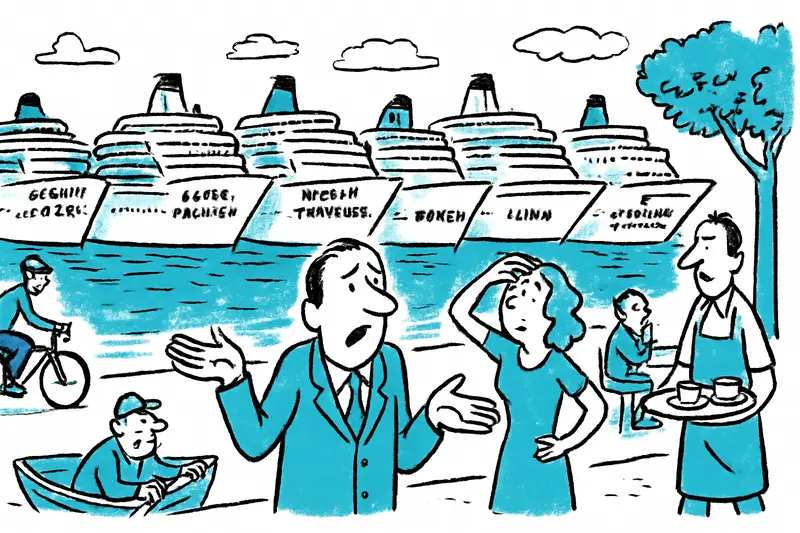
On a very warm morning, the air above the Passeig Marítim shimmered and the seagulls cried. Strollers and cyclists rode with a view of the water: six large and smaller cruise units were tied up at the quay at the same time. The names are familiar: La Belle des Océans, Costa Pacifica, World Traveller, Le Boréal, Ilma and Le Dumont-d’Urville. Five of them appeared in the port operator's official route register; one was already at the Dique del Oeste but not yet in the online directory.
The starting point is clear: an agreement from 2021, concluded between the Balearic regional government and shipping companies, was intended to reduce the visibility of large tourist flows. Core: no more than one mega-cruise ship and two smaller ships at the same time, and a daily limit of 2,500 cruise passengers. Yet that morning the reality was clearly different.
This is not just wordplay. Background: the ships at anchor vary greatly in size and number of passengers. Among the smaller, rather refined vessels is the 103-metre La Belle des Océans with around 130 guests. The World Traveller carries about 196 people, Le Dumont-d’Urville around 184. Le Boréal has capacity for about 264 passengers. And the Ilma, 241 metres long and a yacht-style luxury vessel, has almost 450 guest berths in suites. Together that can quickly reach or exceed the 2,500 limit — depending on actual occupancy.
Critical analysis: there are several layers to the problem. First the rule itself: it is a compromise, not a rigid law. Such agreements often rely on voluntary coordination by the shipping companies and are meant to buffer peaks. Second, implementation: a ship can only be entered into the register after it anchors; sometimes that is done with delay. If authorities, port logistics and companies are not synchronized, days with overcapacity arise.
A third, underestimated point is the method of counting: do you count ships or passengers? A mega-ship with 4,000 berths is a different problem than six small expedition yachts. The 2021 agreement tries to take both into account — but in practice it diverges. Numbers also show: the total number of calls has barely fallen so far; 2023 recorded only a moderate decline of about 3.4 percent. That means: shipping companies adjust routes, but the pressure remains.
What is missing from the public debate: voices of residents, the artisanal harbour economy and the round-the-clock infrastructure are underrepresented. It's not only about ships as a symbol of mass tourism, but about sewage tanks, taxi pools, shuttle buses, waste disposal and even the week when local supermarkets are calmer or busier. Ecological burdens — increased particulate emissions from ship diesel, anchoring impacts on the seabed — are also rarely documented with daily figures.
Everyday scene from Palma: at ten o'clock an old fisherman steered his small boat past the Dique, two tourists photographed the dark hull of the Ilma, a couple sought shade under a line of plane trees on the promenade. A waiter from the corner café balanced trays; the café's dishwasher smelled of sea and espresso. Such scenes show: the city lives with the giants, but not without effects on noise, space and air.
Concrete solutions that achieve more than appeals: first, a binding electronic slot system for berthing times that is viewable in real time by the port authority, the Guardia Civil and the shipping companies. Second, a transparent passenger count at disembarkation and return — linked to the daily limit; this reduces excuses about "not full" ships. Third, stronger sanctions for violations: not just fines, but temporary route bans and deductions of priority points for future calls. Fourth, strategic relocation: divert certain expedition-type vessels to smaller quays outside the central Passeig or to alternative ports to reduce concentration of pressure. Fifth, municipal levies for cruise passengers earmarked for transport, cleaning and noise protection.
This is feasible: Palma's urban landscape and port logistics are suitable to create short-term relief with clear planning. Otherwise the familiar scene remains: island residents meet shiny decks, and in the evening delivery drivers are stuck in traffic.
Conclusion: the 2021 agreement is not fiction, it exists — but its effectiveness depends on synchronization, transparency and the will to enforce it. Without reliable data and without strict requirements, declarations of intent turn into pleasant press releases. Palma does need cruise passengers, but not at the expense of urban quality of life. If politics mean it seriously, they must repair the mechanics of control — and do so quickly.
Frequently asked questions
What are Palma’s cruise ship limits under the 2021 agreement?
Why were six cruise ships in Palma's harbour on a single morning?
How does Palma count ships versus passengers under the rules?
What concrete steps could improve enforcement and relieve Palma?
What are the broader impacts of cruise ships on Palma and Mallorca beyond the port?
Is there progress toward better data and enforcement for Palma’s cruise-ship management?
What should visitors know about cruising days when planning a Palma trip?
Which ships were docked in Palma that morning, and what stood out about their sizes?
Similar News

Solar eclipse closures: Is Mallorca's traffic plan fit for the surge?
The Balearic Islands will close access to around 20 viewpoints and beaches between 3pm and 9pm. Key question: do the mea...

Photographing a Solar Eclipse Safely: How to Protect Your Eyes and Phone in Mallorca
In the evening the island briefly grows dim. With a few simple preparations you can capture the atmosphere without riski...

Hachiko dead: An accident, deep sorrow — and the question of what dog protection on Mallorca should improve
The dog of actor Martin Semmelrogge was found dead after a desperate search. A look at the events, what's missing from t...
Cristiano Ronaldo and Georgina Rodríguez: Wedding after Mallorca Stay — a Family Celebration
The couple shared a photo of their wedding rings on Instagram. After days on a luxury yacht off Mallorca, they reportedl...

Is the traffic plan sufficient for the solar eclipse? A reality check for Mallorca
On August 12 authorities will close access roads to around 20 natural sites. We ask: Can the plan withstand the rush of ...
More to explore
Discover more interesting content

Boat Tour with BBQ along Es Trenc Beach

Private transfer from Mallorca Airport (PMI) to Pollensa
