
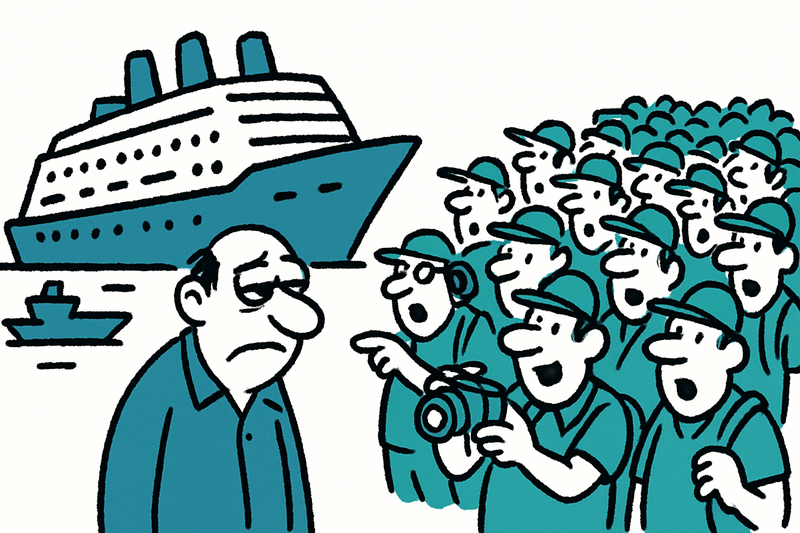
Four Cruise Giants, One Old Town: Palma Struggles with the Tourist Flood
A Saturday with four cruise ships docked at the same time pushed Palma's city centre to its limits. Who actually decides how many visitors our narrow streets can endure?
Who decides how much Palma can take?
On the morning of the hot Saturday, the scent of freshly baked ensaimadas was almost unmistakable, but another sound hung over the Paseo Marítimo: the deep drone of ship engines and the constant cries of the seagulls. Four cruise giants — including vessels from two of the largest fleets — were moored at Palma's quay at the same time. This incident was reported in Invasion of Cruisers: Palma Under the Flood of Tourists. More than 15,000 people poured into the city, the romantic alleys around La Seu filled up, cafés recorded queues and souvenir stands worked at full capacity.
The central question remains: economy before everyday life?
The core question is not new, but its urgency is hard to ignore: should the economic interests of the cruise industry be placed above the quality of life of residents? The Balearic government and the industry had agreed on a daily cap — yet on this day two ships exceeded that limit, and formally the old town remained without noticeable sanctions. The situation is discussed in When the Clouds Come: Palma's Old Town Between Gain and Limits.
What the numbers hide
Official statistics often emphasize the averaged weekly figure rather than individual peak loads, as discussed in Balearic Islands surpass 20-million mark: What the statistics hide. While CLIA points out that the weekly average was respected, Saturday tells a different story: in three or four hours in the morning an entire street can be clogged with passengers. The problem that is underrepresented in public debate is the spatial and temporal concentration — not the daily or weekly balance.
Concrete consequences for the city and its people
The effects are pragmatic and audible: more taxi and delivery traffic, overflowing bins in side streets, longer queues at the baker and a noticeable strain on transport and sanitation facilities in the old town. Air quality also suffers — the deep rumble of the ships' engines mixes with the heat of the afternoon sun. For residents there are only remnants of normality: the seating area at Plaça de Cort takes twice as long to free up again.
What receives little attention
Little discussed is how many cruise passengers actually stay overnight in hotels instead of merely roaming the island as day tourists. Such extensions change demand for accommodation and give hoteliers and flight connections an additional boost — complicating planning because follow-up effects arise in other sectors. Also underestimated is the burden on small businesses that must hire extra staff during such peaks, often at short notice and at high cost.
Concrete approaches — yes, enforceable please
There are practical instruments that have so far been underused or legally weak. These include:
1. Binding daily caps with clear sanctions instead of non-binding agreements — fines, reduced berth fees or temporary bans should be possible.
2. Dynamic port charges tied to peak times and environmental criteria: the fuller the city, the higher the fee — a financial incentive to spread arrivals.
3. Stricter time-slot planning so that multiple large ships do not enter at the same time. A central coordinator in Palma could time calls so that peak loads are reduced.
4. Redistribution of guests through mandatory, pre-booked shuttle or tour offers that direct visitors specifically to less frequented parts of the island — easing pressure on the old town and allowing other regions to benefit from tourism.
5. Investments in infrastructure financed by a dedicated levy: additional public toilets, waste management at the quay, electronic visitor guidance and better information in multiple languages.
Opportunities that should be seized
Handled correctly, the cruise economy could even create opportunities: a shift toward more sustainable shore visits, promotion of local providers away from the cathedral and new jobs in less touristy neighborhoods. Instead of residents being cast as victims and shop owners feeling desperate, Palma should regain negotiating power — with clear rules, transparent planning and sanctions that have real impact.
A call to politicians and the port authority
The reaction from residents on that Saturday was unmistakable: more resignation than anger. A café owner in a side street put it dryly — while tourists posed for photos on the corner —: "We're in the middle of summer, life here is loud, but this isn't summer, this is a test we're failing." Politics must decide whether to continue relying on voluntary agreements or to finally create binding, enforceable rules. Without that, Palma remains the plaything of short-term interests.
The debate must not disappear in winter when the ships are gone and calm returns. Loud engines, narrow streets and the convivial heat of an August day are reminder enough: Palma needs a long-term strategy now — not just declarations of intent.
Frequently asked questions
Why do cruise ships cause so much crowding in Palma’s old town?
Are there limits on how many cruise passengers can visit Palma in one day?
How does a busy cruise day affect everyday life in Palma?
What is the best time of year to visit Palma if you want to avoid cruise crowds?
Is it still possible to enjoy Palma’s old town on a cruise day?
What can Palma do to reduce the impact of large cruise arrivals?
Do cruise passengers in Palma usually stay overnight or just visit for the day?
How can residents and small businesses cope with cruise crowds in Palma?
Similar News

Release after bloody attack in Palma: Why the court's decision raises questions
An 18-year-old who allegedly inflicted a serious neck injury on a man at Plaza Gomila using a wristwatch wrapped around ...
Kidnappings in Inca: Three young men forced into car trunks and abused in the forest – a reality check
In Inca, three 18-year-old men were forced into car trunks by masked assailants at the Plaça des Bestiar, taken to a for...
Spreading Massification: The Brake That Still Has Much Work to Do
Marga Prohens announces limits on volume tourism. The measures sound harsh — but are they enough to save everyday life, ...

Through the Keyhole onto the Party Yacht: How Daniela Katzenberger Is Planning Her 40th on Mallorca
Daniela Katzenberger turns 40 and wants to celebrate it on the island — likely with a boat, cake and her mother. A relax...
By Boat Instead of the Road: Palma's Water Bus — a Reality Check
The 'Bus Nàutic' launches in two stages — but questions remain over interim operations, fares and environmental requirem...
More to explore
Discover more interesting content

Can Cap de Bou

Townhouse Lleo 72
