
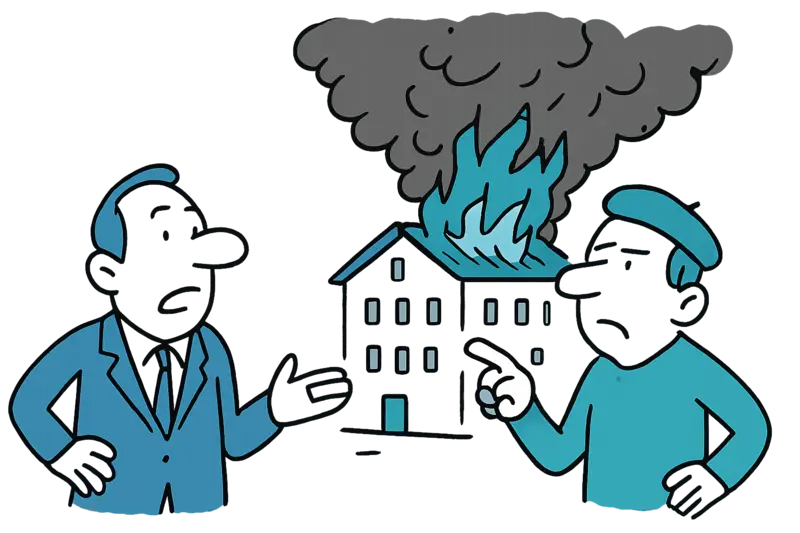
Smoke over the UIB: Who is responsible for the fire on the roof?
Smoke over the UIB: Who is responsible for the fire on the roof?
On Saturday afternoon a fire broke out on the roof of the Arxiduc Lluís Salvador building at the University of the Balearic Islands. No injuries were reported, but there was significant property damage. Time for a reality check on solar installations, roof membranes and maintenance on Mallorca's campus.
Smoke over the UIB: Who is responsible for the fire on the roof?
Fire on the Arxiduc building, thick clouds of smoke over Palma — and many unanswered questions
On Saturday afternoon around 3:00 pm, black plumes of smoke rose above the campus of the University of the Balearic Islands (UIB). A fire apparently broke out on the roof area that houses the School of Economics and Tourism, near electrical installations and solar modules. Firefighters, the Policía Local and Policía Nacional responded, climbed onto the roof and extinguished the flames. Fortunately, according to authorities, no one was injured. What remains are burned bitumen membranes, damaged equipment and a campus that wants many questions answered.
Key question: Could the fire have been prevented — and who is responsible for prevention and maintenance?
The described situation matches a known risk pattern: solar modules can cause fires if they overheat, are poorly mounted, or have faulty wiring; bituminous roof membranes ignite easily and are hard to extinguish. On Mallorca's campus, where labs, lecture halls and offices are close together and the road to Esporles and Valldemossa runs right past the complex, this means high potential for rapid spread.
From everyday life: Later I stood on the square in front of a café, still hearing the sirens, saw students with backpacks walking back toward the campus, and drivers slowing down at the spot where otherwise only the Tramuntana wind blows. At the nearby ParcBit, office workers looked out of windows, some filming with their phones — a scene seen more often in Palma in recent years: technical problems quickly turn into smoke and social media images.
Critical analysis: responsibility is fragmented. Universities run research and teaching, but building services management, awarding of maintenance contracts and installation of large solar arrays are often handled by external companies or specific administrative units. As long as responsibilities are not clearly defined, risks remain: How often are roof installations inspected? Are there temperature and smoke detectors at critical points? Can solar systems be remotely shut down when temperatures reach critical levels?
What is missing from the public debate: three issues are hardly discussed so far. First: the quality of roof materials on older buildings; second: mandatory inspection cycles for solar installations on public buildings; third: coordinated emergency plans that include the campus, the neighborhood and nearby technology centers such as ParcBit. It is not enough to say after an incident that classes will continue — it must be made visible what has been done to prevent a recurrence.
Concrete solutions that can be implemented immediately:
1) Mandatory biannual inspections of solar modules and associated wiring on public facilities;
2) Installation of heat-sensitive shutdown mechanisms and remote shutdown capability for photovoltaic fields;
3) Replacement or protection of bituminous roof membranes at particularly exposed locations with fire-retardant materials;
4) Regular evacuation and firefighting drills in cooperation with Palma fire services, including rooftop access training;
5) Transparent communication: after each incident, an easy-to-access online summary of causes, damage and measures taken;
6) Examine whether financial aid or grant programs are available for universities to retrofit safer roofing systems — this would help public institutions make necessary investments more quickly.
A practical example: a temperature sensor placed between modules and the roof surface would indicate overheating, trigger an automatic shutdown and simultaneously alert the fire control center. Small measures with big impact.
Conclusion, pointed: That nobody was injured must not be the only takeaway. A fire on the roof of a university building is a wake-up call. We need clearer responsibilities, rapid technical upgrades and honest communication — not just reassurances that classes will resume on Monday. The UIB, the island administration and the fire authorities are now obliged to turn the smoke into concrete safety improvements. Palma cannot afford another preventable incident — neither on campus nor at other public sites.
Frequently asked questions
What factors raise the risk of rooftop fires on Mallorca public buildings?
Who is responsible for preventing and maintaining roof systems and solar installations on public facilities in Mallorca?
What concrete safety measures are proposed to prevent rooftop fires at Palma universities?
How could overheating of solar panels on Mallorca campuses be detected and controlled quickly?
What lessons should Palma universities take from the UIB roof fire regarding communication and planning?
What should residents or students expect after a campus fire in Palma in terms of safety updates?
Are bitumen roof membranes a bigger fire risk on older Mallorca buildings, and how can that be addressed?
How can emergency planning around Mallorca campuses involve the surrounding community and tech hubs like ParcBit?
Similar News

Short Getaway with Sea View: Inmood Aucanada among Spain's Top Hotels for Dinner Breaks
A small hotel on the coast of Alcúdia was highlighted by a Spanish experience platform as particularly suitable for shor...
Cala Pi crowned Mallorca's most beautiful beach: A morning at the rocky cove
The travel portal Holidaycheck praises Cala Pi as Mallorca's most beautiful beach: a narrow, romantic cove, clear water,...
Injured captain, big plans: Germania Mallorca before the away match in Consell
The newly founded FC Germania Mallorca travels to Consell on Saturday. Captain Bastian Müller is out injured, but coach ...
Palma, Palma de Mallorca, Palma‑Mallorca: What is it really about?
The debate over the city's name is more than grammar: it concerns identity, law and branding policy. A sober reality che...
Warning to Bathers: Nipping Fish in Cala Major and Other Coves — a Reality Check
In Cala Major and several beaches around Mallorca, bathers report painful “nips”. Who are the animals, why are they gett...
More to explore
Discover more interesting content

Can Cap de Bou

Townhouse Lleo 72
