
Cave near Llucmajor: What the Discovery Reveals—and What Remains Unresolved
At Cova de Son Fosquet, traces from different periods lie close together. The discovery is exceptional—but its value now depends on how carefully it is studied and protected.
One cave, many eras—and an open question of protection
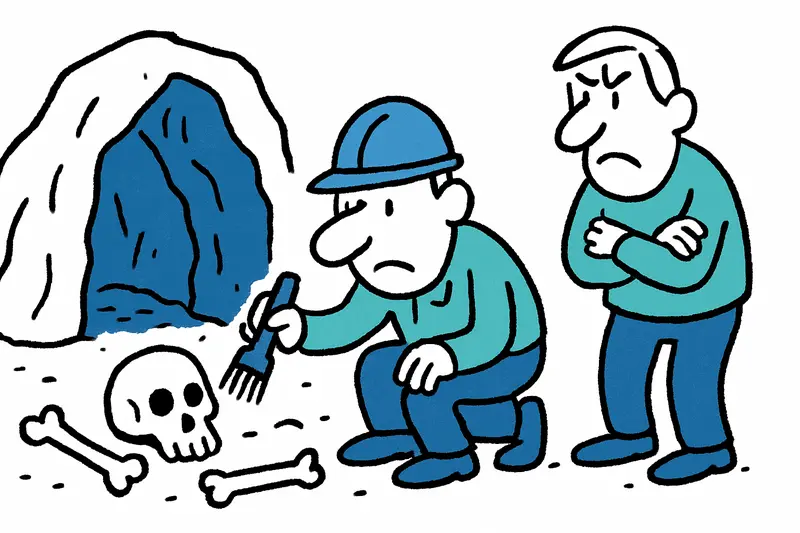
How much of the past can be held in a cave uncovered during construction work in the Son Noguera industrial estate? At Cova de Son Fosquet near Llucmajor, the answer is: quite a lot. Human bones, pottery from various periods and remains of the extinct Balearic cave goat Myotragus balearicus have been discovered there. The finds are remarkable. But perhaps the more important question now is less dramatic: how can a discovery be prevented from becoming a lost archaeological site?
After its discovery, the cave was explored by the Societat Espeleològica Balear over four days. The work was carried out with permission and in coordination with the island council’s heritage administration. The cave system is 124 metres long and reaches a depth of 14 metres. It consists of several chambers and passages on different levels. A small underground lake lies in one area, the Sala del Llac. Water may explain why people visited the site repeatedly—but this does not establish when or why each individual use took place.
Traces, but not yet a complete story
The finds identified so far point to use from prehistoric times through the Roman period and into the Islamic era of the 13th century. According to the evidence currently available, there are no signs of visits after that. The human remains belong to an adult and a child. They were found in a narrow passage called the Rampa dels Morts, or Ramp of the Dead. Use as a Bronze Age burial site is one possible explanation, but it is not yet a conclusively established story.
The animal bones also lend particular significance to the discovery. They include a complete skull and a lower jaw of Myotragus balearicus. The species is extinct and was part of the distinctive wildlife that inhabited Mallorca before its settlement by humans. Pottery fragments and bones, however, do not tell their own story. Only detailed analysis can determine which pieces belong together, how old they are and whether they come from the same period of use.
That is both the strength of the discovery and the limit of what can currently be said about it. A cave can seem like a time capsule, but not one with neatly labelled contents. Layers may have been disturbed, objects may have been moved into a passage from elsewhere, and individual remains do not automatically provide evidence of a specific scene from everyday life. The recovered materials therefore need archaeological analysis. Further research could clarify the sequence of events and show whether use of the cave changed over the centuries.
What can get lost in the public conversation
When an exceptional discovery is made, attention usually goes first to what is rare: the skull of an extinct animal, the human bones, the cave that had long remained hidden. The work that follows is less striking to look at. Who documents the site? Where will the finds be stored? Which results will be made publicly available? And how will the cave be protected once the initial curiosity has faded? These questions help determine whether the discovery becomes reliable knowledge.
According to the information available, the researchers have warned of the risk of looting and called for an archaeological study of the recovered remains. This is not a side issue. In a cave, an object does not lose its scientific value only when it is damaged. Its precise findspot and position in relation to other finds are also crucial. Anyone who removes or relocates something can destroy connections that cannot later be reconstructed.
In everyday Llucmajor, Son Noguera sits among industrial buildings, access roads and the usual comings and goings of delivery vans. People are more likely to pass through on their way to run an errand or go to work than to search for a piece of prehistory underground. That is what makes this case so tangible: archaeology is not confined to remote excavation sites. It can emerge while an excavator is at work on an entirely ordinary project.
Protect, document and explain clearly
What would be a sensible next step? First, the recovered finds need to be professionally assessed, and the cave system must be documented in a clear and verifiable way. Where safety and heritage protection allow, the public should later be told which findings are established and which questions remain open. Access to the cave should also be controlled. Turning a sensitive archaeological site into an open-access attraction would not benefit the island.
Presenting the discovery in an accessible way does not have to mean opening the site itself to visitors. An exhibition or digital documentation could explain what makes the cave special without putting additional pressure on the archaeological site. It would be important to clearly label theories as theories. That may sound matter-of-fact, but when human remains and a possible burial are involved, it is a matter of respect—for the dead as well as for the research.
Cova de Son Fosquet does not yet provide a complete account of Mallorca’s early inhabitants. It offers a rare collection of clues that must be carefully disentangled. The discovery is an opportunity for Llucmajor and for the island’s history. Whether it leads to greater understanding will not be decided by the first glimpse inside the cave, but by what happens next: meticulous work, effective protection and honest answers about what remains unknown.
Frequently asked questions
What has been found at Cova de Son Fosquet near Llucmajor?
What periods of Mallorca's history are represented by the finds at Cova de Son Fosquet?
What was Myotragus balearicus, and why is it significant to Mallorca?
Is Cova de Son Fosquet near Llucmajor definitely a Bronze Age burial site?
How large is the cave discovered near Llucmajor?
Can visitors explore Cova de Son Fosquet in Mallorca?
How do archaeologists work out the age of cave finds in Mallorca?
Why does protecting the location of archaeological finds matter in Mallorca?
Similar News

Mallorcan on the Menu: What Does It Really Mean?
“From Sóller,” “from the island farm,” “Mallorcan”: origin claims create expectations. But not every phrase means the sa...
Sa Calobra: The Bar Stays Open – Its Future Is Secured for Just One Year
The lease for the bar at the Nus de sa Corbata hairpin bend has been extended through the end of October 2027. This keep...

Burrata, Truffle and Chips in a Sandwich: An Unusual Snack Is Making the Rounds
A sandwich with bread, steak tartare, burrata, truffle and potato chips might sound like a fridge-clear-out gone wrong. ...
Alcúdia Is Spain’s Most International Town—but What Does the Figure Tell Us?
Foreign visitors accounted for 64.7 percent of those recorded in Alcúdia. The accolade is welcome, but it says little ab...

Jan Hofer and Mallorca: Who Gets to Define the Perfect Life?
When Mallorca is portrayed as the perfect place to call home, the everyday reality often remains out of sight. A reality...
More to explore
Discover more interesting content

Can Cap de Bou

Townhouse Lleo 72
