
Son Hugo as an Emergency Solution: Between Fencing and Everyday Life – What Palma Must Do Now
Son Hugo as an Emergency Solution: Between Fencing and Everyday Life – What Palma Must Do Now
The city of Palma wants to fence the parking area at the Son Hugo sports centre and block access at night. Residents fear restrictions — the real question remains: how do you protect people without displacing them?
Son Hugo as an Emergency Solution: Between Fencing and Everyday Life – What Palma Must Do Now
Key question: Can safety and order be established without pushing people who have no alternative further to the margins?
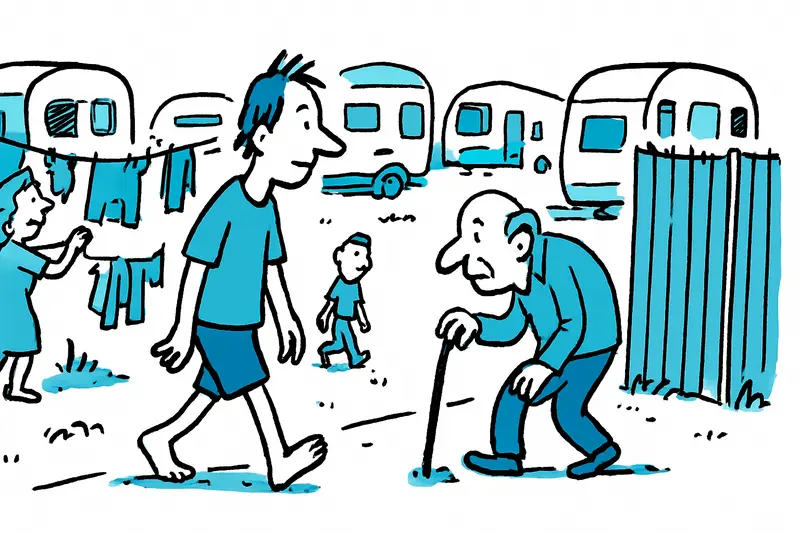
On the long strip of asphalt beside the Son Hugo indoor pool there are more than a hundred caravans and campers. In the morning there's a mix of the smell of coffee, doors closing and the distant rattling of buses. Children run barefoot between tarps, a woman hangs laundry on a line between two vehicles, and an older man with a cane slowly steps over a drainage channel – the scene is calm, but precarious.
The city administration has made it clear: a clearance is not planned. At the same time, fences are to be erected and an access control system installed. From 10 p.m. to 8 a.m. entrances and exits are to be blocked. At first glance this is a rule that creates order. On closer inspection it raises questions that have so far been neglected in the public debate.
The number of residents is given as around 200 people in roughly 105 vehicles. Many of them use the municipal sports facilities Palma renews sports facilities: small repairs, big impact and are members of the municipal institute IME – according to their own statements about nine out of ten residents pay regular contributions and hold an IME card. That changes the situation: they are not just "caravan residents" but users of public services who now sit between usage rights and the right to stay in the city.
Critical analysis: The new access restriction literally creates barriers to existential needs. People who have to be at work early are forced to choose either to skip a bus before 8 a.m. or to walk to their workplace. For residents with health impairments, such as those with spinal injuries, these walks are not trivial. And during heatwaves well above 40°C – residents report interior temperatures of up to 50°C – closed infrastructure at night can cause real harm.
What's missing from the discourse: an honest assessment of the responsibilities of public authorities. The legal classification is known: Balearic regulations make it difficult to establish formal pitches under camping law. Still, the problem is not only legal. There is a lack of short-term provision (water, toilets, waste disposal), emergency shelters for extreme weather and a plan for people with special needs. The neighbourhood perspective – noise, hygiene fears, safety concerns, as reported in the Parking Garage on Carrer Manacor: When Fear Becomes Part of the Walk to the Car – has so far been treated more as a side note.
Concrete solutions that could take effect immediately: 1) A temporary permit system in close coordination with IME that allows regulated pedestrian and vehicle traffic for people who work early. 2) Mobile sanitation and drinking water stations with daily servicing. 3) A daytime heat protection centre and a minimally equipped night threshold for people with health limitations. 4) Mediation of transitional housing through municipal social services with clear prioritisation for families, older people and people with disabilities. 5) Legal review of alternative forms of short-term pitches, for example as social emergency spaces rather than classic campsites.
Everyday scene as a mirror: A young man, a member of the swimming pool, returns to his camper with wet hair, sets up a bench and talks about night shifts in the hospitality industry. He pays his membership fees, but his earnings are not enough for a room in Palma. Such commutes are not uncommon on the island; they make visible how closely housing and the labour market are linked and echo issues seen in Son Espases and the daily parking chaos. The planned fencing will change everyday logistics – without automatically improving quality of life.
Why the city does not simply clear the site is understandable: forced evictions create temporarily free spaces but do not solve problems. Fencing and rules are a political attempt to create control. But control alone is no substitute for coherent social policy. There is a risk that people will be pushed into smaller, less visible niches – often further away from work, school and services.
Concrete steps for the coming weeks: the city should publish binding transition rules (including exemptions for early shifts), deploy social workers on site and establish a joint committee of residents, IME representatives, neighbours and administration. At the same time the regional legal framework must be reviewed for practicable exemptions so that short-term safe pitches are possible. None of this replaces long-term affordable housing – that is the structural construction site.
Concise conclusion: Son Hugo shows what is going wrong in Palma: when housing is lacking, improvised solutions emerge. The city can organise the site, but cannot solve humanitarian problems with fences alone. Pragmatic emergency aid is needed now and honest, legally sound pathways to real alternatives for those affected. Son Hugo must not become a hiding place for unresolved housing issues – otherwise the same drama will begin again somewhere else in a few months.
Frequently asked questions
How hot does it get in Mallorca during summer and how can I stay safe?
What should I pack for a hot summer in Palma?
How do residents living in temporary camps near Mallorca access public services?
What is Son Hugo and why is it central to Palma’s housing debate?
How would fencing and night-time access restrictions affect Son Hugo residents?
What immediate steps could Palma take to help Son Hugo residents?
What longer-term housing policy does Son Hugo reveal for Palma?
How can Palma balance safety concerns with humanitarian needs in places like Son Hugo?
Similar News

From the Reality Studio to the Pitch: Aleks Petrovic Makes Mallorca His Base
The former participant in numerous TV shows moves from Dubai to the island and launches a project with FC Germania Mallo...

When the Phone Falls Silent: Concern for Sarah Joelle in Mallorca — and What It Reveals
After days without a response, the TV personality's unreachability in Mallorca sparked concern. Shortly afterwards an al...

Ultraluxury on the Ground: Four Seasons Jet in Palma — a Reality Check for Formentor and the Island
A high-priced flight crosses Mallorca and its guests stay for days at the Formentor resort. What does the island get bes...

Death of a Witness and the Justice Backlog: Why the Kegel Brothers Trial Matters in Mallorca
A witness in the Playa de Palma fire case has died, and the trial against eight German holidaymakers has been delayed un...

Champagne Reception, Red Carpet and Mini Originals: The Pre-Nit del Art at Gallery Mensing
Almost 400 guests, champagne, pop-art feats by Tom Boston and a raffle for the Parkinson's foundation: Gallery Mensing t...
More to explore
Discover more interesting content

Can Cap de Bou

Townhouse Lleo 72
