
Advertising Poster at the Airport: Sparkasse Under Scrutiny
Advertising Poster at the Airport: Sparkasse Under Scrutiny
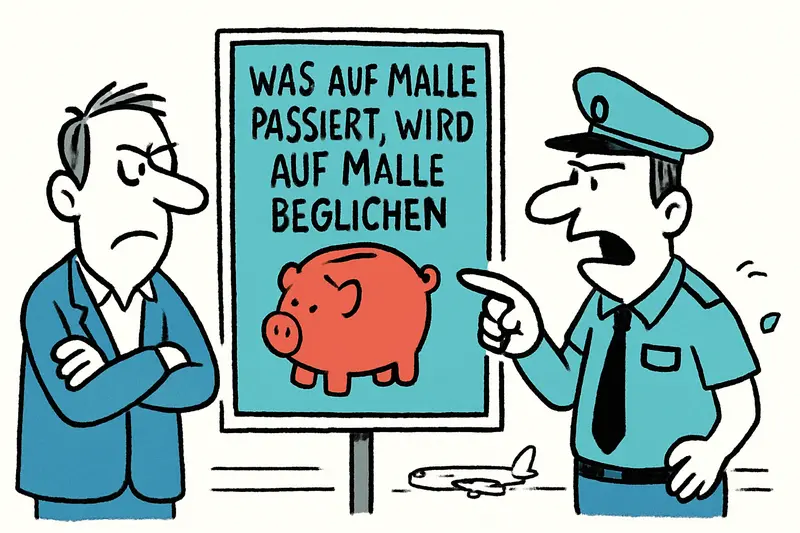
A poster with the slogan 'What happens on Malle is settled on Malle' is causing trouble at Palma airport. The Balearic government is demanding an apology; Sparkasse says it will review the incident. A reality check on what is missing — and what would be sensible.
Sparkasse, the airport and the fine line between punchline and provocation
Key question: Can a bank advertise at the airport without alienating a whole segment of the island's community?
On 30 May 2026 a large advertising poster appeared at Palma airport: 'What happens on Malle is settled on Malle.' It promotes a digital payment service from Sparkasse. The Balearic government sees this as an allusion to binge-tourism and demands a public apology. Sparkasse, for its part, says it finds this connection hard to understand and wants to review how the poster was handled; the company insists no one was meant to be offended.
This is the moment when advertising becomes a public debate. Airports are shop windows for the island: between check-in counters, the beeping of rolling suitcases and the announcements, advertising hits locals and visitors alike, and even other airport functions such as enforcement measures are visible in cases like Checkpoint Son Sant Joan: When unpaid fines can stop a holiday, while system failures and delays can amplify tensions, as shown in Seven Hours of Waiting at BER: What the Mallorca Weekend Taught Us. A slogan that plays so casually with the image of 'Malle' therefore touches a sensitive area — especially where residents, politicians and businesses have been arguing for years about the effects of mass tourism.
Critical analysis: three problem areas stand out. First, the symbolism: the wording links the island with behaviour many Mallorcans perceive as a burden. Second, the setting: a poster at the airport reaches not only tourists but also people who live daily with the consequences of seasonal tourism — shop owners on Playa de Palma, bus drivers, hotel staff. Third, the political dimension: when the government publicly demands an apology, the debate becomes not only cultural but institutional. The company then finds itself between brand communication and public pressure.
What is often missing in the public discourse: discussions about advertising remain superficial, but clear practical rules and transparent processes for promotional content in public spaces are lacking. There are hardly any visible standards for how ads are checked for local sensitivity before they hang seven metres high in an arrivals hall. And the perspective of the people who live daily with the effects of stereotypes is missing — the bakery on Plaça Major, the young waiter on Playa de Palma, the mother who knows the noise on the street.
An everyday island scene: imagine a morning at the Estación Intermodal in Palma — the smell of coffee, commuters on their way to work, schoolchildren with backpacks — and opposite, large and loud, a poster that evokes 'Malle' and revelry. That does not feel abstract; it is a visual message that sparks conversations at the checkout, on the bus and at the greengrocer's.
Concrete solutions: the debate should lead to practical steps, not outrage rhetoric. Proposals that could be implemented immediately: First, a binding advertising review for large outdoor campaigns at the airport involving the airport operator, the island administration and representatives of local civil society. Second, a transparent complaints procedure: citizens and businesses must be able to state easily why an ad is problematic — and an independent body should review it within a short time. Third, a sensitivity check for advertisers: short guidelines before budgets are released, with examples of pitfalls. Fourth, in case of missteps there should be a graduated package of measures: from a public clarification to adjustments and up to an apology — depending on the severity of the impact.
Technically and legally many things are possible without restricting freedom of advertising. It's about responsibility: those who are most visible have an extra duty of care. This applies particularly to banks, because they sell trust, not just services.
In the present case it remains open how Sparkasse will design the review process in detail and whether the government will be satisfied with an apology. It is clear, however, that if companies do not proactively consider local sensitivities, campaigns quickly end up in a political storm.
Conclusion: a slogan is more than a play on words; it is part of the image the island projects to the outside world. Pragmatic advertising regulation at the airport would not silence anyone — it would only prevent headlines that ultimately harm everyone: the community, tourism and the advertiser itself. Sparkasse should now clearly explain how the review will proceed — and politicians can use this incident to introduce binding rules for future outdoor advertising.
Frequently asked questions
What is the weather like in Mallorca in November?
Can you still swim in Mallorca in November?
What should I pack for Mallorca in November?
Is Mallorca busy in November?
What can you do in Mallorca in November?
Is Palma de Mallorca worth visiting in November?
Is Sóller a good place to visit in November?
What is Alcúdia like in November?
Similar News
Body in the Basin of Port Adriano: Who Protects People During Crossings?
In the morning, just before noon: employees of a luxury marina discovered a floating body in the basin of Port Adriano. ...
Raised from the Sand: A Late Antique Merchant Ship Tells of the Sea off Can Pastilla
A 1,700-year-old Roman merchant ship was raised off Can Pastilla. Finds such as sail fragments and amphorae provide rare...
After the Storm: Why Many Fish Died at Riuet de s'Illot — and What's Still Missing
After the severe storm, numerous dead fish were found in the Riuet de s'Illot wetland. Who is affected, why it may have ...
Fire in Can Picafort: Family Rescued at the Last Minute – a Safety Check for the Promenade
A fire in a sports shop on the Can Picafort seafront forced the evacuation of a mother with four children. How safe are ...
Nine-year-old rescued after cliff fall at Cala Murada — How safe are Mallorca's coastal paths?
A boy fell roughly five meters down the rocks near Cala Murada. The dusk rescue was elaborate; a helper also had to be r...
More to explore
Discover more interesting content

Boat Tour with BBQ along Es Trenc Beach
Private transfer from Mallorca Airport (PMI) to Pollensa
