
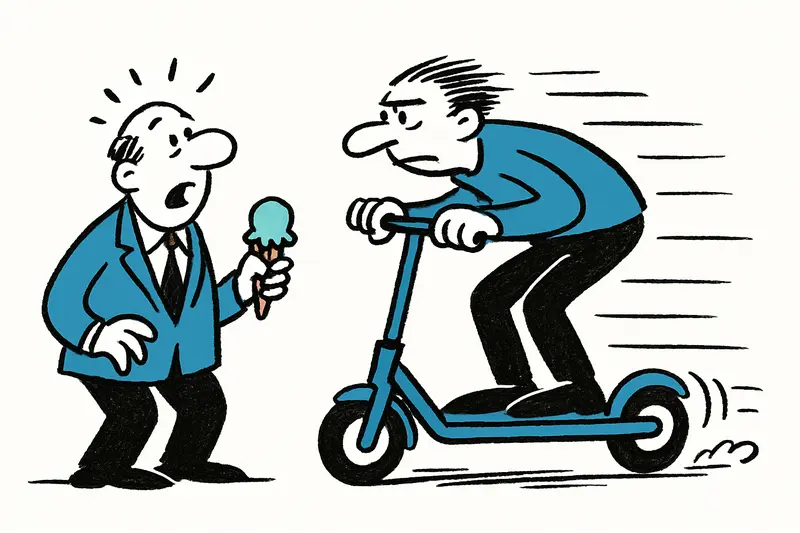
98 km/h on an e-scooter in Cala Millor: How dangerous is the gap in the system?
98 km/h on an e-scooter in Cala Millor: How dangerous is the gap in the system?
A 20-year-old was stopped in Cala Millor after his e-scooter reached 98 km/h. Key question: why are we losing control over such vehicles?
98 km/h on an e-scooter in Cala Millor: How dangerous is the gap in the system?
Key question: Why are we losing control over electrically powered small vehicles?
Late on a Thursday afternoon in Cala Millor: the promenade half full of walkers, the smell of salt water and fried fish in the air, children licking ice cream, bicycle bells alongside the rattle of delivery crates. Into this scene an e-scooter reportedly sped with a measured top speed of 98 km/h — through an area with a high volume of pedestrians. The Policia Local of Sant Llorenç des Cardassar intervened; the rider, a 20-year-old man, had no driving licence, and a similar incident was reported in Palma earlier in which a rider was seriously injured, Serious E-Scooter Accident in Palma: More Than Just an Accident?. Investigations are ongoing, including examinations of which vehicle category the scooter should be classified under.
In short: this is not an isolated incident but a symptom. The numbers (98 km/h and the 25 km/h speed limit for approved e-scooters in Mallorca) suggest this is not just about individual speeders, but about weaknesses in the regulatory framework, enforcement and everyday traffic practice; other high-speed cases on the island highlight the wider problem, such as a driver caught at 175 km/h on the Ma-13, 175 km/h on the Ma-13: Speeding as a Criminal Offense — What the Case Really Shows.
Critical analysis: First, technical modification or design? Investigators are checking whether the vehicle can be considered a "personal mobility vehicle" or must be assigned to another category. When manufacturer specifications, type approvals and technical inspections diverge, a grey area emerges in which high-performance e-scooters operate legally or at least are harder to sanction. Second, registration and responsibility: without mandatory registration or clear identification marks, tracing becomes difficult — especially if a rider has no licence. Third, on-the-ground enforcement: police checks work at specific points, but a permanent presence on promenades like the Passeig in Cala Millor is not realistic.
What is often missing in the public debate: discussion usually focuses on personal responsibility or on rental scooters as a business model, and less on technical standards, inspection intervals and the gap between EU norms, Spanish rules and municipal practice. Also rarely examined is the role of privately imported devices and modifications. Many fast devices enter circulation via online purchases or repairs — outside the dealer control path; some councils have already taken steps, for example by banning e-scooters on the first line by the sea, Son Servera Draws a Line: E-Scooters Banned on the Coast.
An everyday scene that intensifies the urgency: in the mornings, when the fish market in Cala Millor closes, pensioners, parents with prams and tourists mingle on the narrow pavement. A motorbike overtakes close to a bus stop, an e-scooter shoots past. In such moments seconds are enough to provoke a collision. This is precisely the problem: public space is not designed for 100 km/h, even if the vehicle only "looks like a scooter."
Concrete solutions, without platitudes:
1) Technical standardisation and inspection loops: clear rules on what motor power and top speed are permissible for the category "personal mobility vehicle", combined with regular technical inspections in municipalities. Manufacturers, dealers and large platforms should be required to affix a registration number to the device so that modifications remain traceable.
2) Geofencing and speed limiting on new devices: sales and approval requirements could mandate that devices have a binding electronic limiter that automatically prevents exceeding 25 km/h in pedestrian zones.
3) Targeted controls instead of show policing: more mixed teams present during the day at hotspots such as the Cala Millor promenade or outside schools, combined with mobile measurement technologies and transparent follow-up procedures for violations.
4) Tighter regulation and accountability for rental systems: operators must be obliged to provide firmware updates, regular inspections and a direct reporting function for altered devices. Fines for violations should not only target riders but also operators when negligence can be proven.
5) Localised awareness campaigns: instead of abstract posters, municipal campaigns should show real scenes — for example the Passeig at sunset, the bustling weekly market or school routes in Porto Cristo — and give clear instructions. People remember stories, not legal paragraphs.
What authorities can do: forwarding the case file to the judiciary is a necessary step. In the long term, coordination is needed between municipal, island and regional levels: uniform classification, a shared control database and mandatory labelling.
Conclusion: The Cala Millor case is alarming because it exposes the brittle transitions between leisure device, road user and potential danger. Anyone who rides at 98 km/h through a promenade on a balmy afternoon risks lives. It is not only the police's job but also the responsibility of manufacturers, rental companies, municipalities and every individual user to close this gap. If we continue to rely on spot repression instead of systemic repair, the promenade will remain a place where nothing is automatically safe anymore — neither a child's ice cream nor the feeling of strolling the paseo unscathed.
Frequently asked questions
How fast can an e-scooter legally go in Mallorca?
Why are fast e-scooters such a safety risk on the promenade in Cala Millor?
Can you ride an e-scooter in Mallorca without a driving licence?
What should I check before buying a powerful e-scooter in Mallorca?
How do police enforce e-scooter rules in places like Cala Millor?
Are rental e-scooters in Mallorca more tightly controlled than private ones?
What could Mallorca do to reduce dangerous e-scooter use?
What makes the Cala Millor e-scooter case so alarming?
Similar News
Smoke over the UIB: Who is responsible for the fire on the roof?
On Saturday afternoon a fire broke out on the roof of the Arxiduc Lluís Salvador building at the University of the Balea...

Short Getaway with Sea View: Inmood Aucanada among Spain's Top Hotels for Dinner Breaks
A small hotel on the coast of Alcúdia was highlighted by a Spanish experience platform as particularly suitable for shor...

Cala Pi crowned Mallorca's most beautiful beach: A morning at the rocky cove
The travel portal Holidaycheck praises Cala Pi as Mallorca's most beautiful beach: a narrow, romantic cove, clear water,...
Injured captain, big plans: Germania Mallorca before the away match in Consell
The newly founded FC Germania Mallorca travels to Consell on Saturday. Captain Bastian Müller is out injured, but coach ...
Palma, Palma de Mallorca, Palma‑Mallorca: What is it really about?
The debate over the city's name is more than grammar: it concerns identity, law and branding policy. A sober reality che...
More to explore
Discover more interesting content

Can Cap de Bou

Townhouse Lleo 72
