
Talk, Don't Cram: Learning Spanish in Palma's Streets
Talk, Don't Cram: Learning Spanish in Palma's Streets
Instead of grammar books: Spanish courses that turn Palma into a classroom. Language teacher Pia Ferrer combines cooking, city walks and café sessions into everyday lessons.
Talk, Don't Cram: Learning Spanish in Palma's Streets
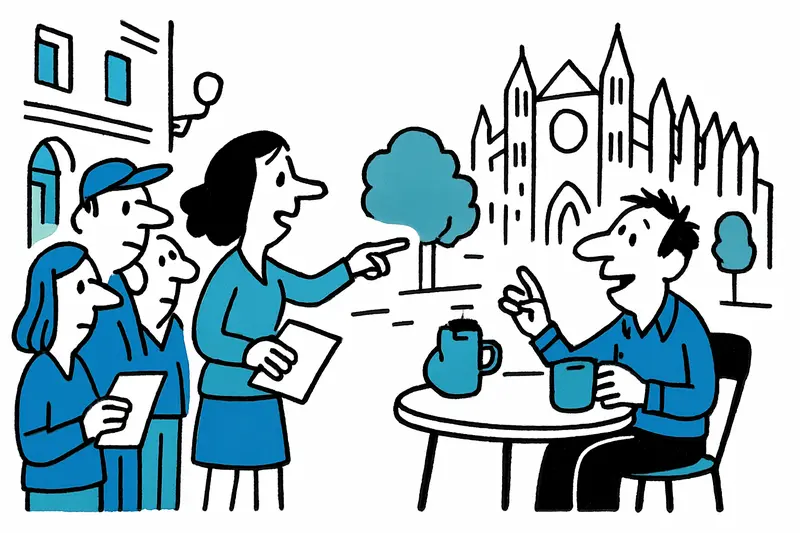
Saturday morning on the Plaça de la Reina: the scent of coffee in the air, occasional church bells ringing and seagulls mixing into the voices. A group of about 15 people gathers, half tourist, half island resident — and all are here to practice Spanish. The lessons do not take place in a classroom but in the middle of the city; Palma's cobblestones become the textbook.
Language teacher Pia Ferrer intentionally chose a get-out-of-the-room concept. Her courses, offered under the name "SpanishByLiving", link everyday activities with targeted exercises: cooking together, sailing a llaüt into the sunset, pottery or a guided city walk. The approach is simple: those who use the language in real situations remember vocabulary and expressions faster.
At the meeting point Ferrer distributes worksheets with useful vocabulary and short texts about the city's history. The group is accompanied by a guide who explains the stops at an easily understandable pace. Thus, an architectural episode on the cathedral's facade becomes not only a bit of knowledge but also a practice field: How do you ask about the year of construction? Which words describe shapes and ornaments? In short: it's about speaking, not rote rule-learning.
Participation is international: the Netherlands, France, England, the USA, Switzerland, Germany — languages meet and spark conversations. One participant from Switzerland attends the courses regularly, another spends several months of the year on the island and especially appreciates the practical focus. The concept brings people together: there is laughter, a word is explained, a tip about a local spot is given.
The tour winds its way through places such as S’Hort del Rei and ends near La Lonja. At the cathedral everyone stops, looks at the stone figures and listens as the guide explains details about function and symbolism. Such moments provide not only cultural knowledge but also language opportunities: one participant asks, another repeats — a small conversation arises, and the memory sticks deeper than after a vocabulary list.
Those who prefer one-on-one can book private lessons — often in a café, where the sound of cups and passing buses accompanies the session. Private tuition starts at about 32 euros for 60 minutes; a practice that helps many lose inhibitions faster than in traditional courses.
These alternative learning forms are not unique; several providers on the island experiment with similar ideas — from short video lessons and social media formats to personalized private sessions, and institutions also promote events such as the open day at the Escuela Oficial de Idiomas de Palma, while community programmes have published registration announcements for neighbourhood centre courses from 2 euros per hour.
This is a gain for Mallorca: those who communicate better feel more connected. Restaurants, shops and neighborhoods benefit because encounters become easier. And for newcomers, a course that connects everyday life and the city is a quick bridge to the community.
My tip for anyone who wants to join: find a small group, take part in a city walk and practice the new phrases immediately in a café, for example at the relaxed Friday language café in Santa Catalina. Those who regularly learn through real experiences notice quick progress — and still have time for a stroll through Palma's alleys.
Conclusion: Learning Spanish doesn't have to be dry. When the island itself becomes the classroom, vocabulary stays in the head longer and conversations become natural. Whether you live in Palma or visit the island often, these courses provide not only language skills but also access to people and everyday life.
Frequently asked questions
Can you really learn Spanish faster by practicing it in Palma instead of in a classroom?
What kind of Spanish courses are available in Mallorca for people who do not want a traditional classroom?
Is Palma a good place for beginners to practice Spanish in real situations?
What is a language café in Palma, and is it useful for learning Spanish?
Where in Palma do Spanish walking classes usually take place?
How much do private Spanish lessons in Palma usually cost?
Do Spanish courses in Mallorca help with meeting local people and settling in?
What makes learning Spanish in Palma different from studying from a book?
Similar News
Mistaken identity with fatal consequences: Brutal assault in S'Aranjassa — what's missing in the follow-up?
At S'Aranjassa a visitor to a finca was tied up, beaten and thrown out of a van. Three men have been arrested, including...
High heel slips, car accelerates: accident on Camí de Son Hugo
A woman lost a high-heeled shoe on the forecourt of the sports facility at Camí de Son Hugo. The car accelerated, mounte...
Phone Scam: How Two Hotel Employees at Playa de Palma Lost Thousands of Euros
One morning in September, two reception employees at Playa de Palma were pressured by alleged alarm-company staff — in t...

When the Wallet Becomes a Danger: Attack in Peguera and Lessons for Mallorca
In Peguera, two women are said to have stolen the wallet from a 75-year-old German couple. When the victim intervened, t...
Plata stays Plata: Young people take over, Llonguets remain
A small bar on Carrer de l'Argenteria will continue: Tolo Serra hands the place over to young Mallorcans at the end of t...
More to explore
Discover more interesting content

Can Cap de Bou

Townhouse Lleo 72
