
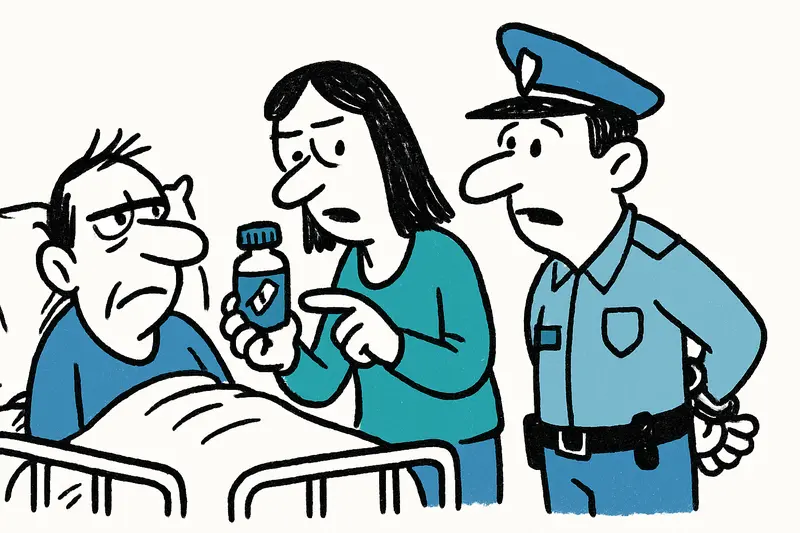
Vitamin D Alert in Palma: Who is liable when a supplement severely harms people?
Vitamin D Alert in Palma: Who is liable when a supplement severely harms people?
Twenty people in Mallorca became ill after a dietary supplement contained an excessively high concentration of vitamin D3, some sustaining permanent organ damage. The National Police arrested the local distributor. What went wrong — and how can we protect ourselves in the future?
Vitamin D Alert in Palma: Who is liable when a supplement severely harms people?
Twenty patients, several hospital stays, an arrested distributor — and many unanswered questions
In Palma, twenty people recently fell ill after taking a dietary supplement that contained an excessive amount of vitamin D3. Some of those affected were hospitalized, and according to medical sources, some have sustained lasting damage to vital organs. The National Police took the person responsible for the distribution company into custody as a suspect on charges of bodily harm. The news has unsettled the city.
Key question: How could a product with an obviously dangerous dosage enter the market — and who bears responsibility?
The chronology known so far is short and explosive: A female customer alerted the manufacturer and distributor after her partner became seriously ill following consumption. The contracted laboratory identified an incorrectly high concentration of vitamin D3, immediately called for a recall and informed the health authorities. The distributor contacted some customers and returned numerous packages to the manufacturer, but left parts of the shipment undelivered. He reported the incident to the authorities only belatedly and is said not to have fully disclosed the scope of those affected — according to investigators, this is the reason for a criminal investigation.
In short: manufacturing error, delayed notification and unclear recall practices. The ongoing investigations by the National Police's drug squad and the statements of the injured parties should clarify whether this was gross negligence or something more, comparable to medical fraud cases involving alleged practitioners and online offers.
Critical analysis: There appear to have been failures on several levels. First, product control: Why was the deviation not detected earlier — at the manufacturer, the laboratory or an independent body? Second, the reporting culture: A recall is only as effective as the speed and transparency of the information. Anyone who informs consumers hesitantly or withholds data endangers lives. Third, market oversight: Dietary supplements sit between medicinal products and food law; precisely for that reason they need clear rules and enforcement powers.
What is often missing in public debate is the voice of those affected and their aftercare. Reporting tends to be dominated by legal details and finger-pointing — but rarely by the question of how people with permanent organ damage are to be supported medically, psychologically and financially. The everyday reality of small vendors also receives too little attention: many sell products in small settings without legal resources or experience with complex recall processes, as with an illegal filler treatment in Palma that led to hospitalisation and an arrest. The issue of threshold limits and laboratory standards is also too rarely discussed concretely: Which tests are mandatory? Who pays for retesting?
A scene increasingly visible in Palma since the reports: people sitting on benches along the Passeig del Born, the whistle of a coffee kettle from a bar, an ambulance racing toward Son Espases — and an elderly couple nervously checking their vitamin bottles as they talk. Such small observations make the abstract danger tangible: these are neighbors, club members, people from the corner café.
Concrete solutions could be implemented quickly if there were political will:
- Mandatory immediate reporting: Distributors and manufacturers must report and document health-endangering deviations within 24 hours. Delays should incur clear fines.
- Central recall platform: A publicly accessible, continuously updated database with batch numbers, affected lot sizes and contact information would make recalls effective.
- Stronger batch testing: Random checks by independent laboratories, financed by a small levy on traded goods, could detect manipulations or manufacturing errors earlier.
- Transparent liability rules: Clear guidelines on who is responsible along the supply chain, in distribution and storage would simplify victim protection and compensation.
- Local education: Pharmacies and municipal health centers as information points, especially for older people who use dietary supplements more frequently.
These measures may sound technical, but they are everyday protection: each measure shortens the period during which faulty products can cause harm.
Pointed conclusion: The case in Palma is more than a criminal episode — it is a wake-up call. Consumer protection and product safety are not self-evident; they require control, transparency and political tightening. And last but not least: the victims must not remain mere numbers in a file. Medical care and clear compensation routes must be put on the agenda now.
In the end, a bitter aftertaste remains: while investigations continue, many people are left wondering whether they can trust the next product. Mallorca must now show that it not only protects tourists but also the people who live here and rely on a dependable health system.
Frequently asked questions
What is the best time to visit Mallorca if I want good weather?
Can you swim in Mallorca outside the summer months?
What should I pack for a trip to Mallorca?
Is Mallorca a good destination for walking and sightseeing in spring?
Is Palma de Mallorca worth visiting for a short city break?
What is Cala d'Or like for a holiday in Mallorca?
How warm does Mallorca usually get in the summer?
Is Mallorca better for beaches or for exploring inland villages?
Similar News

Fewer Airlines, Fewer Destinations: What Palma's Winter Flight Schedule Means for Mallorca
Analysis shows: Winter at Son Sant Joan Airport will be quieter, with significantly fewer airlines and destinations. Who...
German tourist dies in Sa Calobra – a reality check for emergencies on Mallorca's beaches
A 40-year-old tourist died at the Torrent de Pareis. The emergency call, a doctor who happened to be present, a defibril...
Deadly Tractor Accident in Bunyola: What Needs to Be Done Now
In a work accident on an estate near Bunyola, a roughly 40-year-old man lost his life. His wife and a small child were o...
Head-first dive into the shallow part of Cala Fonoll: An accident and the unresolved question of responsibility
A young tourist dove into Cala Fonoll and was seriously injured. Key question: Why are clear warning signs missing at da...
Mistaken identity with fatal consequences: Brutal assault in S'Aranjassa — what's missing in the follow-up?
At S'Aranjassa a visitor to a finca was tied up, beaten and thrown out of a van. Three men have been arrested, including...
More to explore
Discover more interesting content

Can Cap de Bou

Townhouse Lleo 72
