
Key question: Storm "Leonardo" — How well is Mallorca really prepared?
Key question: Storm "Leonardo" — How well is Mallorca really prepared?
Low-pressure system "Leonardo" brings fresh gusts, showers and high waves. Aemet warns the island will remain stormy. A reality check: What is missing in the protection of coastal towns and in the everyday life of Mallorcans?
Key question: Storm "Leonardo" — How well is Mallorca really prepared?
The low brings wind, rain and high waves — time for a sober inventory and practical measures
Key question: Are our villages, coastal towns and infrastructure prepared for another recurring storm cycle? This is not a rhetorical question, but what we must discuss now while Aemet issues the low "Leonardo" and Yellow Storm Warning: How Well Is Mallorca Prepared for Heavy Rain?.
The facts, briefly and concretely: After a short sunny breather on Sunday, when some weather stations recorded 18 degrees (Son Servera, Artà, Palma), the next round is coming, as described in First storm warning, then sun: How well is Mallorca prepared for this changeable weather?. Aemet reports, among other things, coastal warnings (yellow), gusty southwest winds, showers across the island and a lowered snow line to around 1,100 meters, Storm, Rain, Maybe Snow: How Well Is Mallorca Prepared for the November Low?. One extreme figure from recent days still stands: in Bunyola on the Serra d'Alfabia a gust of 177.6 km/h was recorded. On the coast, the Tramuntana and the southwest have already issued advisories for high seas — the warning is valid until midnight.
The problem is not just the single low, but the accumulation: a stormy winter with repeated stress events quickly turns small weak points into bigger ones. Storm drains that normally channel water are often blocked after a series of showers. Roadside gutters that are rarely cleaned can turn into streams within minutes. Tree crowns that are not regularly pruned become hazards that threaten roofs and power lines; similar concerns have been raised in New Storm Front on Mallorca: How Prepared Are the Island and Its People?.
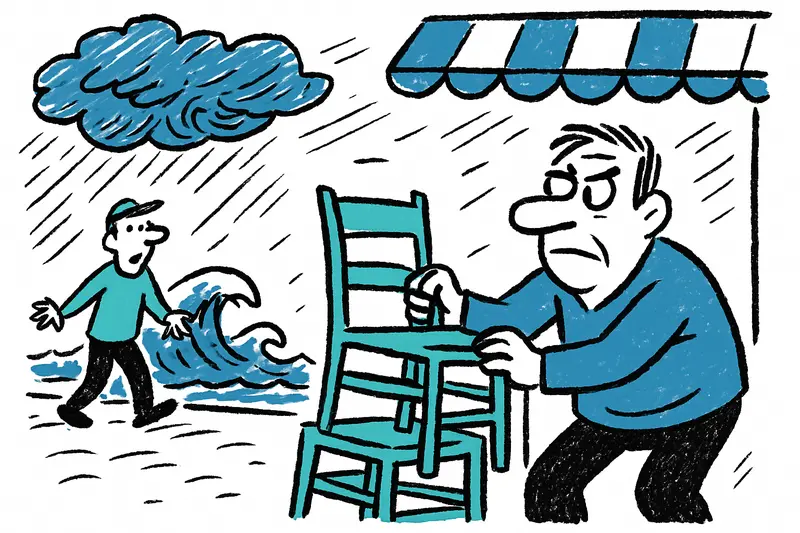
A everyday scene: In the morning I see on the Passeig del Born how a café owner hurriedly secures the terrace, ties chairs together and rolls up the awning. In Port de Sóller surfers stand on the beach delighted by high waves — for them luck, for the harbor mole a risk. Such images repeat in all coastal towns: people oscillating between concern and practical routine.
Critical analysis: The warning chain works on paper — Aemet publishes forecasts, the authorities give notices — but gaps appear in translating this into practice. Who is responsible when a tree falls across a country road? Who clears blocked gutters in remote districts? And how quickly do harbor authorities act to secure boats before the gusts arrive? These questions are not new, but the answers often seem uncoordinated.
What is missing from the public debate: prevention costs money, but it is cheaper than the sum of all emergency damages. There is no clear schedule for tree maintenance along access roads and no priority list for cleaning combined drainage systems before the rainy season. The role of private landowners is also rarely discussed: many clogged drains are on private property — targeted communication and, if necessary, support from municipalities are required here.
Concrete solutions that can work immediately: 1) Local checklists before each storm: harbor masters, municipal workers, utility companies and schools receive a coordinated to-do list (check mooring lines, clean drain grates, inspect emergency power centers). 2) Mobile response teams in island centers that can quickly clear blocked drains and obstructed roads. 3) Prioritised tree maintenance along access roads and lines — this saves on later repairs. 4) Improved information management: short, repeated notices via municipal WhatsApp groups, radio stations and harbor apps that give concrete behavioral rules (e.g. secure boats, do not park cars under trees). 5) Simple citizen services: collection appointments for reports of loose roof tiles or hazardous spots, handled quickly by municipal services.
Practical immediate tips for all Mallorcans: check fuses, secure balcony plants, fasten rubbish bins, do not park vehicles in exposed coastal areas, and pack winter hiking boots and warm clothes for trips into the Tramuntana. If morning fog banks are expected, adapt speed limits and use headlights.
A look at responsibilities: Aemet provides the basis — its forecasts are reliable. Municipalities are obliged to coordinate local measures. Energy providers must have emergency plans ready. And harbor administrations should check their berths before the first wall of gusts arrives. Only if this chain holds will the risk to people and infrastructure be reduced.
Bottom line: "Leonardo" is not an isolated event, but a wake-up call. We cannot rely on a wait-and-see routine. If authorities, harbor masters and neighbors all do their part now — with clear checklists, rapid response teams and better communication — the final bill will be noticeably smaller. Those who secure chairs on the Passeig del Born today are doing the right thing. The bigger task is to ensure that no one in the village ends up paying the bill later.
Frequently asked questions
How severe can storm weather get in Mallorca during a low like Leonardo?
Is it safe to go to the beach or coast in Mallorca during a yellow storm warning?
What should I pack for Mallorca if a storm is expected?
Can you still hike in the Tramuntana when Mallorca weather turns bad?
What does the storm warning mean for Port de Sóller and other Mallorca harbors?
Why are blocked drains and gutters such a problem in Mallorca during repeated storms?
What should Mallorca residents do to prepare their homes before a storm?
Who is responsible for storm preparation in Mallorca: municipalities, ports or energy providers?
Similar News

More water than last year: Mallorca's reservoirs breathe easier
September rain refilled the Tramuntana's reserves: overall fill around 35 percent, Cúber at 40.42 percent, Gorg Blau at ...
Three Luxury Hotels in Banyalbufar: Lots of Money, Many Questions
A Danish investor plans three exclusive accommodations in Banyalbufar — including the historic Son Valentí. The announce...
2.1 tonnes of cocaine on sailing yacht off Spain's coast – a reality check for the coastguard
A 14-metre yacht was seized with 2.1 tonnes of cocaine. Who monitors the ports, how does the international hunt succeed ...

Heat Bonus in Mallorca: 100 Euros Extra for Outdoor Staff at MarSenses
MarSenses pays employees who worked outdoors in August an extra €100 as recognition. Lighter uniforms, reduced hours for...
Renovating in Mallorca: What You Really Can Do Without Neighbour Consent
Many think they can do whatever they want in their apartment. That's partly true — but only as long as structural elemen...
More to explore
Discover more interesting content

Can Cap de Bou

Townhouse Lleo 72
