
When a Suitcase Becomes the Trigger: Beating at Ryanair Check-in in Palma
When a Suitcase Becomes the Trigger: Beating at Ryanair Check-in in Palma
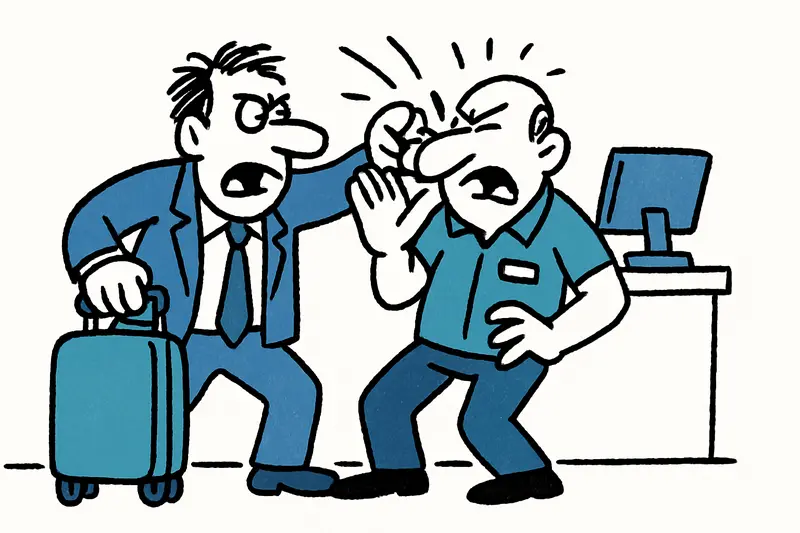
A carry-on dispute at Palma Airport escalated: a passenger struck a ground agent so violently that the worker lost teeth. How could it come to this — and what is missing in handling such situations?
When a suitcase becomes the trigger: Beating at Ryanair check-in in Palma
Key question: Why does a baggage check increasingly turn into a dangerous confrontation?
On Sunday morning at Palma Airport, an everyday scene suddenly turned into a bloody clash. Check-in staff were inspecting carry-on luggage according to the familiar rules outlined in Ryanair carry-on checks in Palma. A passenger whose luggage apparently exceeded the permitted dimensions got into a heated argument with the ground staff. The situation escalated: the attacker inflicted severe facial injuries on the employee, severe enough that teeth were lost. Officers from the Guardia Civil and staff from a private security company intervened and arrested the man.
Key question: What failed at that moment? Was it only the anger of one individual — or are there structural gaps in conflict prevention, staff and passenger information that make such scenes more likely?
Critical analysis: The scene at the counter exposes several problems at once. First, the expectation gap: many travelers do not take the strict carry-on measurements seriously or do not understand the details. Second, the staffing model: ground staff must perform hundreds of checks per hour while remaining de-escalatory — two tasks that fit poorly together when time, protective equipment and backing are lacking. Third, the safety net: the response by security forces was quick enough to prevent worse, yet the attack itself showed that physical violence can occur despite the presence of security personnel.
What is often missing from public discourse: the debate quickly reduces to outrage about the incident, to the claim that it is "inexplicable." Rarely are the working conditions of the ground staff asked about: how many people work at a counter, how are breaks regulated, what de-escalation and first-aid trainings are provided? Also little considered is the responsibility of the airlines in prior communication — poor signage, unclear booking information or contradictory rules between ticket purchase and boarding can fuel frustration.
An everyday scene from Mallorca to make it tangible: the hall smells of coffee and cleaning agents, roller suitcases clatter over the laminate floor, parents pull children behind them, and somewhere a boarding call beeps. Suddenly a loud cry, people step back, a woman covers her mouth with her hand. This is how escalation looks in everyday life — not a media construct, but a direct disruption of the travel flow that leaves many feeling uneasy.
Concrete solutions so it does not come to this again: 1) Better pre-travel information: airlines must provide clear, easily visible information on permitted carry-on (image, measurements in centimeters, concrete examples) already at purchase. 2) Visible measuring stations before check-in: those who can measure in advance pay or decide earlier — fewer surprises at the counter. 3) Training for ground staff: mandatory courses in de-escalation strategies, reading body language, first aid and safe restraint techniques. 4) Deployment planning: sufficient staff so checks do not happen under time pressure; clear protocols for when to call security immediately. 5) Alcohol and aggression screening: identifying conspicuous passengers earlier, especially at peak times. 6) Legal clarity: faster procedures for charging perpetrators to act as a deterrent.
Accompanying measures on Mallorca could include better cooperation between the airport operator, airlines and the Guardia Civil, regular security workshops in the departure hall and an information campaign along Passeig Mallorca and at hotels so tourists already know what to expect before arrival.
What becomes clear here is also a social problem: airports are places where congestion, waiting, language barriers and stress meet. Small frictions — an oversized bag, a delay — can develop into explosive situations. The task is not only to punish lone perpetrators, but to change the environment so that violence does not appear as a solution in the first place.
Conclusion: The incident in Palma is a wake-up call. Not every confrontation can be prevented, but many escalations could be significantly reduced through better information, more staff and targeted training. For the people who work here every day — the woman who puts up the sign early in the morning, the man at the baggage belt — it is about safety and dignity. For travelers it is about trust: when the clatter of suitcases echoes through the hall at the next check-in, it should not be accompanied by fear of violence, but by the familiar chaos of a travel day.
Frequently asked questions
Why are Ryanair carry-on checks in Palma sometimes so strict?
What should I do before flying from Mallorca if I’m worried my hand luggage is too big?
Can a suitcase size dispute at Palma Airport turn into a security issue?
What are the main causes of conflict at airport check-in in Mallorca?
How can airport staff in Palma de Mallorca reduce aggressive incidents at the counter?
When is the best time to arrive at Palma Airport if you are flying with carry-on luggage?
What role does the Guardia Civil play at Palma Airport?
What can airlines do to prevent baggage disputes at Mallorca airports?
Similar News
Magaluf: Watchtower Alarm – Lifeguards Pull Unconscious Beachgoer from the Water
After a drama in the late afternoon, two lifeguards at Magaluf beach rescued an unconscious 44-year-old man. He was stab...
Turquoise in the City: How dangerous is the color play of the Sa Riera?
The Sa Riera in Palma suddenly turned turquoise — a pretty motif, but behind the effect lies a discharge of saline waste...

Jeckliner at Sunnesching: Cologne spirit sets sail from Palma
In September 2027 the Mein Schiff 2 briefly becomes a floating carnival stage: four days with Cologne bands, comedy and ...
Finally Home: Mike and Leyla Heiter Buy Villa with Sea View in Mallorca
The reality TV couple Mike and Leyla Heiter have bought a house in Mallorca with a roof terrace and sea view. An Instagr...
Arrest after series in Palma: Who protects apartments from repeat offenders?
The National Police arrested a man in Palma who investigators say may have broken into several apartments. In one incide...
More to explore
Discover more interesting content

Can Cap de Bou

Townhouse Lleo 72
