
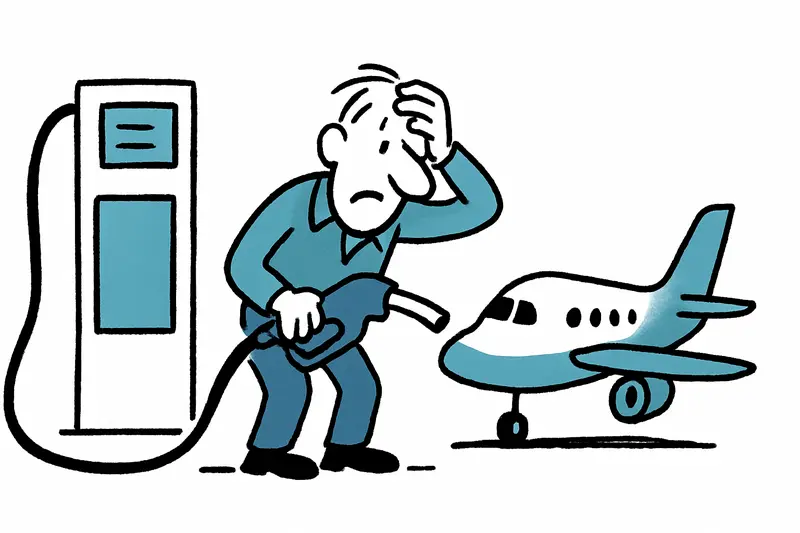
When the Tank Runs Low: What Mallorca Should Do About Fuel Risks for Air Traffic
Ryanair warns of possible fuel shortages if the conflict in the Persian Gulf continues. What does that mean for Mallorca's travel season — and what's missing from the debate?
When the Tank Runs Low: What Mallorca Should Do About Fuel Risks for Air Traffic
Key question: Can the island maintain its air connections if fuel supplies become scarcer and more expensive?
At Son Sant Joan on a typical morning you see coaches arriving in sequence, taxis with suitcases on the back seat and, on the horizon, a line of aircraft landing and taking off. This normality depends far more on the oil price and on shipping routes in the Persian Gulf than most passengers realize. The recent warnings from the aviation industry about possible fuel gaps if the conflict around Iran expands make this dependency clearly visible, as highlighted in Ryanair threatens further cuts – How at risk is Mallorca?.
In short: Large airlines have hedged parts of their fuel needs; some competitors have already reduced or cancelled routes, as reported in Ryanair Cuts Winter Flights — a Warning Signal for Mallorca. Experts estimate that supply chains could be noticeably disrupted in the worst case in May and June. For Mallorca this means: less comfort for holidaymakers, possible price jumps for tickets and more uncertainty in a month when the island enters its high season.
Critical analysis: Hedging helps but does not solve the underlying problem. If an airline has purchased up to 80 percent of its demand in advance at a certain price, that protects against short-term price spikes — but not against physical supply shortages. Crude oil can be bought on paper, but tankers can be blocked, detours may be necessary or terminals can fail. Transport routes through the Strait of Hormuz are particularly sensitive; if the strait remains closed, fuel deliveries arrive delayed or more expensive.
Mallorca's vulnerability is twofold: the island is heavily dependent on air traffic while local storage volumes are limited. Son Sant Joan is not a fuel depot that can buffer for weeks; large fleets usually store their fuel decentrally with operators and suppliers. That means: even if major carriers say they have hedged prices, local supply shortages can occur despite hedging — and everyone waiting for a connection flight will notice that on site.
What stands out in the public debate: There is a lack of concrete information about local reserves, transparent emergency plans from airport operators and clear communication from Spanish authorities, a problem underscored by incidents such as the Jet fuel shortage in Hamburg causes uncertainty for Mallorca travelers. Travellers and businesses on Mallorca hear warnings from airlines but receive few indications on how to prepare concretely — for example about alternative connections, refund rules or local timetables if flights are reduced.
Everyday scene from Palma: Two animated taxi drivers stand on the Plaça de la Reina after helping a return-flight customer. “If prices go up, fewer guests come into town,” one says, while a guest glances at their phone searching for cheaper connections. These small conversations show: the impacts would be felt not only at the airport but in restaurants, boutiques and among excursion providers along the coast.
Concrete solutions for the island:
1. More transparency and local emergency plans: Airport operators and authorities should disclose how many days of fuel are stored locally, who the suppliers are and how shortages are prioritised. A clearly communicated step‑by‑step strategy reduces panic.
2. Coordination with the mainland and shipping companies: If ships must take detours, coordinated route planning and priority for civilian supplies are needed. The Balearic government can act as a mediator here.
3. Temporary capacity planning: Airlines, tour operators and ferry companies should run joint scenarios: which flights are indispensable, where can capacities be consolidated, which alternative transport modes can cover short distances?
4. Consumption reduction and prioritisation: In the short term, non-essential cargo flights and ferrying of empty aircraft can be reduced. Local authorities can prioritise critical deliveries — medical, food-related — for supply allocation.
5. Communication for travellers: Hotels, tourist offices and local transport providers should have simple information ready: rights in case of flight cancellations, ferry options, guidance on refunds and rebookings.
Is something else missing? Yes — a regional view on alternatives: more investment in maritime corridors, reserve agreements with national operators and incentives to seasonally stockpile Jet‑A1. Also, the role of demand must not be underestimated: if the market becomes noticeably more expensive, travellers react — and that directly affects local businesses, as recent carrier pullbacks demonstrate in Ryanair pulls back – what threatens Mallorca's tourism summer.
Punchy conclusion: Mallorca's everyday life depends on global commodity flows. That airlines are naming risks is not alarmism but a wake-up call. The island now needs clear information, coordinated emergency plans and pragmatic measures so that neither the holidaymaker in Palma nor the bar in Port d'Alcúdia suddenly ends up grounded. This can be organised — if politicians, airport operators and the tourism industry work together instead of just hoping the shipping lanes will soon be free again.
Frequently asked questions
Could fuel shortages disrupt flights to Mallorca this summer?
Why is Mallorca so vulnerable to aviation fuel problems?
What happens to flight prices in Mallorca if fuel gets more expensive?
What should travellers do if their Mallorca flight is cancelled because of fuel issues?
Does hedging protect airlines operating to Mallorca from fuel shortages?
How could fuel supply problems affect tourism in Palma?
Is Palma airport prepared for an aviation fuel shortage?
What can Mallorca businesses do if flights are reduced because of fuel risks?
Similar News

Haute Nuit in Puerto Portals: Fashion, Art and Indulgence by the Water
On October 2 the Lobster Club in Puerto Portals will be transformed into a stage for curated fashion, art and culinary e...
Magaluf: Watchtower Alarm – Lifeguards Pull Unconscious Beachgoer from the Water
After a drama in the late afternoon, two lifeguards at Magaluf beach rescued an unconscious 44-year-old man. He was stab...

Turquoise in the City: How dangerous is the color play of the Sa Riera?
The Sa Riera in Palma suddenly turned turquoise — a pretty motif, but behind the effect lies a discharge of saline waste...

Jeckliner at Sunnesching: Cologne spirit sets sail from Palma
In September 2027 the Mein Schiff 2 briefly becomes a floating carnival stage: four days with Cologne bands, comedy and ...
Finally Home: Mike and Leyla Heiter Buy Villa with Sea View in Mallorca
The reality TV couple Mike and Leyla Heiter have bought a house in Mallorca with a roof terrace and sea view. An Instagr...
More to explore
Discover more interesting content

Can Cap de Bou

Townhouse Lleo 72
