
Red Water, Spray-Painted Words: Sa Feixina as a Flashpoint in Palma
Red Water, Spray-Painted Words: Sa Feixina as a Flashpoint in Palma
A fountain at Sa Feixina was dyed blood-red on Sunday and a monolith sprayed with anti-Franco slogans. With a rally approaching, the question arises: what is happening to Mallorca's culture of remembrance and its public space?
Red Water, Spray-Painted Words: Sa Feixina as a Flashpoint in Palma
A fountain turned blood-red — and a renewed debate over history, protest and monument protection
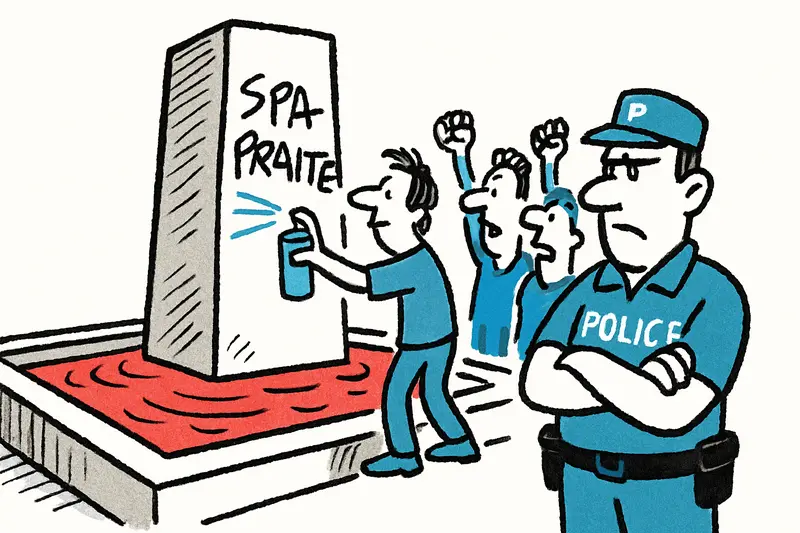
The scene on Sunday afternoon: at Sa Feixina there is the smell of wet stone, children toss crumbs to the pigeons, and in the distance you can hear the tram softly gliding by. Among the pines a fountain shows unusually red water, and freshly spray-painted slogans against racism and fascism cover the monolith. Shortly afterwards a small group gathers to defend the monument; police stand by.
Key question: What does this action — red dye in the fountain basin and graffiti on the monument — mean for the way Palma deals with its controversial heritage?
The facts are sparse: the water of the fountain in front of the monument was dyed red and antifranco slogans were found on the monolith. The slogans refer to violence and crimes during the Civil War, including the attack by the frigate "Baleares", then under nationalist control, on civilian convoys off the Andalusian coast; the warship later sank in 1938 in the Battle of Cabo de Palos, and almost 800 sailors lost their lives. The monument itself was erected in 1948 and is regarded by many as a relic of the Franco era; the central government has ordered its removal, and the city administration is contesting that in court.
Critical analysis: such actions are not accidental or pure provocation. They are an expression of an unresolved conflict: public memory versus monument protection, historical reckoning versus local identity. Those who dye the basin red create a powerful image — a political message that sits in a gray area between protest and criminal damage. The small counter-rally by right-wing extremists with only 18 participants shows how fragmented public resonance is, while the official response — visible police presence, ongoing investigations — moves the conflict into the realm of public order and criminal law.
What is often missing in the public discourse is a factual, locally rooted explanation that takes both sides seriously. There is the legal dispute over the monument, the historical contextualization of the "Baleares" story and the remembrance of civilian victims. What is missing is a place for exchange on site — a moderated debate, explanatory plaques, educational offers in schools or a cultural programme that connects the different perspectives without flattening them. Also too rarely discussed: the question of safe public space. A monument must not permanently become a stage for threats and assaults; at the same time, monument protection must not serve as a shield for unaltered narratives that are no longer appropriate.
Everyday scenes in Mallorca: those who strolled down Passeig Mallorca on that Sunday encountered unsettled residents, delivery drivers parking their vans, and seniors visiting cafés on the plaza. A woman from the corner grocery shook her head: "The children ask why the water looks like that." Such impressions show: remembrance policy is not abstract, it plays out in courtyards, on school routes and in conversations over the afternoon coffee.
Concrete approaches: first, transparent information: a municipal commission could install temporary, understandable explanations at the monument — who is commemorated, which debates are ongoing, which steps are planned. Second, citizen participation: moderated forums in the neighborhood, schools and cultural centres would create space for different memories. Third, pragmatic safety rules: better lighting, regular cleaning and controlled video surveillance at sensitive sites can prevent escalations without suffocating the right to assemble; Since the start of the year Emaya has removed nearly 7,000 graffiti in Palma. Fourth, educational work: local projects that factually explain the historical events around the "Baleares" and the Desbandá contexts could engage young people and defuse emotionally charged symbols. Fifth, legal clarity: city and central government should communicate legal steps openly and provide a timetable for decisions so the dispute does not get lost in legal fog.
Pointed conclusion: the red-dyed water is an image that hurts — and at the same time a warning signal. If Palma leaves the debate to the courts, a few demonstrators and nighttime graffiti artists, the city will miss the chance for a reasonable public engagement with its history. Those who want lasting peace here need more than repression: spaces for explanation, exchange and remembrance that are visible and experienced in everyday life — on the plaza, at school, over coffee on the Passeig.
A practical next step would be to publish a locally accessible information page and hold two public conversations at the monument this month; it costs little but signals: Palma is taking responsibility for its public space — against graffiti and for an honest culture of remembrance.
Frequently asked questions
Why was the fountain at Sa Feixina in Palma dyed red?
What is the controversy over the Sa Feixina monument in Palma?
Is Sa Feixina in Palma still open to the public?
What does the Sa Feixina protest in Palma say about public memory in Mallorca?
What is the historical background of the Baleares reference in the Sa Feixina debate?
How should visitors behave if there is a protest at Sa Feixina in Palma?
Could Sa Feixina in Palma be removed from its current site?
What would help reduce tensions around Sa Feixina in Palma?
Similar News

Magaluf: Watchtower Alarm – Lifeguards Pull Unconscious Beachgoer from the Water
After a drama in the late afternoon, two lifeguards at Magaluf beach rescued an unconscious 44-year-old man. He was stab...

Turquoise in the City: How dangerous is the color play of the Sa Riera?
The Sa Riera in Palma suddenly turned turquoise — a pretty motif, but behind the effect lies a discharge of saline waste...

Jeckliner at Sunnesching: Cologne spirit sets sail from Palma
In September 2027 the Mein Schiff 2 briefly becomes a floating carnival stage: four days with Cologne bands, comedy and ...
Finally Home: Mike and Leyla Heiter Buy Villa with Sea View in Mallorca
The reality TV couple Mike and Leyla Heiter have bought a house in Mallorca with a roof terrace and sea view. An Instagr...

Arrest after series in Palma: Who protects apartments from repeat offenders?
The National Police arrested a man in Palma who investigators say may have broken into several apartments. In one incide...
More to explore
Discover more interesting content

Can Cap de Bou

Townhouse Lleo 72
