
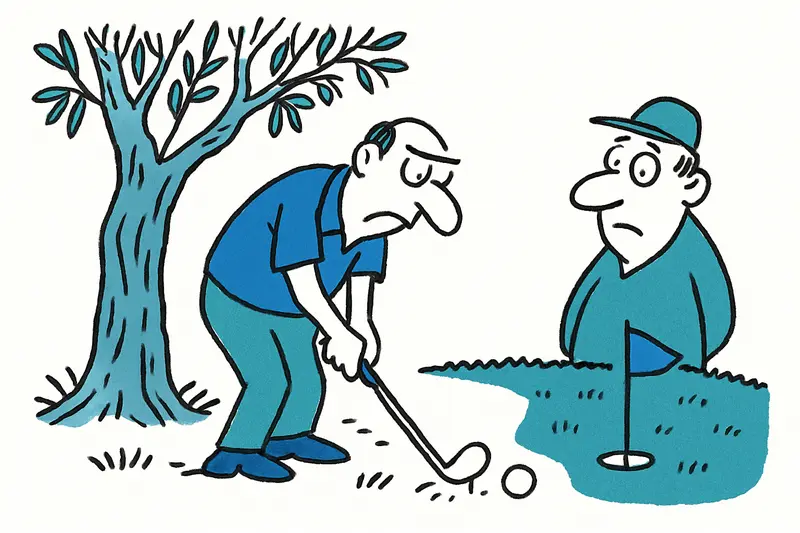
Tee Behind the Olive Tree: When Country Estates Become Mini-Golf Courses
Tee Behind the Olive Tree: When Country Estates Become Mini-Golf Courses
On Mallorca, private properties increasingly host small, privately used golf areas. Who decides on changes of use, what about water and soil — and which rules are missing? A reality check with concrete proposals.
Key question: Who decides how rural properties in Mallorca are used — and according to which rules?
When I drive along the country road toward Llucmajor in the late afternoon, the smell of freshly cut grass mixes with diesel from the tractor. Behind dry stone walls pools, palms and occasionally an impeccably mown strip of lawn flash into view, like the anteroom of a private charter. New are not only the single-family houses, but increasingly the idea: a few tees, a green sweep among olive trees, a pond as a water hazard. What was fantasy five years ago is now visible to environmentalists more and more often in aerial images.
Critical analysis
Facts in brief: There are officially around two dozen public golf courses on Mallorca, as reflected in celebrations like Ten Years of T Golf Calvià: A Day That Smells of Fresh-Cut Grass and Sea; in addition, smaller, often unauthorized fairways have been discovered on private properties, including in the municipality of Llucmajor. The trail points to a combination of lots of money, large plots and legal uncertainties. Municipalities are formally responsible for land-use issues and water allocation, but binding caps for private lawns or golf infrastructure are missing in many places — or are difficult to enforce.
The interventions go far beyond a nice green. Ponds with liners, sculpted bunkers, drains and pumps change the subsurface, can tap nearby water veins and require soil works that no longer fall under the term 'garden'. When private estates turn essential landscape structures into leisure parks, proper land use ends where it becomes a functional transformation.
What is missing in the public discourse
Public debate often focuses on large resorts and tourism water use; matters such as farm conversions have received attention in pieces like Holidays in the Tool Shed? New Agricultural Law Puts Farms to the Test. The quiet cases on private properties hardly appear. Reliable figures are lacking: How many of these installations actually exist? Which areas have been permanently sealed? And above all: who granted permits — or were they deliberately circumvented? Without transparent inventories, control remains piecemeal.
Everyday scene from the countryside
One morning in the village of Campos, the old neighbor Maria sits on a plastic bench in front of her house and pours olives into a sieve. “We used to keep sheep, now we mow lawns like at the airport,” she says as a convertible with German plates arrives. Children tramp past, the school bells ring — and nearby a new ornamental lagoon gurgles, which on warm days could end up in tourist photos. This discrepancy between peasant practice and private leisure claims is tangible everywhere.
Concrete solutions
1) Mandatory mapping: Municipalities must produce a binding inventory of changes of use on rural properties and make it publicly accessible. Aerial images alone are not enough — records must be open.
2) Clear permit categories: Garden maintenance is not equivalent to building sports infrastructure. Ponds, bunkers, liners and sealing should have their own permit levels with environmental assessments.
3) Water quotas and meters: Approvals for artificial greens must be tied to a transparent municipal water budget. Decentralized flow meters and variable tariffs prevent availability from being decided solely by wealth.
4) Use-binding obligations: If agriculturally used land is permanently converted into recreational areas, compensatory land or restoration requirements should be imposed. Those who change the function bear the responsibility — not the municipality.
5) Sanctions and remediation: Fines alone are not enough. Municipalities should be able to order concrete dismantling or renaturation measures. Additionally: funding programs that make real agriculture more attractive than private greenery, as highlighted in Olives Instead of Concrete: Why a Plantation in Mallorca Is Now More Than a Dream.
Why this matters
It's not just about aesthetics. Soil function, the water balance and the diversity of the island's interior are threatened if recreational areas spread uncontrolled. When a finca mutates into a mini-golf course, landscape character and use change permanently — with consequences for neighbors, groundwater levels and long-term food production.
Conclusion: It's time to sharpen the rules and improve oversight. Those who own land in Mallorca should have to act according to clear, public rules — not according to their personal desire for a tee. Otherwise small patches of grass risk becoming a big problem for the island.
Frequently asked questions
Can private rural estates in Mallorca legally build golf-style lawns and ponds?
Who controls land use on rural property in Mallorca?
Why are private mini-golf-style lawns a problem in Mallorca’s countryside?
Are there many golf courses in Mallorca already?
What should I know about building artificial lawns on a finca in Mallorca?
Is water use for private lawns and ponds regulated in Mallorca?
What happens if someone converts agricultural land in Mallorca into a leisure area?
How can Mallorca prevent hidden golf-style developments on private land?
Similar News
Just Bought — Already Trouble: Water Damage in the Heiters' Villa and What Owners in Mallorca Should Know Now
A newly purchased sea-view property — and within days a water damage. What risks lurk in new properties in Mallorca, and...

Rich, Richer, Mallorca? A critical look at the growing super-rich bubble
Numbers: Around 3,600 millionaires in the Balearic Islands hold a combined €27.6 billion. What this concentration of wea...
Chain reaction on the MA-1: Eight injured in rear-end collision near Portopí
On Tuesday morning there was a crash at the Andratx exit to the MA-1 towards Palma: a rear-end collision between a car a...
Happy Couple and Water Damage in Mallorca: A Reality Check for Home Buyers
Just moved in, already water under Mallorca's sun: the case of the influencer couple highlights risks often overlooked w...
Bendinat as a meeting place: Padel Cup brings together nearly 120 players
Three days of padel at the Bendinat Urban Country Club: organized by El Económico and Borbalán, with around 120 particip...
More to explore
Discover more interesting content

Can Cap de Bou

Townhouse Lleo 72
