
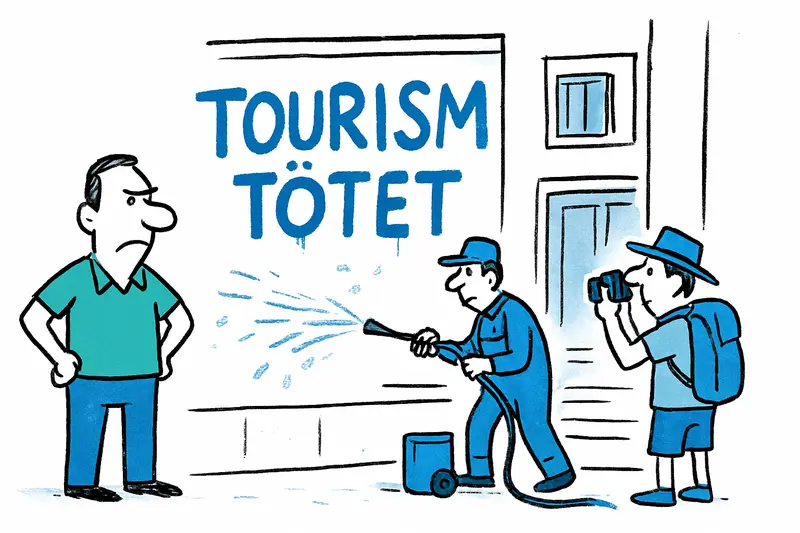
"Tourism kills" on the ministry facade: What do such slogans achieve?
"Tourism kills" on the ministry facade: What do such slogans achieve?
Graffiti on the headquarters of the Balearic tourism ministry in Palma have rekindled the debate about tourism. What do such messages convey — and what's missing from the conversation?
"Tourism kills" on the ministry facade: What do such slogans achieve?
Vandalism in Palma, minister's video and the question of real answers
Key question: When someone sprays "El turisme mata!!" on an official facade, does it channel anger — or does it simply shut doors to dialogue?
Early on Friday morning, employees of the Balearic tourism ministry in Palma discovered two large slogans on the exterior wall: in Catalan "El turisme mata!!" and in English "Your luxury our misery". The words did not remain visible for long: cleaning crews removed the paint over the course of the morning. The responsible minister responded with a short video on his Instagram channel: "We must not reduce a complex debate to a simple slogan," said Jaume Bauzà, pointing to the economic weight of tourism. Prime Minister Marga Prohens called the action an inappropriate form of expression and emphasized that the government deals respectfully with dissatisfaction. Similar graffiti had already appeared in July 2025.
Anyone walking along the Plaça de Cort knows the scene: noise in front of the town hall, the ticking of keys in the alleys, passing delivery vans, and sometimes the smell of cleaning agents when paint is removed in the morning. Such scenes are common here — the message on the ministry facade was not, but it fit into a broader mood: frustration over rising rents, whole neighborhoods altered by short-term rentals, seasonal low-paid jobs, overcrowded beaches and the feeling that everyday life is becoming more expensive and constrained.
Critical analysis: Sprayers want to provoke, and they succeeded. But provocation is double-edged. On one hand it forces politicians and the public to look. On the other hand, a blanket slogan — "Tourism kills" — acts like a closure: it gives little indication of causes, those responsible, or realistic demands. In public discourse the question then remains: whom exactly do the authors mean? Large operators? Investment funds? The average tourist? Without a concrete addressee the message flattens into an emotionality that mobilizes but does not organize.
What is missing from the debate: numbers, places and solutions. There are few easily understandable comparisons that show where tourism brings positive effects (jobs, income) and where it harms (housing market, damage to infrastructure, local environmental burdens). Equally rare are clearly described, realistic action plans that balance employment interests with housing and environmental concerns. When protesters feel their voice is not heard, they look for more drastic forms — graffiti is a frequent outcome.
Concrete approaches that could help here: first, publish transparent, locally broken-down data on tourist numbers, types of overnight stays and seasonality — so discussions are built on facts. Second, create binding city-level forums in which residents, business owners, industry employees and administration regularly list and prioritize concrete problems (e.g. vacant apartments, noise, litter). Third, strengthen controls on illegal short-term rentals combined with incentives for long-term renting and support for hospitality workers (e.g. training, fair contracts). Fourth, provide spaces for creative, legal forms of protest — wall areas, temporary installations, moderated debates — so discontent can be visible without damaging public buildings.
A final everyday scene: Friday, Passeig del Born, street sweepers drive by, two municipal workers in blue overalls scrub paint residue from the joints with steam cleaners, a delivery driver parks briefly, a tourist photographs the blank wall. These small observations show the precise focus of the problem: it's not the paint on the wall that makes everyday life difficult, but the issues behind it — rents, jobs, infrastructure.
Pointed conclusion: Graffiti are a symptom, not the cause. They express anger, but they rarely do political work in terms of structural change. Those who truly want to make a difference must channel anger into formats that aim: put data on the table, start negotiations, set concrete rules — and create places where people can be heard. Respect for people and institutions is necessary; at the same time we must look closely at which policies on the island's streets ensure the balance between quality of life and economic survival.
Frequently asked questions
What is the best time of year to visit Mallorca for warm weather and calm seas?
Is Mallorca suitable for swimming year-round?
What should I pack for a trip to Mallorca?
What family-friendly activities does Mallorca offer?
How are Mallorca’s beaches and sea conditions?
What are the best ways to get around Mallorca without a car?
Is Mallorca a safe destination and what should I know about local culture?
What are easy day trips from Palma for a first-time Mallorca visit?
Similar News
Dead Tourist in Valldemossa: Who Bears Responsibility When Streetlights Become Dangerous?
On the afternoon of August 17 a tourist in Valldemossa was killed by a falling streetlight after a bus grazed the fixtur...
TV tip: Tim Raue discovers Mallorca's cuisine
German top chef Tim Raue is touring Mallorca: in a new episode of his travel series he tries focaccia in Palma's old tow...
Key Ring Instead of Conscience: Maintenance Worker in Manacor Arrested Over Series of Hotel Thefts
A 28-year-old maintenance worker from a hotel in Porto Cristo has been arrested. The suspect is alleged to have repeated...

First Rain Clouds After the Heatwave: A Hopeful Sign for Mallorca
After weeks of continuous sun, Aemet forecasts showers and thunderstorms for Thursday and especially Friday. Rain would ...

Sydney Sweeney and Scooter Braun enjoy quiet days in Mallorca
US actress Sydney Sweeney and music manager Scooter Braun spent several days off Mallorca aboard the megayacht "Rising S...
More to explore
Discover more interesting content

Boat Tour with BBQ along Es Trenc Beach

Private transfer from Mallorca Airport (PMI) to Pollensa
