
Two years' imprisonment after tradesman fraud: Who pays for clients' protection?
Two years' imprisonment after tradesman fraud: Who pays for clients' protection?
A service technician in Palma was sentenced to more than two years in prison after defrauding several customers of advance payments in 2023. What is missing in the protection of clients in Mallorca — and what can residents do concretely?
Two years' imprisonment after tradesman fraud: Who pays for clients' protection?
Key question: Why do fraudulent service providers on Mallorca repeatedly slip through gaps in oversight?
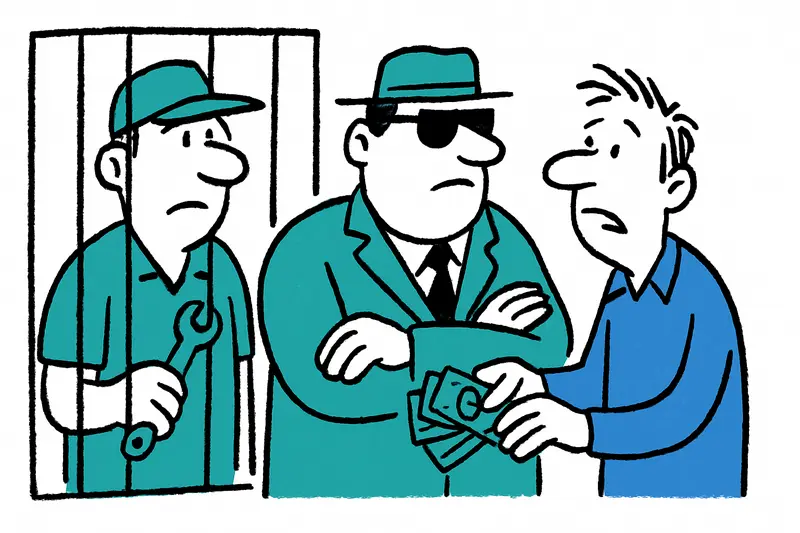
In spring 2023 a service technician in Palma apparently sought contact with several households, offered repairs and appliance sales, took advance payments and then failed to deliver. A court in Palma has now sentenced the man to two years, four months and 15 days in prison; the victims are to be reimbursed a total of 3,822 euros. Two victims transferred 350 euros each, another transferred 650 euros, one woman transferred 1,397.55 euros and a day later another 474.96 euros, and the last person paid 600 euros in cash. Payments were mostly made by bank transfer or via the payment service Bizum; cash was used once. The victims filed reports with the National Police; the accused was identified and, according to the judiciary, is currently held in a prison in Seville.
It sounds like a headline — and yet such cases repeat more often than we think, as shown by a handyman scam in North Mallorca. The conviction was possible because the defendant and the public prosecutor struck a deal: he admitted the allegations and accepted the sentence via video call from prison. The judgment was pronounced by the judge in the same session. Legally the case has been addressed; practically many questions remain open for the victims: How can I avoid this? And what responsibility do municipalities, chambers of trades and neighborhoods bear?
Critical analysis: The mechanics of the fraud were simple and exploit two local weaknesses. First: the culture of cash payments and quick, unwritten arrangements. Second: the thin line between amateur one-person operations and regulated businesses — many residents hire neighbors or sole traders without documentation to save money or secure quicker appointments. On a busy corner in Santa Catalina you often hear: "He knows someone who does it cheap." It sounds reliable because it is personal. That is exactly what fraudsters exploit.
What is often missing from the public debate is the perspective of small clients: many do not know which documents they should request, how much of a deposit is reasonable, and how to effectively recover a claim. Authorities like to talk about laws and rulings — that helps afterward, but not before you pay. The role of digital payment methods is also judged inconsistently: Bizum and bank transfers leave traces, cash does not. Still, on markets and in neighborhoods like El Terreno or La Soledat, payments without invoices are repeatedly seen.
An everyday scene: on a rain-dark morning on Passeig Mallorca two neighbors at a pavement café explain how they advanced three to four hundred euros to a "well-known acquaintance." The buzzing motor of a Vespa, the shout of a deliveryman, the clatter of cups — and the resigned conclusion: "We will probably see nothing back." Such conversations are everyday occurrences here; they show that distrust often comes from exhaustion, not ignorance.
Concrete solutions — immediately implementable at the municipal level: First, awareness campaigns in neighborhoods and at weekly markets: short information leaflets with tips on which payment methods are safer (record small deposits in writing, prefer bank transfer over cash) and which documents to demand (NIF, invoice, written quote with signature). Second, a municipal list of vetted tradespeople: not a guarantee of correctness, but a starting point for clients. Third, caps on deposits for home repairs in municipal guidelines (e.g. maximum 30% with a dated estimate). Fourth, rapid support services: a local consumer office helpdesk or special consultation hours at the Guardia Civil so victims can file reports quickly and secure evidence.
Legal and criminal-law improvements would also be useful: expedited proceedings for repeat fraud cases, better coordination between police authorities on the islands and the mainland, and civil cases prioritized to restitute small claims, as seen in debates after a suspended sentence after €35,000 fraud. Banks could also be supported to review transfers more quickly when fraud is reported — without violating privacy, a concern highlighted by coverage of a major real estate fraud.
For private individuals, pragmatic rules apply: request a written offer with NIF and a clear description of services; pay preferably by transfer or card; avoid large cash deposits; keep all messages and payment receipts; report suspicions immediately to the National Police and the municipality's consumer protection office. And ask neighbors for references — not as sole verification, but as an indicator.
Concise conclusion: The judgment in Palma is legally consistent, but it is not a cure-all for a structural problem. As long as information, prevention and simple bureaucratic safeguards are lacking, opportunistic fraudsters will exploit the gaps they find. In Mallorca, neighborhood networks, town halls and consumer protection can become more effective together — and that can happen faster than some think: a notice in a district, a list of vetted providers, a lower cap on advance payments. That protects not only wallets but also the trust that keeps community life alive here.
Frequently asked questions
How can I avoid handyman scams in Mallorca?
Is it safe to pay a tradesman in Mallorca with Bizum or bank transfer?
What documents should I ask for before hiring a tradesman in Mallorca?
How much deposit is reasonable for home repairs in Mallorca?
What should I do if I think I’ve been scammed by a tradesman in Palma?
Why do tradesman scams keep happening in Mallorca?
Where can Mallorca residents get help after a payment dispute with a tradesman?
Are cash payments risky when hiring a handyman in Mallorca?
Similar News
High heel slips, car accelerates: accident on Camí de Son Hugo
A woman lost a high-heeled shoe on the forecourt of the sports facility at Camí de Son Hugo. The car accelerated, mounte...
Phone Scam: How Two Hotel Employees at Playa de Palma Lost Thousands of Euros
One morning in September, two reception employees at Playa de Palma were pressured by alleged alarm-company staff — in t...
When the Wallet Becomes a Danger: Attack in Peguera and Lessons for Mallorca
In Peguera, two women are said to have stolen the wallet from a 75-year-old German couple. When the victim intervened, t...
Plata stays Plata: Young people take over, Llonguets remain
A small bar on Carrer de l'Argenteria will continue: Tolo Serra hands the place over to young Mallorcans at the end of t...
Unnoticed in the Luggage Compartment: How a Boy Traveled More Than 100 Kilometers in a Team Bus
A minor traveled in the undercarriage of a team bus for more than 100 kilometers until his cries for help were heard. A ...
More to explore
Discover more interesting content

Can Cap de Bou

Townhouse Lleo 72
