
When a Tree Blocks the Door: Why Palma's Disabled Parking Spot on Isaac Albéniz Is a Wake-Up Call
When a Tree Blocks the Door: Why Palma's Disabled Parking Spot on Isaac Albéniz Is a Wake-Up Call
A newly planted tree and a traffic sign are blocking exactly the area in Son Oliva where people with mobility impairments need their car door. Is this a planning mistake or a symptom of larger failures in the urban space?
When a Tree Blocks the Door: Why Palma's Disabled Parking Spot on Isaac Albéniz Is a Wake-Up Call
Central question: How can it be that a designated disabled parking space in Son Oliva is placed so that the driver’s door can no longer open — and what does this say about planning, oversight and the everyday functionality of our streets?
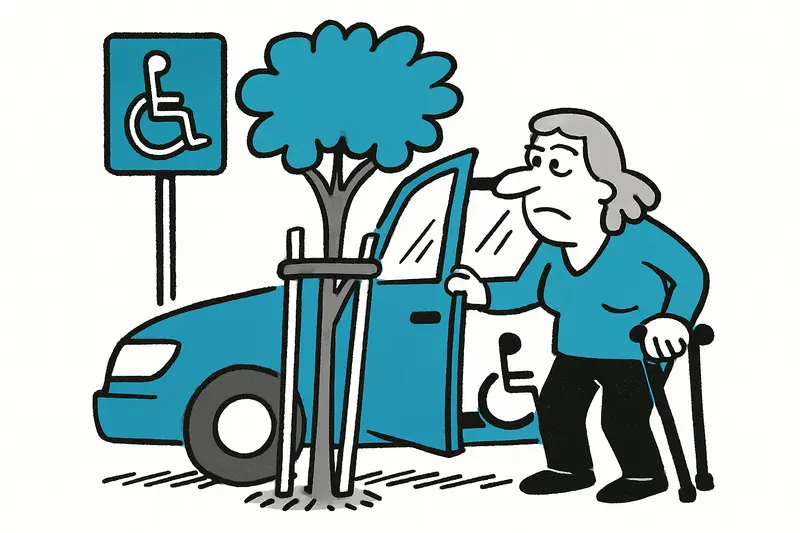
On Calle Isaac Albéniz, at around half past eight in the morning, the scent of freshly baked pa de llong mixes with the sounds of delivery vans honking, a scooter zipping by, and a man leaning against a terraced house facade holding newspapers. Right there is a blue parking bay with a wheelchair symbol. At first glance everything seems correct: markings, sign, curb lowered. At second glance: a traffic sign and a newly planted tree staked with wooden posts sit so close to the edge that the driver’s door of a properly parked car cannot fully open. A woman with crutches who passes by every day has to stow her crutches in the trunk and squeeze through a narrow gap to reach the driver’s seat. This is not only uncomfortable — it is a barrier. This mirrors other tensions around street trees, notably the resistance to tree felling on Plaza Llorenç Villalonga.
Critical analysis
Formally, everything may have been approved: sign placed, tree planted, curb lowered. That is not relevant in practice. Here two planning worlds collide: compliant paper-based planning and the actual use space, which is determined by vehicle widths, door opening angles and the movement of people using mobility aids. The result is an installation that appears accessible on paper but in reality prevents use.
The problem begins on several levels: lack of coordination between road construction and green space maintenance, missing on-site checks with affected people, and a kind of routine in approvals that relies too much on standards on paper rather than practical functionality. It seems decision-makers have to actually see how a person gets in and out with a wheelchair, walker or crutches — not virtually, but in reality.
What is missing in the public discourse
The debate often lacks the voices of those for whom accessibility is intended. People argue about regulations, responsibilities and formal legality — but rarely about how a parking space becomes usable in everyday life. Also largely absent are systematic checks after completion: Who verifies that a newly planted tree group leaves the required movement area free? Who documents such defects and ensures remedial action? There is a need for a binding, fast process for objections and repairs.
The question of responsibility remains diffuse. Urban planners, green departments, civil engineering and the public order office work at interfaces — but apparently no one carries the responsibility that ultimately matters: functionality for people with limited mobility.
A scene from everyday life
I still clearly see the woman with crutches: she parks, puts the parking change in her pocket, opens the rear trunk lid, shoves the crutches inside, pushes herself in with the free leg and slides through a gap while passersby on the sidewalk avert their eyes. A baker complains because a delivery van is blocking the street. An elderly neighbor makes an offhand remark about “modern regulations,” then falls silent after two words. This is reality — not the well-intentioned line on a plan. The morning disorder with delivery vans and blocked access echoes wider troubles with urban parking, like the daily parking chaos at Son Espases.
Concrete proposals
Short term: The traffic sign and the tree's wooden stakes must be temporarily moved until the movement area is clearly guaranteed. A simple measurement (door opening plus safety clearance) is enough to decide whether immediate adjustments are necessary. The city could also place a provisional marking and a no-parking zone until a permanent solution is in place so the driver’s door remains unobstructed.
Medium to long term: Introduce a mandatory on-site inspection by an accessibility expert before signing off on public measures; involve self-advocacy groups for people with disabilities in the planning loop; create binding checklists that cover not only standard dimensions but practical cases (e.g. door opening angles, use with crutches/walker); implement a digital reporting platform with clear deadlines for remediation; and provide training for municipal gardeners and road workers so that planting and traffic signs do not later encroach on functional space. These steps should be coordinated with broader municipal parking strategies such as Palma plans 131 parking spaces to ensure accessibility is integrated into all projects.
Additionally: create a georeferenced registry of all designated disabled parking spaces in Palma that is publicly accessible and shows regular inspection intervals. This would make errors visible, traceable and harder to forget.
Conclusion
The case on Isaac Albéniz is more than a curious isolated incident with an inconvenient tree. It is a symptom: our urban space is correct on the drawing board, but not always designed for people. The technical solution is simple, but politically uncomfortable — it requires responsible parties to do more than tick boxes; they must take the trouble to look through an open car door and ask: Can someone really get in and out here? Those who take this seriously can fix it in a few days; those who rely only on formalities will continue to create barriers.
Frequently asked questions
Why can a disabled parking space in Palma still be unusable?
What should make a disabled parking space accessible in Mallorca?
Is it safe to plant trees next to parking spaces in Palma?
Who checks whether a parking space in Palma is actually usable?
What should I do if an accessible parking bay in Mallorca is blocked?
Why do parking spaces in Palma sometimes fail people with reduced mobility?
Does Mallorca need better checks after public works are finished?
What is the wider lesson from the disabled parking spot on Calle Isaac Albéniz in Palma?
Similar News

When the Wallet Becomes a Danger: Attack in Peguera and Lessons for Mallorca
In Peguera, two women are said to have stolen the wallet from a 75-year-old German couple. When the victim intervened, t...
Plata stays Plata: Young people take over, Llonguets remain
A small bar on Carrer de l'Argenteria will continue: Tolo Serra hands the place over to young Mallorcans at the end of t...
Unnoticed in the Luggage Compartment: How a Boy Traveled More Than 100 Kilometers in a Team Bus
A minor traveled in the undercarriage of a team bus for more than 100 kilometers until his cries for help were heard. A ...

Cap Vermell Grand: Second Michelin Key – a Gift for the East
The Cap Vermell Grand in Capdepera has been awarded its second Michelin key. For the region this elevates the luxury off...
Eurowings lets four aircraft carry names – a friendly idea that also reaches Mallorca
Eurowings is launching a campaign: four Airbus A320s are to carry the first names of people who help others in everyday ...
More to explore
Discover more interesting content

Can Cap de Bou

Townhouse Lleo 72
