
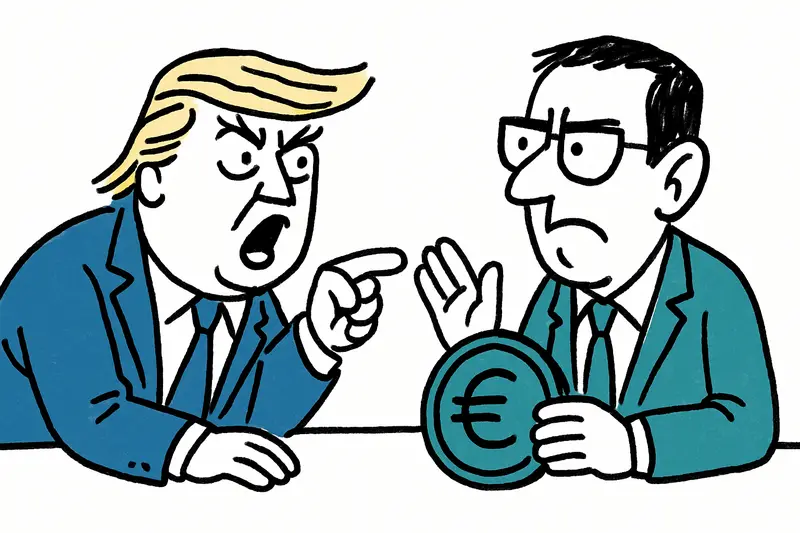
Trump threatens NATO expulsion: What Spain's defense row means for Mallorca
A short sentence from Washington is causing debate in Palma: Is Spain really facing expulsion from NATO — and what does that mean for Mallorca? An analysis with a local perspective.
Confrontation from Washington — and the Plaça de Cort murmurs
A short, brusque sentence from the President of the United States was enough to set the conversations at tables in Palma's cafés in motion again. "Expulsion from NATO," Donald Trump said of countries that do not share his views on defense spending, as reported in Trump pone sobre la mesa la exclusión de España de la OTAN – polémica por los gastos de defensa. In the bar at the Plaça de Cort the espresso cups clinked, seagulls flew over the harbor outside, and the debate began: Is this just show, or does the threat have substance?
The guiding question that is now heard more often here on Mallorca: How much money must a state spend on defense — and may that come at the expense of schools, hospitals or the infrastructure we use every day?
Why the threat is more than mere rhetoric
At first glance the statement from Washington seems paradoxical. NATO has no fixed mechanism to suspend or expel members. Formally, an expulsion is complicated to the point of being almost unthinkable. Nevertheless, the threat is politically effective: it raises pressure, changes conversations in Brussels and gives conservative forces in individual countries ammunition.
Less noticed is often that it is not only about percentages of GDP. It is about the type of spending: Are we buying complex weapon systems that bind money for decades? Or are we investing in joint European capabilities, cyber defense, satellites, border protection and civil crisis preparedness — areas that also have tangible relevance on an island like Mallorca?
What Madrid says — and what the island feels
The Spanish government wants to stay at around 2.1 percent of GDP and use the funds more selectively. On the island that sounds reasonable. At the rumble of the tourist bus rolling through the coves, at the ferry's leap in the morning, people think of jobs in tourism, healthcare and roads, not rocket launches inland.
Practically this means: Madrid is well integrated into NATO structures. Spain provides personnel, logistics and training areas, and the military bases in the Balearics — Mallorca en estado de inquietud: qué significa realmente el estatus de 'interés de defensa' para Son Sant Joan — are part of this network. An immediate rupture would be of no use to anyone — neither to the soldiers nor to the tourism industry that depends on a secure island.
Aspects that are rarely discussed
First: The distribution of defense spending within a country is politically sensitive. Investments in the coast guard and disaster response could have double impact here — as a security measure and as protection against storms and wildfires that regularly affect Mallorca.
Second: European cooperation is too rarely named as an answer. Instead of nationally investing in expensive systems, Spain and partner states could develop joint capabilities — research, logistics, training. That would lower costs per country and strengthen capacities that are useful locally.
Third: The communicative dimension. Debates on Mallorca often produce two moods: some are unsettled by threats from overseas, others see them as a wake-up call. Politicians should explain more transparently what money is spent on — and how that also improves everyday life here.
Concrete opportunities and proposals
More transparency: Present budget items more clearly — island residents want to know whether money flows into infrastructure or into individual systems.
Dual-use investments: Funds for coast guard, airport security or disaster protection count for both defense and civil protection and tourism stability.
Regional cooperation: Use Balearic facilities as training centers for joint European missions — that boosts the local economy and increases operational readiness.
EU-wide projects: Instead of each country financing its own high-end armaments, joint projects in cyber defense, satellite technology and reconnaissance could be more cost-effective.
Conclusion — no alarm, but a need for more discussion
In the short term, little is likely to change: NATO has no simple expulsion routine, and Spain remains embedded. In the long term, however, the debate could have a useful effect if it leads to more coordination, greater transparency and clear prioritization.
On Mallorca, between the rumble of buses on the Passeig del Born and the murmur in the cafés, calm prevails more than panic. Still, it is good that the discussion is happening — not only in TV studios in Washington, but here, where over a café con leche people hear what fiscal policy means for life and work on the island.
Frequently asked questions
What does the NATO defence spending debate mean for Mallorca?
Can Spain really be expelled from NATO?
Will Mallorca be affected if Spain changes its defence spending?
Why do people in Palma talk about NATO spending and defence politics?
How much should Spain spend on defence?
Would stronger coast guard and disaster protection help Mallorca?
What role do the Balearic bases play in Spain's NATO links?
What is the main takeaway for Mallorca from the NATO row with Washington?
Similar News

New lift on the Passeig Marítim brings El Terreno closer to the seafront promenade
In Palma the city is building a lift between Calle Patrimoni and the Passeig Marítim at Parc de la Quarentena. The proje...
Drama at Cala Agulla: 45 Minutes of Resuscitation — What the Rescue Tells Us
On Wednesday afternoon lifeguards pulled an unconscious tourist out of Cala Agulla. Resuscitation lasted 45 minutes befo...
Gloomy Days in Majorca: Why the Next Low Pressure System Should Make Us Nervous
Thick clouds over Palma, storms at sea and red warnings for Valencia: AEMET forecasts showers at least until Monday. Wha...

Maribel: Five Decades of Service – Housekeeper from Peguera Celebrated with a Special Honor
Over 50 years in the hotel business: María Isabel “Maribel” Molinos was honored in Palma at the Nit del Turisme by Unive...
Orange Alert over Parts of Mallorca: Are We Prepared?
Dark clouds and an announced wet spell have triggered an Orange alert in parts of Mallorca. A reality check: what's miss...
More to explore
Discover more interesting content

Can Cap de Bou

Townhouse Lleo 72
