
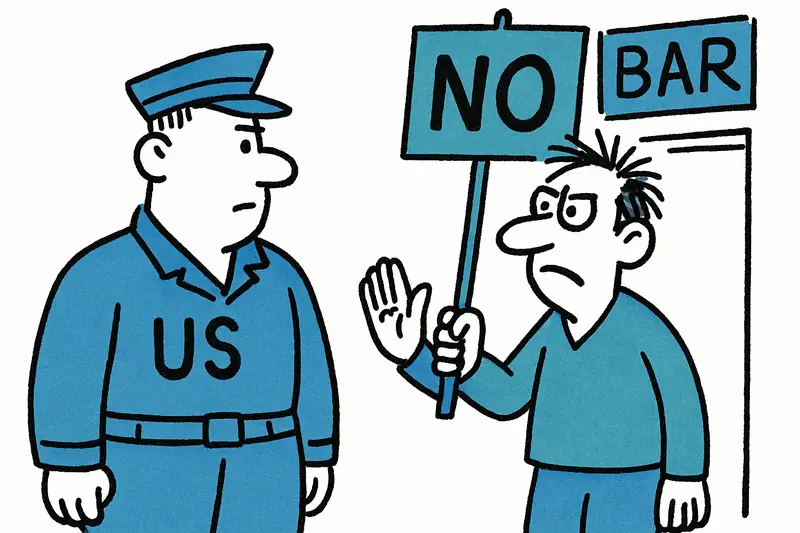
"US Army? No, gracias" – A small sign, big questions for Palma
A handwritten sign on a bar in Palma's old town sparks debate: How much of a stance may or must hospitality show when military personnel visit the island? An investigation between pragmatism, principles and everyday life.
A small sign, big questions – Palma between principle and economy
Last Friday Palma hadn't fully woken when the USS Gerald R. Ford rolled into the bay (see 4,500 US Marines in Palma) and the old town suddenly smelled of boots, sunscreen and cold drinks. On the Passeig del Born glasses clinked around midday, the church bells rang on the Plaza Cort, and vendors sold T‑shirts with ship motifs. In a narrow alley, no more than ten minutes from the town hall, a handy sign hung on the door of a small bar: "US Army? No, gracias." A sentence as short as a knife‑thrust — and yet only paper. The discussion, however, was larger than the sign itself.
The question behind the sign
The central question is simple and at the same time difficult: May or must a hospitality business refuse entry to people in uniform? For the owner of the bar, who stood at the counter when I met her and wanted to remain anonymous, the answer was clear: "It's our decision, we don't want that in our place." She also knew the price: less turnover, perhaps harsher reactions in the neighbourhood, and the uncertainty about how this affects staff and nearby residents. On the other hand, restaurants on Playa de Palma and in Magaluf reported being very satisfied: full tables, tips and a short extension of the season.
More than a moral stance – economic realities
What is often overlooked in the loud debate about taking a stance is the economic perspective: many businesses live from what comes in the short term. Especially in the low season, when the island adjusts to the quieter pace of October, unexpected guests are economically welcome. At the same time Palma faces an image problem; residents complain about rising prices, noise and the commercialization of historic streets, and debates over the defense-interest status at Son Sant Joan colour local discussions. A sign that excludes uniforms thus becomes a symbol of a deeper question: How does the island find a way to deal with external forces without endangering the everyday existence of local businesses?
What the debate rarely sheds light on
1) Legal situation: In Spain there is no general obligation for restaurateurs to admit guests, as long as this does not amount to prohibited discrimination. But what counts as discrimination in this context? The line between legitimate expression of values and unlawful exclusion is narrow and hardly tested in court. 2) Security and staffing issues: Employees are suddenly confronted with conflicts — from unclear instructions to aggressive guests. Staff need training and support. 3) Long‑term consequences: A single sign can become a PR problem, local loyalties can shift, and sometimes aftereffects remain in online reviews and travel forums that influence future visitors.
Concrete options instead of blanket judgments
Those looking for solutions will not find them in slogans but in everyday practice. A few proposals that city politics and the industry could tackle together:
Municipal code of conduct: A voluntary guide for hospitality businesses that explains how to deal with external groups — military, tour groups, rugby teams. Not a regulation, but orientation.
Transparent labelling: Those who take a clear stance should communicate it openly and in several languages — so guests know what to expect and staff are not suddenly left to decide on the spot.
Dialogue forums: Round tables at city level where residents, hosts, unions and the local administration negotiate the balance between economy and urban life. Such conversations could defuse conflicts before they end up on doors and signs.
Training for staff: De‑escalation, legal basics and handling discrimination‑related conflicts — this strengthens teams and reduces the risk that small signs lead to large escalations.
Palma as a stage for bigger questions
The scene that evening was typically Mallorcan: a few young people singing, a moped rattling somewhere, and a light breeze carrying the scent of frit mallorquí and espresso through the alleys. The sign was small, the discourse large. In the end the debate reflects something fundamental: Palma is an island that lives from visitors but is also a living space with ordinary worries and principles. It's not just about a single warship, but about how society decides which guests are welcome, what concepts of public space apply and how economic pressures are weighed against ethical ideas.
Maybe the result is unspectacular: different answers for different streets. But a little more conversation, a bit more planning and clear rules would help resolve the next controversy faster, calmer and more fairly. With a cortado at the bar next door, of course.
Keywords: USS Gerald R. Ford, Palma, gastronomy, militarism, urban life
Frequently asked questions
Can a bar in Mallorca refuse service to people in uniform?
Why did a small sign in Palma cause so much debate?
How important are military visits for restaurants in Mallorca?
Is Palma more affected by tourism pressure than other parts of Mallorca?
What should staff in Mallorca do if a guest refuses to respect a house rule?
What are the risks for a bar in Mallorca that puts up a political sign?
What could Palma do to avoid future disputes between locals and hospitality businesses?
Is October a good time for bars and restaurants in Mallorca to rely on walk-in guests?
Similar News

Rent explosion in the Balearic Islands: Why prices rose so sharply between 2020 and 2025
New data from the Observatori show: the average rent for new contracts in the Balearic Islands was €1,390 in 2025 — almo...

First Day, First Consequences: What Palma's Rent Freeze Really Means
A new decree stops a planned eviction in Palma — but what really changes for tenants and landlords? A reality check with...

When Housing Becomes a Matter of Survival: Mallorca Between Rental Frenzy and Everyday Life
The case of 87-year-old Maricarmen showed that on Mallorca many people's lives are poised between affordable and uninhab...

Autumn in Mallorca: When Melancholy Gets a Window
Why autumn quietly tightens here — and how to make use of the mood: walks, culture, candles and the light from Palma to ...

Near-miss on Lanzarote: Landing Ryanair Jet and Iberia Takeoff — what really went wrong
On Lanzarote there was a dangerous incident: A Ryanair flight (FR5910) from Dublin landed on runway 03 while an Iberia E...
More to explore
Discover more interesting content

Can Cap de Bou

Townhouse Lleo 72
