
When the Village Street Became a Flood: What Storm Adam Reveals About Mallorca's Vulnerability
When the Village Street Became a Flood: What Storm Adam Reveals About Mallorca's Vulnerability
Roaring water turned Carrer de Palma in Consell into a torrent on 19 October; on the coast beachgoers helped prevent a sailboat from capsizing. A reality check: what worked — and what still needs to be done so Mallorca isn't caught off guard by the next heavy downpour?
When the Village Street Became a Flood: What Storm Adam Reveals About Mallorca's Vulnerability
Reality check after a week of storms: Consell, Palmanova, Sóller – images, questions, solutions
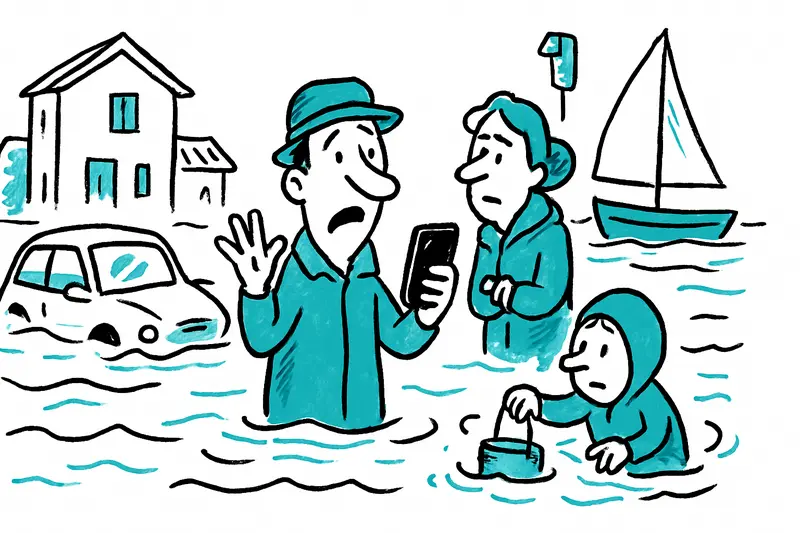
On the afternoon of Monday, 19 October 2026, everything in Consell suddenly sounded like another life: instead of car horns there was the patter of rain, instead of voices only the water drumming against house facades. For minutes the Carrer de Palma became a strong current; residents stood at the curb, photographed with their phones, shook their heads at soaked doorways and cars, and in several ground floors water was already standing on the floor. At the same time, a single-masted boat ran aground on the coast at Palmanova. People on the beach gave up their swim breaks, dug with their hands in the sand and held the boat steady until professionals from the harbor could help.
Key question: Was this just a natural event — or does it reveal a structural failure in prevention and adaptation?
In short: both. The national weather service Aemet reports that very large amounts of rain — up to 300 liters per square meter — fell south of Mallorca over the sea. A so-called mesoscale convective system, which originally formed over Ibiza and Formentera, moved on and released much of its moisture over the water. That was fortunate for the island, because the effects were much harsher on Ibiza and Formentera, where nearly 200 liters per square meter fell regionally and caused severe flooding. On Mallorca there were locally heavy downpours and gale-force gusts; gusts of up to 86 km/h were recorded in the port of Sóller.
Critical analysis: Weather situations like this are natural, but their consequences are by no means entirely unforeseeable — and in part avoidable. Aemet provided forecasts, and the regional government ordered the suspension of classes in view of the models. That is the right practice: precautionary school closures can save lives. But the images from Consell make clear that warnings alone are not enough when physical infrastructure cannot drain water quickly enough.
What often gets too little attention in public discussion is the everyday perspective: residents of small towns know where the storm drains clog, where natural gullies run on either side of the road and when maintenance was last carried out. These are not glamorous topics — but they determine whether water flows into houses or soaks away in designated retention areas. Also rarely discussed is the question of harbor security: Palmanova showed how vulnerable small yachts are in rough northerly seas when they are inadequately moored or waves wash unimpeded onto the beach.
Everyday scene: In Palmanova the air smelled of damp pine wood and sea salt. Teenagers in flip-flops stood ankle-deep in the sand shouting instructions, and an older woman pulled her jacket tighter while a child bailed water out of a boat entrance. In Consell neighbors sat on a low wall, dried photos, exchanged tips on raising furniture and where to get sandbags. These scenes show something important: first help often comes from the people on site — neighbors, beachgoers, shopkeepers.
Concrete solutions — not appeals to vague demands, but practical steps:
1) Municipal risk checks and prioritization: Every place, starting with small municipalities like Consell, needs a prioritized list of weak points: overflowing storm drains, blocked barrancos (gullies), low bridges. A simple inspection before the rainy season — and a publicly accessible map of danger points — would drastically reduce response time.
2) Regular maintenance instead of emergency repairs: Many damages occur because drains and sewers are not cleaned in time. A fixed maintenance cycle, anchored in the town hall with a clear budget plan, prevents leaves, plastic and sediments from combining into a deadly mix in autumn.
3) Promote natural water retention: Small retention basins, strictly protected vegetated zones on mountain slopes and increased reforestation reduce peak runoff. Such measures cost less than rapid repairs after floods and can be implemented locally.
4) Secure harbors and berths: For beach sections with frequent boat traffic, simple standards should apply: stronger mooring lines, inspected anchoring points and warning signs during storm alerts. Volunteer boat clubs can coordinate emergency plans with municipalities.
5) Define communication chains clearly: Warnings must reach people in everyday language — by SMS, loudspeakers in villages, notices posted at schools and harbors. Not everyone sees social media posts; older people and seasonal workers often do not. The decision to close schools was correct; it would be better, however, to have a standardized template for informing parents, small business operators and commuters.
And finally: drills build preparedness. Municipalities should conduct annual storm drills, train volunteers and keep simple aid packages on hand (sandbag stations, emergency numbers). That takes time, but less than cleaning up after the next Carrer-de-Palma flood.
Punchy conclusion: The storm showed us how closely extreme weather and human organization are intertwined. Aemet provided the forecast, and fortunately most of the rain fell over the sea. But the images from Consell and Palmanova remind us that forecasts are only the first step. If we do not want to rely on luck next time, we must invest in infrastructure, preparedness and the small, practical measures that make local communities more resilient. Otherwise the next storm will again be a test we barely pass.
Frequently asked questions
What weather conditions led to Storm Adam's rainfall on Mallorca?
What practical steps can Balearic municipalities take to reduce flood risk?
Why is regular maintenance of drains and sewers crucial in Mallorca’s autumn storms?
How should Mallorca secure harbors and boat berths during storms?
How are storm warnings communicated to residents in Mallorca during extreme weather?
What did the flooding in Consell reveal about local preparedness in small Mallorca towns?
What happened to the boat in Palmanova during Storm Adam?
What practical steps can individuals take to prepare their homes for heavy rainfall in Mallorca?
Similar News
Krümel in a celebratory mood: How Peguera danced at the season closing
With accordion, glitter and an international audience: Marion "Krümel" Pfaff combined her birthday with the season-closi...
After the bathing accident off Formentera: Should the rescue network have acted faster?
The widow of the 64-year-old swimmer levels serious accusations: delayed rescue, no flag on the tower and a 112 that was...
Probation sentence after 575 euros taken from a wallet in Marratxí: Is returning the money a mitigating factor?
A woman took 575 euros from a wallet left at a Marratxí gas station. She confessed, returned the money and received a fo...
Fire at the Son Hugo Parking Lot: When a Neighbourhood Dispute Becomes a Fire Catastrophe
Three motorhomes in the parking lot by the Son Hugo indoor pool burned out completely. Police suspect arson following a ...

DANA on the Way: When Mallorca Will Get Wet and Stormy — and How We Should Respond
AEMET announces a DANA: From Sunday onward, locally very heavy, persistent rainfall, thunderstorms and strong winds are ...
More to explore
Discover more interesting content

Can Cap de Bou

Townhouse Lleo 72
