
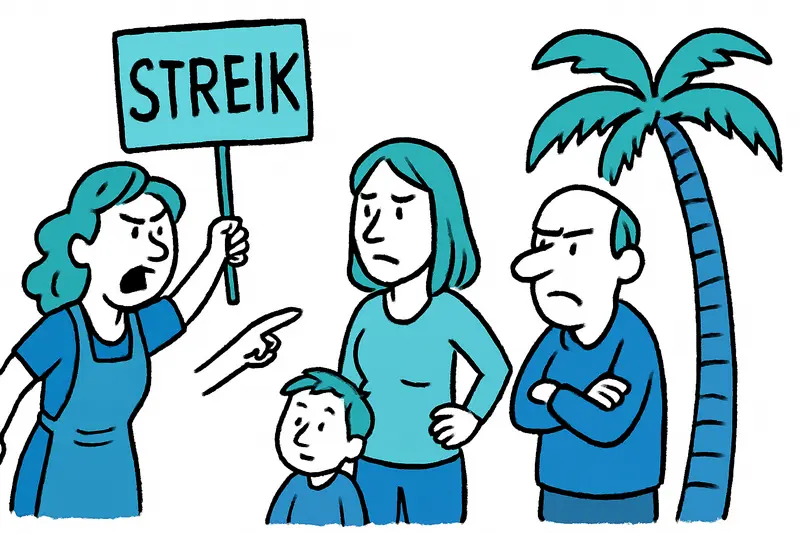
Warning strike in daycare centers: How fair is childcare in Mallorca?
Warning strike in daycare centers: How fair is childcare in Mallorca?
Another day of strikes in the public daycare centers of the Balearic Islands: employees demand higher wages, binding staff-to-child ratios and a regional collective agreement. What does this mean for families, politics and everyday life on the island?
Warning strike in daycare centers: How fair is childcare in Mallorca?
Guiding question: How can we create a daycare system in Mallorca where children are well cared for and staff are paid fairly, without families bearing the main burden?
What is happening tomorrow?
Tomorrow a wide-ranging warning strike is threatened in the public daycare centers of the Balearic Islands, including Mallorca, where around 43 percent of children under three now attend a daycare center in the Balearic Islands. Trade unions have called on employees to stop work. The core demands are clear: higher wages, binding rules for staff-to-child ratios and a dedicated collective agreement for the Balearics. According to the announcement, employers and unions are stuck in deadlocked negotiations. The regional government has agreed minimum services for the strike period. In parallel, demonstrations are planned for 6:00 pm at Plaza España in Palma and on Ibiza.
Brief analysis: Why is it escalating now?
The situation is the result of several long-standing problems. Local reporting has also pointed to demographic pressures, as in When the strollers are missing: Mallorca's quiet demographic wake-up call. First: wages in early childhood education are often below the regional average, even though the work is highly demanding. Second: staffing ratios are not binding in many places, so educators have to cope with too many children at once. Third: without a specific collective agreement for the Balearics there is little room for regionally adapted solutions. All this leads to overload, high turnover and gaps in provision, especially in neighborhoods and municipalities that lack sufficient financial flexibility.
What is missing from the public debate?
Three topics are often under-addressed: the actual staffing numbers on site, the working conditions beyond salary (e.g. further training, preparation time) and the distribution of costs between regional government, municipalities and parents. Specific figures on group sizes at individual locations are rarely discussed — yet daily operations in a daycare determine whether care is perceived as adequate. Second, there is a lack of a clear conversation about qualification and career paths: who will stay in the profession if there are no prospects? Third, the question remains how financial relief for low-income families can be secured in the long term without lowering quality.
What does this look like in everyday life? A scene from Palma
Early in the morning in front of a daycare near the Plaça d'Espanya: parents with bicycles, a child clutching a soft toy under their arm, the scent of fresh coffee from the bar next door in the air. Colorful backpacks sit on the pavement, and through a window you can hear a faint children's song. The door opens, two educators juggle greetings, a colleague is missing — she is sick and no replacement can be found. Such mornings are not unusual here. For many families the daycare is more than childcare: it is part of the daily structure that makes work, school and shopping possible.
Concrete approaches to solutions
The debate needs less blanket rhetoric and more realistic steps. Proposals that could take effect immediately:
1) Binding staff-to-child ratios: Municipalities and the regional government should set clear minimum ratios adapted to group composition (age, special needs). This creates predictability for staff and parents.
2) Regional collective agreement: A dedicated agreement for the Balearics would allow wages and working conditions to be adjusted to local living costs and seasonal particularities.
3) Transition plan for staffing needs: A five-year plan with clear hiring targets, incentives to return to the profession (e.g. part-time models, recognition of professional development) and transparent budgets for municipalities.
4) Open data and transparency: Available figures on staff-to-child ratios, sick leave and staffing levels should be publicly accessible. This facilitates discussion and prevents speculation.
5) Support for families: In the short term, flexible opening hours and emergency care offers (also at central locations in Palma) could help cushion the hardships of a strike day.
What can parents do now?
Practically that means: ask your municipality whether minimum services are being organized; form networks in your circle of acquaintances to cover care shortages; inform your employer early about possible absences. Those who can should consider alternatives to striking: swapping drop-off or pick-up times, setting up shared emergency groups with other parents. At the same time, it is fair to take the legitimate demands of staff seriously — they concern the quality of care from which all children benefit.
Concise conclusion
Tomorrow's warning strike is more than a single dispute about money. It exposes structural problems: underfunded services, too few binding rules and a lack of regional solutions. If politics does not act now, the quality of early childhood care risks suffering permanently — and with it the everyday viability of many families on Mallorca. It is time for clear figures, transparent division of responsibilities and a plan that protects staff and relieves parents.
Frequently asked questions
What is the daycare strike in Mallorca about?
Will daycare centers in Mallorca be open during the strike?
What should parents in Mallorca do if their daycare is affected by the strike?
Where is the daycare strike demonstration in Palma?
Why are daycare workers in Mallorca asking for a separate collective agreement?
How do childcare ratios affect daycare quality in Mallorca?
Is daycare in Mallorca affordable for families with low incomes?
What long-term changes could improve daycare in Mallorca?
Similar News

Magaluf: Watchtower Alarm – Lifeguards Pull Unconscious Beachgoer from the Water
After a drama in the late afternoon, two lifeguards at Magaluf beach rescued an unconscious 44-year-old man. He was stab...

Turquoise in the City: How dangerous is the color play of the Sa Riera?
The Sa Riera in Palma suddenly turned turquoise — a pretty motif, but behind the effect lies a discharge of saline waste...

Jeckliner at Sunnesching: Cologne spirit sets sail from Palma
In September 2027 the Mein Schiff 2 briefly becomes a floating carnival stage: four days with Cologne bands, comedy and ...
Finally Home: Mike and Leyla Heiter Buy Villa with Sea View in Mallorca
The reality TV couple Mike and Leyla Heiter have bought a house in Mallorca with a roof terrace and sea view. An Instagr...

Arrest after series in Palma: Who protects apartments from repeat offenders?
The National Police arrested a man in Palma who investigators say may have broken into several apartments. In one incide...
More to explore
Discover more interesting content

Can Cap de Bou

Townhouse Lleo 72
