
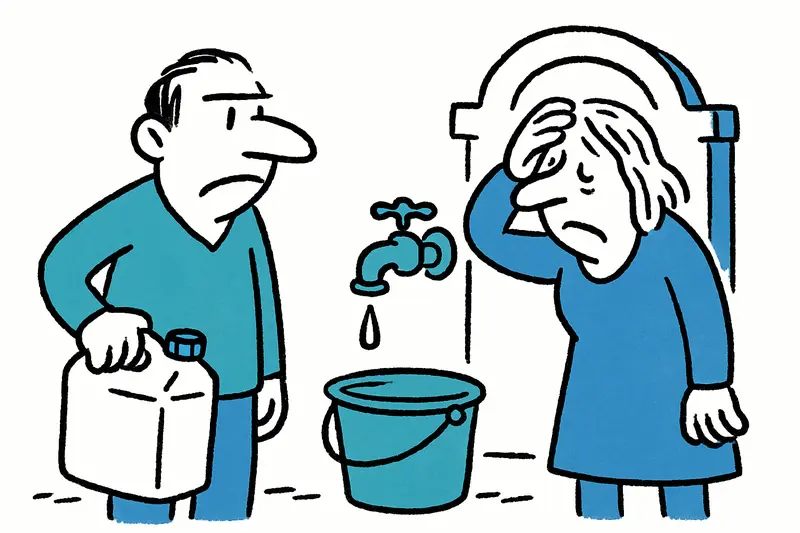
Valldemossa on the drip: When jerrycans are louder than tourist walks
This autumn Valldemossa's tap water is running low. Between short-term conservation measures and the need for structural action, unanswered questions remain — from prioritization to emergency power for pumps. A local look at causes, blind spots and concrete measures.
Valldemossa on the drip: the village, the jerrycans and the quiet warning signs
Anyone who climbs the steep steps to the charterhouse in the morning right now hears more than the church bell: the clattering of plastic jerrycans, the whir of a small generator and the distant murmur of tourists on the plaça. In parts of Valldemossa, tap water now only comes sporadically; in the upper streets it has already run dry, as detailed in a report that parts of Valldemossa are already without running water. Buckets are being filled, neighbors carry bottles through narrow alleys — scenes more typical of an August heatwave than the mild October.
Key question: temporary failure or structural breakdown?
Several factors have come together in the short term: an unusually long dry spell, low groundwater levels and a past power outage that forced pumps into power-saving mode. The result: reservoirs barely fill and distribution is throttled. At the same time, sunny days with day-trippers and short-term rentals raise consumption — a bad mix.
In the long term, however, more is at play. Old pipes lose water, storage is limited, and distribution policy hardly considers a priority list for critical uses. Valldemossa thus stands as a representative case for problems in the Tramuntana: Estellencs, Sóller and other mountain villages report similar symptoms.
What is missing from the debate
Public discussion mostly revolves around acute measures — pressure reduction, bans on garden watering, emergency deliveries by tanker. Important questions remain unanswered: Who has priority when water is scarce — care homes, individual households with medical needs, livestock keepers? Are there automatic emergency power solutions for pumps so that a power outage does not cripple the entire system? And how fair is it when water pressure is distributed along contour lines and the upper streets are left empty?
Another blind spot is tourism: short-term rental hosts and day visitors increase peak consumption without effective short-term controls or price signals. There is also often a lack of clear sequencing: when does the municipality resort to tanker deliveries, and according to which objective criteria are they triggered?
Concrete immediate measures that could help
Some steps could be implemented immediately — if carried out consistently:
- Create a prioritization map: A visible map (town hall, online portal) showing priority zones creates transparency: nursing care, households with limited mobility and drinking water stations are at the top.
- Use mobile tankers more targetedly: Instead of broad deliveries, fixed delivery windows should be introduced for particularly affected streets — mornings at the plaça, evenings for the higher areas.
- Secure emergency power for key pumps: Generators or battery storage for selected pump stations prevent a single grid failure from emptying entire reservoirs.
Medium- and long-term orientations
The current shortage makes it clear: temporary saving rules cannot be the only response. Valldemossa needs a series of structural measures:
- Decentralized cisterns and rainwater storage: Small household and commercial cisterns smooth consumption peaks; subsidy programs could promote rapid adoption.
- Leak detection and network modernization: Old pipes often lose water unnoticed. Smart metering, targeted renewals and continuous monitoring save water and money in the long run.
- Renewable energy for pumps: Solar-powered pump stations and battery storage reduce dependence on the grid and increase resilience against power outages.
- Seasonal consumption management: Fair tariffs or temporary surcharges in high season could reduce peaks — politically sensitive, but technically feasible and economically effective.
What the municipality is already doing — and what it should explain
The town hall has already reduced pressure, banned garden watering and announced emergency plans for tanker deliveries. That helps in the short term, and local coverage noting reduced pressure and bans on private pools provides further detail. But communication remains patchy: at what threshold will further restrictions be imposed? Which criteria trigger tanker deliveries? And how will responsibility for accommodation providers and short-term renters be regulated? Greater transparency would build trust and better coordinate neighborhood assistance.
How the neighborhood is responding
On the Carrer de la Cartoixa pragmatic solutions are emerging: shopkeepers ration coffee, older residents haul jerrycans from the municipal source, younger households install provisional rainwater catchment systems on balconies. Solidarity is tangible — the clatter of jerrycans mixes with the rustle of pine trees and the soft murmur of passing tourists. But patience is limited. Many ask: will the makeshift solutions last until the next rain?
An opportunity for change
The crisis can serve as a wake-up call. Valldemossa has the chance to lead by example: with decentralized storage, smarter technology, clear rules for tourism and transparent decision-making processes. If action now means not only reacting but planning and investing, the village can use this episode as a starting point for greater resilience — rather than a recurring story of jerrycans and discontent.
Conclusion: In the short term, the call is to save, prioritize and act in solidarity. In the medium and long term, political decisions are needed, investment programs for cisterns, intelligent pump control and emergency power concepts. Rain alone is not enough — without structural changes Valldemossa will remain vulnerable. And that would be a pity: the village deserves more than provisional jerrycan solutions.
Frequently asked questions
Why is there a water shortage in Valldemossa?
How long does the current water shortage in Mallorca villages usually last?
Can you still drink tap water in Valldemossa during a water shortage?
What water restrictions are usually introduced in Valldemossa?
Why do the upper streets of Valldemossa run out of water first?
Is Valldemossa a good place to visit during a water shortage?
How are Mallorca villages like Sóller and Estellencs affected by water shortages?
What long-term fixes could help Valldemossa with water supply problems?
Similar News
When Rescuers Stand Down: Why the Lifeguards' Strike in Calvià Is More Than Just a Loud Bang
Lifeguards in Calvià have called a strike for August 23. What's behind the conflict, what risks are looming — and what i...
Pickpocketing at Ballermann: What the intervention of two off-duty police officers shows
Two off-duty officers stopped two suspected pickpockets near Playa de Palma and secured the victim's phone and wallet. T...
Short Jump, Big Fright: Pregnant Holidaymaker Falls on Rocks at s'Arenal
A 29-year-old British woman, ten weeks pregnant, jumped into the water near the jetty at s'Arenal on Monday afternoon — ...
Who Pays the Price? Why Holidaymakers in Mallorca Are Now Skimping on Excursions and Taxis
Several bus companies report idle capacity, and taxi drivers notice more cautious guests. Our guiding question: How deep...

Off-duty police officers stop thieves at Ballermann – a reality check
Two off-duty police officers observed on Playa de Palma how two men stole a tourist's phone and wallet. What does the in...
More to explore
Discover more interesting content

Boat Tour with BBQ along Es Trenc Beach

Private transfer from Mallorca Airport (PMI) to Pollensa
