
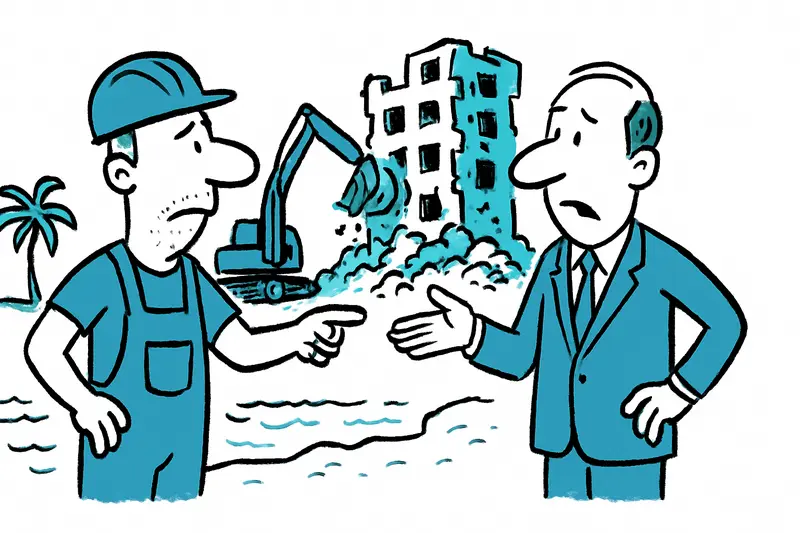
Demolition in Bendinat: Who Really Clears Up Mallorca's Coastal Burdens?
The Balearic government has approved the demolition of a multi-storey complex in Cala Oli/Bendinat. Who is responsible for years of tolerated illegal coastal development — and is a dismantling alone sufficient?
Demolition in Bendinat: Who Really Clears Up Mallorca's Coastal Burdens?
Key question: Is the planned dismantling of a house at Cala Oli sufficient, or will the site remain the same — only without walls?
The essentials first: The Balearic government has authorized the removal of a multi-storey residential building in Cala Oli (Bendinat district, municipality of Calvià). The building dates from the 1960s, an original permit is from 1963 and, according to authorities, is no longer valid. About 195 square meters of built area will be dismantled, including stairs and terraces — new construction on the site is explicitly not allowed. Technical reports cite safety deficiencies and the risk of further damage to the coastal strip as reasons.
The decision sounds simple on paper: enforce the law, remove the wall, return the coast. In reality, however, many issues hang on cases like this: property relations, inheritance, often decades-long habits of local residents, the costs for the public purse and the question of how the coast will actually be restored afterwards.
Critical analysis
First: responsibilities are entangled. That a building permit existed in the 1960s says nothing about later interventions, alterations or changes of use. Was oversight insufficient for decades? Probably. Authorities tolerated much during the tourism boom of the 20th century that current protection rules would no longer allow. Second: demolition does not automatically mean restoration. When stairs, terraces and retaining walls are removed, poorly secured slopes often remain, which can slide away after heavy rain. Third: social resistance cannot be planned away. Residents who have come here for generations or even live here see part of their daily life disappear — even when the legal situation is clear. In other coastal towns such conflicts have already triggered administrative processes and legal delays, as seen in Demolition in Palma: When Reconstruction Replaces the Original.
What is missing in the public discourse
Debates focus on one buzzword: demolition. Rarely is it clearly discussed who will bear the costs of dismantling and how the area will be secured and rewilded afterwards. There is no open plan for handling debris, protecting sensitive vegetation and restoring public access. Also little discussed is a systematic inventory of similar old coastal buildings. Without an inventory the pattern repeats: a permit fades, the building fabric decays, years pass, and then the administration must act — to the frustration of many, for example Calvià plans demolition of eleven vacant shops in Magaluf.
A scene from Bendinat
If you drive the small coastal road between Portals Nous and Bendinat in the morning, you hear seagulls, the distant hum of motorboats and the clink of coffee cups on a bar terrace at the roundabout. Retirees sit on benches, dogs are walked, sailing students launch their boats. Exactly where construction took place in the 1960s, proximity to the sea is today both an attraction and a problem. The people who take their walks here want views, access and safety, not crumbling steps that lead to nowhere.
Concrete approaches
1) Transparent schedule: The municipality must present a clear timeline together with the responsible ministry — demolition, disposal, stabilization, renaturation — with deadlines and a cost breakdown. 2) Public consultation: Information days for residents should take place before work begins so uncertainties and social consequences can be discussed openly. 3) Ecological follow-up: After dismantling the coast needs technical protection (e.g. stabilization works), followed by planting with native species and erosion monitoring. 4) Preventive strategy: An island-wide inventory of all fragile coastal buildings would help address similar cases in an orderly manner instead of dealing with them one by one. 5) Clarify financing: It must be transparent who will cover demolition and renaturation costs — owners, municipality or regional funds — and how this is legally secured.
Concluding points
The demolition in Bendinat is not merely an aesthetic act; it is part of a larger question: How does Mallorca protect its coast without making local people feel left behind? Law must prevail. But the law must also be accompanied by practical plans and clear communication. Otherwise a cleared house will remain just a gap while the causes of uncontrolled coastal construction remain untouched.
If authorities now act differently than they did in previous decades, the dismantling could become a fresh start for this coastal section, similar to Calvià Cleans Up: Demolition Instead of Holiday Hotels — Green Spaces for Paguera and Magaluf?. If not, another ruin will soon be on the list — and the same struggle will begin again.
Frequently asked questions
What is happening to the old building at Cala Oli in Bendinat?
Why are old coastal buildings in Mallorca being removed?
Does demolishing a house on the coast in Mallorca mean the land is restored automatically?
Will new construction be allowed after the Cala Oli demolition in Bendinat?
Who pays for demolition and coastal restoration in Mallorca?
How does demolition in Bendinat affect local residents?
What should happen to a demolished coastal site in Mallorca afterwards?
Is Mallorca planning a wider inventory of fragile coastal buildings?
Similar News

Who Bears the Burden? Mallorca Between Tenant Protection and Landlord Fears
Madrid's new housing decrees strengthen tenant rights — but on Mallorca concern is growing: will the law drive small lan...

On the Edge: What Mallorca's Airport Loses If a Major Low-Cost Carrier Falters
The company that operates numerous connections from Palma to France and domestically is negotiating with creditors to re...
Ballermann star Frenzy wins 'Villa of Temptation' and donates prize money to Mallorca animal rescue
Ballermann singer Frenzy won the German reality show and donated the remaining prize money — around €14,080 — to an anim...
70 Trees Removed on Avenida Jaume I: What's Happening in Santa Ponça?
On October 1 the final redevelopment phase on Avenida Jaume I in Santa Ponça begins: 70 trees and old streetlights are t...

When a Boundary Is Crossed: The Case of Isi Glück and the Responsibility of Venue Operators
The singer from Mallorca reports an assault backstage in Halle. A clear guiding question, analysis of missing protective...
More to explore
Discover more interesting content

Can Cap de Bou

Townhouse Lleo 72
