
New Mandatory Breakdown Light in Mallorca: Heat Can Disable the Device — What You Need to Know and Do Now
New Mandatory Breakdown Light in Mallorca: Heat Can Disable the Device — What You Need to Know and Do Now
The new V-16 warning light is mandatory, but its 9-volt battery can fail in summer. Key question: Who is liable if the light doesn't work in an emergency? Clear tips, a critical assessment and practical solutions for Mallorca's heat.
New Mandatory Breakdown Light in Mallorca: Heat Can Disable the Device — What You Need to Know and Do Now
Key question: Who is left stranded if the light fails in high summer?
Since the beginning of the year, the V-16 warning light has complemented the classic warning triangle in Spain as the prescribed replacement device. Anyone caught without an approved device pays a fine of 80 euros. At first glance a sensible modernization. For more background on the new obligation see V16 Warning Light: What Will Be Mandatory in the Glove Compartment in Majorca from 2026 — a Reality Check.
Critical analysis: Most V-16 devices operate with a small 9-volt alkaline battery. Due to chemistry, the performance of such batteries shrinks when exposed to high temperatures for extended periods. If a car stands in the midday heat on the Paseo Marítimo or in the Calas parking bay, the interior temperature of the vehicle can rise well above 50 °C. In this situation there is a real risk that the battery will be significantly more discharged or that the light will not reach full brightness when used.
What is missing here: public discourse and official guidance have so far focused on the obligation itself and the fines. Communication about how the devices should be stored, checked and protected from heat in everyday use is thin — practical handling and rental-car rules are discussed in V16 Mandatory in Mallorca: What Drivers Really Need to Know. Dealers and manufacturers are often silent about how robust the installed batteries really are — and what happens during long-term parking in the sun.
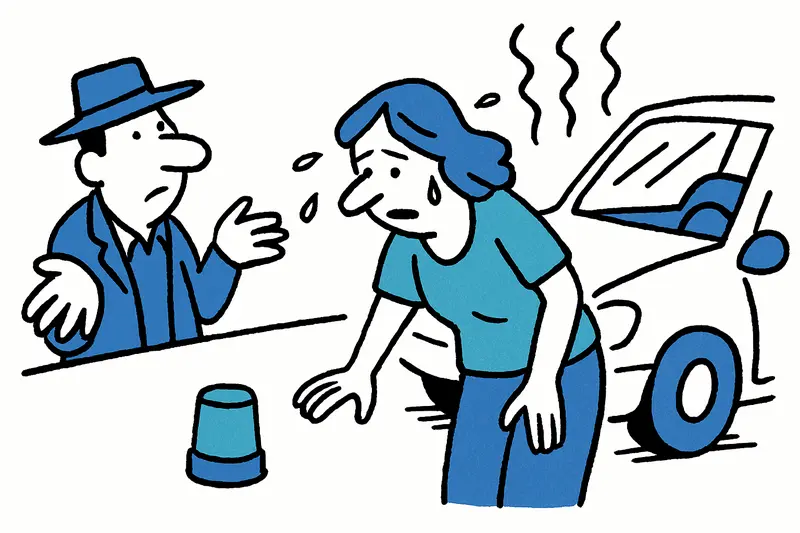
Everyday scene from Mallorca: Imagine the MA-13 on a July afternoon: endless lines of cars, tourist convertibles with tinted windows, and a parked family car on the hard shoulder. The mother gets out, puts beach towels on the back seat, takes the V-16 out of the glove compartment — and only on the highway notices that the hours of sun and heat have finished off the small battery. Then you stand at the roadside with sweaty hands, the light there, battery low — and the clock is ticking.
Concrete approaches: First: Check your V-16 now before the heat arrives. Many devices can be briefly tested at home; most manufacturers state how a functional check looks. Second: Do not store the light permanently in direct sunlight or on a hot windowsill. A place in the center console, in the compartment under the seat or in the trunk, protected in a small bag, reduces temperature peaks. Third: Replace the battery before the summer season or look for models with better battery types (attention: use only approved models). Fourth: Keep a warning triangle in the trunk as redundant protection — it is no longer mandatory, but reliable in case of doubt.
Technical notes without guarantee: Alkaline batteries react more sensitively to heat than some lithium cells. That does not mean every V-16 will fail immediately, but the likelihood of reduced performance increases. If unsure, ask the manufacturer for operating temperature specifications when buying and request a CE or homologated product.
Legal note and everyday practice: The fine of 80 euros for not carrying the device is real. Greater sanctions threaten for misuse of the hazard lights: anyone who uses them abusively to justify parking in a second row or unnecessary stops can be fined up to 200 euros. Conversely, it is also problematic if a prescribed light is physically present but non-functional in an emergency.
What is missing in public discourse: a clear chain of responsibility. Who must inform — manufacturers, dealers, traffic safety authorities? There is no simple recommendation for end users: How often to test? Which battery to replace? Where to store? Mallorca does not need additional confusion on hot days, but clear and easy-to-implement guidance that can be distributed at parking booths, on ferries and in tourist information centers.
Concrete proposals to authorities and retailers: 1) Publicly visible notices at car parks and toll booths with storage tips and testing instructions. 2) Points of sale should offer a short function test at purchase and hand out written storage instructions. 3) A simple information campaign by the traffic authority — also multilingual — with a summer checklist: check the battery, carry a spare battery, store the device in the shade, keep a warning triangle as backup.
Conclusion, concisely: The V-16 is a modern solution in itself. Without pragmatic rules for storage and without a minimum of consumer instructions, however, it risks becoming an empty promise at the hottest moment. In Mallorca, where the sun is often harsher than elsewhere, the response should not consist only of sanctions but of practical help: test, protect, inform — otherwise all that's left is the fine and congested traffic.
Frequently asked questions
Can Mallorca heat stop a V-16 warning light from working properly?
How should I store a V-16 warning light in Mallorca during summer?
Do I still need a warning triangle in Mallorca if I have a V-16 light?
What happens if I drive in Mallorca without an approved V-16 warning light?
How can I check if my V-16 warning light still works before summer in Mallorca?
Are V-16 warning lights with alkaline batteries reliable in Mallorca’s heat?
Where is the safest place to keep a V-16 warning light in a Mallorca rental car?
Can you get fined for using a V-16 warning light wrongly in Mallorca?
Similar News

"Expensive chaos" and many open questions: What clients can do when a lawyer suddenly stops responding
Several clients complain that a well-known German lawyer in Mallorca has been unreachable for months. Key question: What...

TV tip: 'The Last Problem' — Mallorca as the setting of a classic crime
A classic whodunit on Mallorca: A new miniseries set in spring 1959 brings storm, an isolated hotel and a dense web of s...
Nipping Sea Creatures: Why Bathers in Cala Major and Elsewhere Should Be Cautious
In Cala Major, bathers have reported being nipped by small fish. What is behind it, how can problems be avoided — and wh...
Forced eviction in Santa Catalina: When a 65-year-old slept in her car and showered on the beach — a question of responsibility
The story of Pilar López from Santa Catalina represents a problem affecting many Mallorcans: How can an island with a bo...
New traffic rules from October 1: What Mallorca visitors and locals need to know
From October 1, 2026, Spain will implement far-reaching changes to traffic regulations. Important for Mallorca: greater ...
More to explore
Discover more interesting content

Can Cap de Bou

Townhouse Lleo 72
