
Construction in Santa Catalina: Why Palma's Trendy Quarter Is Now a Dead End
Construction in Santa Catalina: Why Palma's Trendy Quarter Is Now a Dead End
A project planned for just under thirteen months to replace old water and sewer pipes is turning Servet and its surroundings into a motorists' dead end. Why the renovation is necessary — and which questions remain unanswered.
Construction in Santa Catalina: Why Palma's Trendy Quarter Is Now a Dead End
Key question: Does the infrastructure need modernizing — and why do residents and business owners feel so poorly informed?
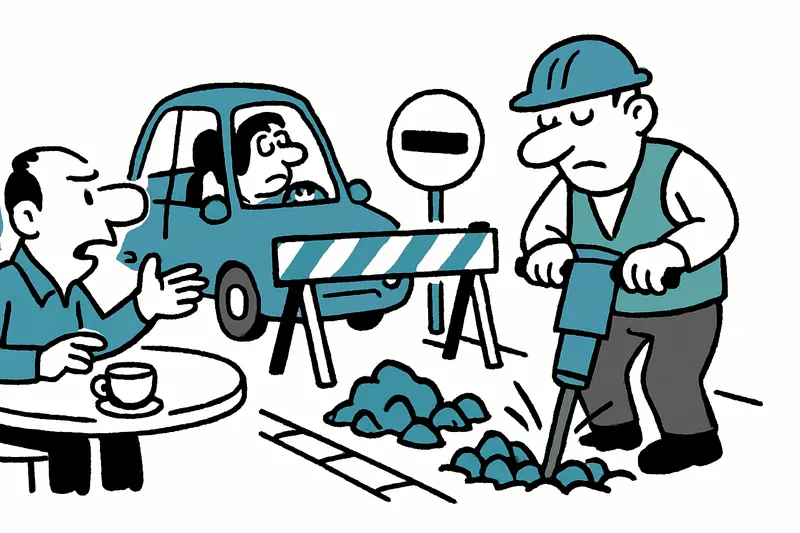
In the morning, when the cafés around the Plaça del Mercat still send the scent of freshly brewed coffee through the alleys and scooters whistle along Calle de Sant Magí, a sign suddenly appears on a narrow side street: "Calle cortada". The barriers in front of Calle Servet are not a short-term nuisance but the start of a major project: Emaya is beginning to renew the drinking water and sewer pipes in parts of Santa Catalina.
The figures are clear: around €1.22 million will be invested, and just under thirteen months are planned. Over a total distance of 1,546.71 metres old pipes are to be replaced — roughly 554.59 metres for the drinking water network and 992.12 metres for the sewer system. The current pipes date from 1986; in the past ten years there have reportedly been 140 emergency interventions (116 in the sewer system, 24 in the drinking water network). More durable pipes made of polyethylene and PVC-U will now replace fibre cement and concrete.
That sounds technical and necessary. For everyday life it so far mainly means: detours, closed parking spaces and reduced traffic flow around Avenida Argentina and the streets Murillo, Caro, Aníbal and Servet. The initial focus is on Calle Servet — which is why cars cannot pass there at the moment. Emaya emphasises, however, that residents may access their private parking spaces.
Critical analysis: The renovation is justified — ageing pipes lead to water losses and emergencies. But planning and communication fall short in some areas. The closures appear to have been decided piecemeal: work crews, excavators and freshly torn-up asphalt cause noise from early morning until the afternoon, delivery traffic is stuck in congestion, and small shops lose customers because parking spaces disappear, echoing complaints from longstanding residents in Santa Catalina. There is a lack of clear alternative routes, reliable time windows for particularly affected sections and information on how networks will be kept stable during peak times.
What is missing from the public discourse is a transparent presentation of risk management. Which works are weather-dependent? Are there time buffers for material shortages? How will older buildings with sensitive drainage systems be treated? The question of financial reserves for unforeseen additional work — for example, if further damage is revealed while digging — is also insufficiently answered. A map with construction phases and a weekly schedule would be extremely helpful for residents and business owners.
A typical everyday scene: the bar on the corner of Avenida Argentina — the owner knows the regular disruptions; she takes out a chair every day to argue with regulars about delivery times. The rubbish collection can hardly be adjusted, delivery trucks have to turn around twice, and the wheelchair user from the third floor reports that the curb outside her door is now more often provisionally fixed — not ideal for mobility.
Concrete short-term solutions that could be implemented quickly include: better signage with detour routes two streets earlier; fixed delivery time windows; coordinated night or off-peak work in particularly narrow sections to relieve daytime operations; a digital, publicly accessible construction board with progress updates, contact persons and phone numbers; temporary parking spaces in neighbouring streets; and, where technically possible, the use of trenchless methods to reduce excavation and noise.
In the longer term, the city should consider whether similar renewals can be bundled to avoid repeated interventions in the same neighbourhoods, a discussion closely connected to the broader housing shortage in Mallorca. A binding dialogue between Emaya, the municipal administration and a representative circle of residents and business owners would also help to cushion social and economic consequences in a timely manner — for example with eased delivery permits or temporary parking permits.
Conclusion: The renewal of the pipes in Santa Catalina is technically sensible and probably overdue. However, the way it is carried out will decide whether the neighbourhood experiences the coming months as a necessary evil or as an avoidable burden. Anyone walking through the alleys in the morning and hearing the clatter of the excavators sees the bare facts — and wonders whether better planning and more open communication wouldn't pay off just as much as new pipes.
Frequently asked questions
Why is there road construction in Santa Catalina, Palma?
How long will the construction work in Santa Catalina last?
Can I still drive to my parking space in Santa Catalina during the roadworks?
Which streets in Santa Catalina, Palma are affected by the construction?
Why are residents in Santa Catalina upset about the construction?
Is the road construction in Santa Catalina necessary?
How does construction in Santa Catalina affect local shops and deliveries?
What practical help would make the Santa Catalina roadworks easier to live with?
Similar News

Ancient Piece Brought to Light: Guardia Civil Recovers Roman Anchor Fragment off North Coast of Mallorca
Divers from the Guardia Civil recovered a massive iron piece from Roman times off Mallorca's north coast. The roughly 35...

Who Benefits from the Half‑Hourly Flight on the Edge? Aena, Investments and the Island's Interests
Almost one billion euros is flowing into Son Sant Joan. The figures show the scale of investment and expected beneficiar...

Are the Balearic Islands the Southern Border of Europe? A Reality Check on Immigration
The Balearic Islands are again calling for EU aid after a sharp rise in arrivals by sea. Conflicting priorities between ...

"Expensive chaos" and many open questions: What clients can do when a lawyer suddenly stops responding
Several clients complain that a well-known German lawyer in Mallorca has been unreachable for months. Key question: What...

TV tip: 'The Last Problem' — Mallorca as the setting of a classic crime
A classic whodunit on Mallorca: A new miniseries set in spring 1959 brings storm, an isolated hotel and a dense web of s...
More to explore
Discover more interesting content

Can Cap de Bou

Townhouse Lleo 72
