
Nostalgia in Thousands of Postmarks: How Daniel Voelker Builds Images from Stamps in Mallorca
Nostalgia in Thousands of Postmarks: How Daniel Voelker Builds Images from Stamps in Mallorca
Daniel Voelker glues thousands of canceled postage stamps into large-format portraits and abstract fields — a project that gives Mallorca new art stories.
Nostalgia in Thousands of Postmarks: How Daniel Voelker Builds Images from Stamps in Mallorca
A man from Frankfurt, a suitcase full of miniature art and the island as a studio
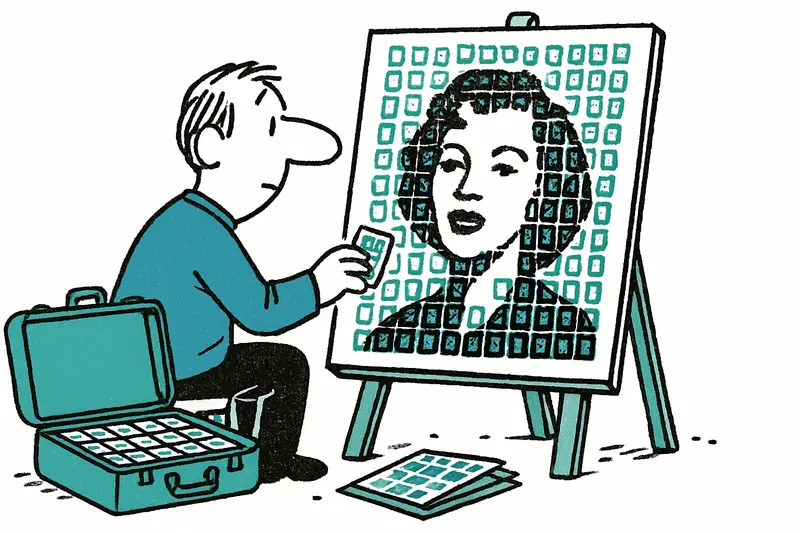
On a mild April evening in Palma, 19°C, a few clouds and seagulls over the harbor, sitting near the restaurant Simply Son Braho you can see a portrait of Marilyn Monroe made up of several thousand postage stamps. Up close you notice the fine cancellations, small spots of color, edges, paper fibers — each piece carries time and use. This is Daniel Voelker's language: not brushstrokes, but stamped fragments of everyday history.
Voelker, born in Frankfurt in 1977, has lived on Bali, in Mexico and the USA. He studied photography design in Munich and worked for many years as a fashion and portrait photographer. Out of this visual language he developed, nearly two decades ago, the idea of composing portraits from stamps. Depending on the format, a picture sometimes requires a few thousand stamps; in larger works it can be ten to twenty thousand stamps.
His working method appears both craft-precise and archaeological: he examines collections, sorts stamps in albums by color and motif, arranges eyes, noses and shadows like movable puzzle pieces and finally adheres the selected stamps to aluminum composite panels. Two to three months are not uncommon for a larger work. It is important to him that the stamps are canceled — that way they store messages, journeys, senders and recipients. For Voelker each stamp is a small story.
His motifs have changed. Where well-known faces from fashion and pop once dominated, he has in recent years often shown unknown people or monochrome fields. In the single-color works he uses a single stamp in large numbers so that an apparently homogeneous surface emerges, which on closer inspection again consists of individually marked pieces. This contrast between unity and fragment is a recurring theme in his work.
When asked why he settled in Mallorca, Voelker replies simply: the island lives art differently. In the first weeks he and his family visited dozens of places, discovered sleepy bays, lively weekly markets and small studios in Palma's alleys, a city whose past is visible in Palma, silently beautiful: A walk into the city a hundred years ago. The people here are open, curious and willing to give art a chance; that surprised and attracted him. It is the feeling of space and a small artist community that gives him energy: a morning café on the Born, afternoons sorting stamps with the balcony door open and the sound of passing mopeds.
The project has practical prospects for the island: it connects collectors, antiquarian shops and local exhibition spaces. Whoever inherits an album in a neighborhood may now think first of a new home for the stamps instead of a drawer. Galleries and restaurants receive works that attract audiences because they are easy to read and yet endure; the local scene is examined in When Pictures Lie: Why Mallorca's Art Market Must Rethink Now. Above all, such a work brings stories into the city: of letters that once traveled across continents, of fashion designs from past decades and of small everyday moments.
Voelker's plan for the future is clear: in the coming years he wants to create a work made exclusively from Spanish stamps and thus lay a kind of local homage to the country's cultural history. Until then he remains on the island, sorting, gluing, showing his images in cafés and small galleries, in the same spirit that supports young artists like Nine-year-old from Palma Shows His First Collection of Pictures at Garaje Son Armadams, and enjoying watching people slowly approach a picture. This shared discovery — the slow reading of a large-format mosaic — matches what he loves about stamps: slowness, memory, intimacy.
If you stroll over the Plaça de Cort early in the morning, you hear vendors setting up their stalls, children on their way to school and an artist placing a new stamp into an album. It is such small scenes that have inspired Voelker: art arises where everyday life and memory meet. And that is good news for Mallorca — a place where not only sun but also curiosity and dedication can grow.
Frequently asked questions
What is the weather usually like in Mallorca in October?
Can you still swim in Mallorca in October?
What should I pack for Mallorca in October?
Is October a good time to visit Mallorca?
What is Alcúdia like in October?
What is Sóller like in October?
Is Palma still busy in October?
What are the best things to do in Mallorca in October?
Similar News

"Expensive chaos" and many open questions: What clients can do when a lawyer suddenly stops responding
Several clients complain that a well-known German lawyer in Mallorca has been unreachable for months. Key question: What...
TV tip: 'The Last Problem' — Mallorca as the setting of a classic crime
A classic whodunit on Mallorca: A new miniseries set in spring 1959 brings storm, an isolated hotel and a dense web of s...
Nipping Sea Creatures: Why Bathers in Cala Major and Elsewhere Should Be Cautious
In Cala Major, bathers have reported being nipped by small fish. What is behind it, how can problems be avoided — and wh...
Forced eviction in Santa Catalina: When a 65-year-old slept in her car and showered on the beach — a question of responsibility
The story of Pilar López from Santa Catalina represents a problem affecting many Mallorcans: How can an island with a bo...
New traffic rules from October 1: What Mallorca visitors and locals need to know
From October 1, 2026, Spain will implement far-reaching changes to traffic regulations. Important for Mallorca: greater ...
More to explore
Discover more interesting content

Can Cap de Bou

Townhouse Lleo 72
