
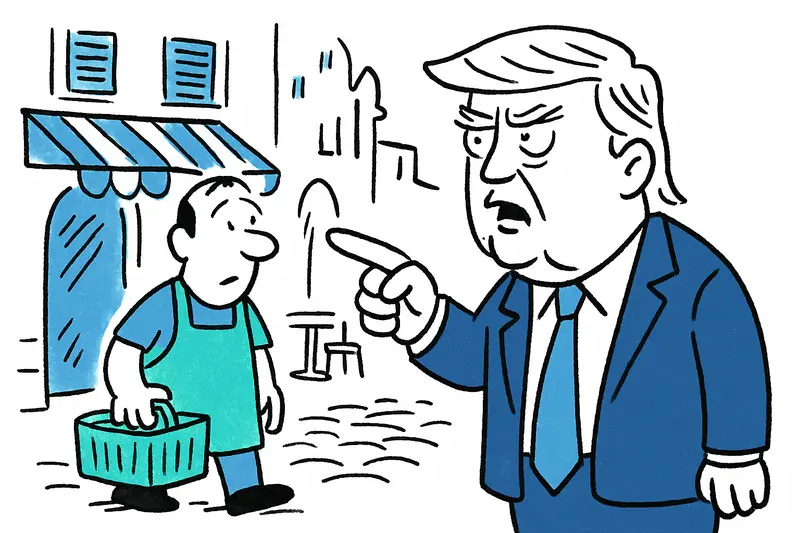
When Washington Threatens Trade: Trump's Words and Mallorca's Situation
When Washington Threatens Trade: Trump's Words and Mallorca's Situation
US President Trump threatened a trade halt against Spain after Madrid refused to allow the use of its military bases for operations against Iran. What does this mean for Mallorca — economically, practically in everyday life, politically? A reality check from Palma.
When Washington Threatens Trade: Trump's Words and Mallorca's Situation
A Clear Guiding Question
Guiding question: Can a political crisis between Washington and Madrid really disrupt the quiet lanes of Palma and everyday life on the island — and if so, how severely?
Short version: US President Donald Trump publicly threatened a possible trade embargo against Spain after the Spanish government prohibited the use of its military bases in Andalusia for operations against Iran, a controversy discussed in Mallorca on Uneasy Standby: What the 'Defense-Interest' Status Really Means for Son Sant Joan. Chancellor Friedrich Merz is meanwhile trying to build pressure on NATO financing issues, as noted in Merz in Madrid: Why political differences with Sánchez are also felt in Mallorca. The Spanish government signals that it could cushion potential effects and diversify supply chains.
Critical Analysis — What Is Really at Stake
At first glance an embargo sounds like an abstract crisis scenario for foreign policy enthusiasts. On closer inspection, the effects are concrete: Mallorca depends on international supply chains — fuel, aircraft spare parts, food imports from outside the EU, and some industrial products. An abrupt suspension of important trade flows could raise fuel prices, trigger spare-part shortages and delay the arrival of seasonal goods.
Tourism is sensitive to price and availability changes. If kerosene becomes more expensive, airfares will rise and airlines may cut routes. Smaller businesses in Mallorca that operate on thin margins — landlords, dive schools, bus companies — would notice this immediately.
Politically the threat is also a test: How vulnerable is a NATO partner to political blackmail when bilateral interests are at stake? Trump put leverage on the table; Spain relied instead on international legal principles and the autonomy of its own decisions.
What Is Often Missing from Public Discourse
First: The debate quickly narrows to buzzwords like 'embargo' or 'bases'. The practical intermediate steps are rarely explained: Which goods would be affected, what contractual mechanisms would come into play, how quickly can suppliers be changed? Second: The discussion overlooks local vulnerabilities — the island economy's living room, not just large corporations. Third: There is no concrete plan for the transition period, such as government credit lines or targeted stockpiling strategies for key goods.
Everyday Scene from Palma
Early in the morning on the Paseo del Borne a crate rattles, a delivery van stops at the Mercado de l’Olivar, and on the Plaça de Cort small retailers argue about rising fuel prices. In the café across the street a chef from Es Trenc orders her usual tomatoes for the day — she worries that imported specialty ingredients could become more expensive. These images are not metaphors; they are everyday life: small businesses with narrow margins that depend on predictable deliveries. The broader context of naval visits and their political symbolism is covered in Aircraft carriers off Mallorca: When the sea becomes a political stage.
Concrete Approaches — Pragmatic and Local
1) Stockpile and diversification funds: The Balearic Islands, together with Madrid, could provide short-term aid and credit lines for affected SMEs so that supply disruptions do not immediately lead to insolvencies.
2) Regional warehousing: Build strategic reserves for fuel, medical equipment and seasonally relevant foodstuffs in port and logistics halls — the faster, the smaller the shock, a point also raised in Aircraft Carriers in the Bay: What Role Should Mallorca Play in the New Mediterranean Game?.
3) Supply-chain audits for key sectors: Hospitality, transport and health services need rapid reviews of which components come from third countries and how quickly replacements from the EU or North Africa can be arranged.
4) Strengthen political de-escalation channels: Palma and the Balearic representatives in Madrid should communicate how strongly the local economy and employment depend on national foreign policy decisions — factually, not rhetorically.
What Decision-Makers Should Do Now
Government in Madrid: Provide transparent scenarios and short-term support measures; actively involve EU partners to jointly cushion trade consequences. Local politics: Develop emergency plans for critical supply chains and inform businesses. Companies: Carry out risk analyses, check alternative suppliers, plan short-term price adjustments.
International partners: The EU and NATO must make clear that bilateral tensions should not automatically lead to the economic collateral damage of entire regions — while at the same time remaining constructive in discussions about defence spending.
Concise Conclusion
The threat to 'cut off all trade' is a political lever with real consequences — also for Mallorca. It would be naive to simply dismiss the words as rhetoric; it would be equally wrong to panic. Sober preparation, regional solidarity and concrete storage and financial instruments can limit the damage. At the Plaça de Cort over morning coffee people will continue to argue about politics — but it's easier to sleep with a plan in your pocket than with nothing but fear of the unknown.
Frequently asked questions
Could a trade dispute between the US and Spain affect everyday life in Mallorca?
Why would fuel prices in Mallorca be affected by a political crisis abroad?
Would flights to Mallorca become more expensive if kerosene prices rise?
What kinds of businesses in Mallorca are most vulnerable to supply disruptions?
How prepared is Mallorca for a sudden disruption in imports?
What would a trade embargo mean for tourism in Mallorca?
What is the significance of Palma and Plaça de Cort in Mallorca’s response to political tensions?
What should Mallorca businesses do if trade tensions start affecting supply chains?
Similar News

"Expensive chaos" and many open questions: What clients can do when a lawyer suddenly stops responding
Several clients complain that a well-known German lawyer in Mallorca has been unreachable for months. Key question: What...

TV tip: 'The Last Problem' — Mallorca as the setting of a classic crime
A classic whodunit on Mallorca: A new miniseries set in spring 1959 brings storm, an isolated hotel and a dense web of s...
Nipping Sea Creatures: Why Bathers in Cala Major and Elsewhere Should Be Cautious
In Cala Major, bathers have reported being nipped by small fish. What is behind it, how can problems be avoided — and wh...
Forced eviction in Santa Catalina: When a 65-year-old slept in her car and showered on the beach — a question of responsibility
The story of Pilar López from Santa Catalina represents a problem affecting many Mallorcans: How can an island with a bo...
New traffic rules from October 1: What Mallorca visitors and locals need to know
From October 1, 2026, Spain will implement far-reaching changes to traffic regulations. Important for Mallorca: greater ...
More to explore
Discover more interesting content

Can Cap de Bou

Townhouse Lleo 72
