
When History Becomes Luxury: The Cartujana de Santa Creu in Palma
When History Becomes Luxury: The Cartujana de Santa Creu in Palma
In the heart of Palma a building from 1411 is being converted into high-priced apartments. Smallest unit: 53 square meters for one million euros. Who benefits — and who is left behind?
When History Becomes Luxury: The Cartujana de Santa Creu in Palma
Who does the upgrade serve when locals are displaced by rising prices?
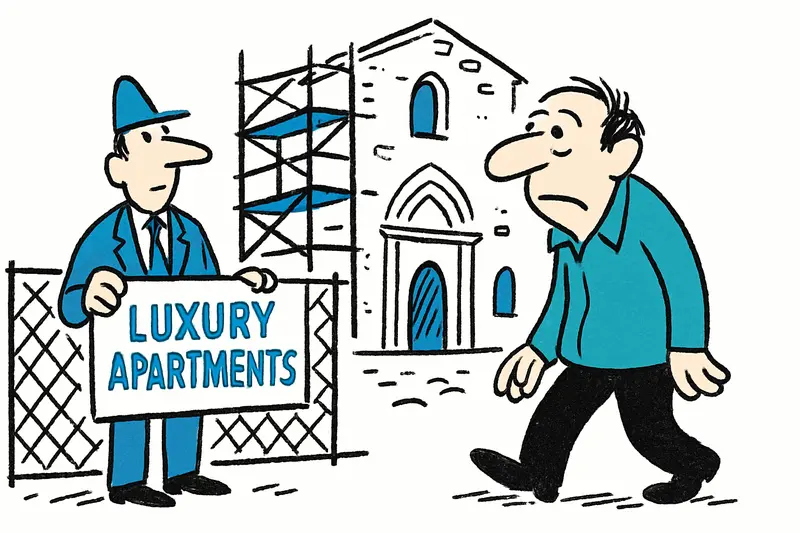
In Palma's old town a construction site is transforming a building dating back to 1411 into an upscale residential complex. The construction sign bears the name "The Heritage Residences" in English; behind the scaffolding freshly restored windows gleam, and above the noise of the works one can hear the cathedral bells in the distance. It's raining lightly and the temperature is around 12 °C — typical for a winter morning, on which nevertheless the spearhead of the city's marketing becomes visible: five apartments, from the 53-square-meter unit advertised at one million euros to the roughly 435-square-meter penthouse with a private lift and pool. Three of the five units have already been sold, according to current information.
Main question: Is it justifiable that a historic building, whose walls once hosted pilgrims and monks, is primarily marketed as a commodity for particularly affluent buyers — and what consequences does this have for Palma?
Critical analysis: At first glance the restoration is laudable. Monument protection requires that old murals and two gate arches remain untouched; that is good. But the economic logic behind it is clear: such projects are tailored to buyers with an international profile, a trend noted in Who Owns Palma? When Luxury Quietly Repaints the Working-Class Neighborhoods. Advertising in English and luxury extras indicate that the focus is less on the urban common good than on profit and prestige. Large developments such as 57 Units in Es Jonquet: Palma's New Luxury Project Puts Urban Development to the Test illustrate this logic. When 53 square meters are sold as an exclusive product for one million euros, this sets a price anchor that pushes the local market upward — especially in central neighborhoods, as documented in Palma at Two Prices: Why the Same Square Meter Can Suddenly Be Luxury.
What is often missing from public debate is the precise accounting for the city. There is little transparent information on tax contributions, whether buyers must be resident locally, or on obligations that would give the project added value for the neighborhood. Equally rarely discussed is how such conversions affect local services, artisan businesses and small shops in the long term. If historical facades are preserved but the residents change, a district loses its social cohesion.
An everyday scene: two retirees sit outside the café on the square side and watch delivery scooters bringing packages for a domestic and international clientele. A small bakery that has been baking bread there for decades has already reduced its opening hours because weekend customers are missing. In the evenings hardly any young families stroll the narrow streets any more — instead souped-up cars with foreign license plates park and short stays by visitors are the norm. Such perspectives remain invisible in brochures but are tangible in the daily atmosphere of the city.
Concrete solutions: The city administration can shape outcomes if it chooses. Proposals that make sense and are legally feasible include: 1) Introduce binding social quotas when converting historic buildings — for example a mandatory share of affordable housing or a compensation payment invested in social housing. 2) Create a transparency register for buyers and beneficial owners so speculation does not happen in secret. 3) Strengthen municipal pre-emption rights for listed properties, combined with a fund to secure cultural uses (studios, community spaces). 4) Offer tax incentives to investors who create local jobs or secure commercial space for traditional crafts. 5) Anchor conditions in building permits that guarantee public access to certain parts of the ensemble (small exhibition areas, accessible courtyards on specified days).
These measures are not a panacea, but they redirect levers where they have effect: not only into the pockets of sellers and brokers, but also into the neighborhood. The balance between conservation care and social responsibility is crucial.
Concise conclusion: It is legitimate to preserve and use a historic building. It becomes problematic when use serves only the luxury market and urban society is left out. Palma needs rules to prevent old stones from functioning solely as investment objects. Otherwise, what remains is a nicely restored facade — and the life that once shaped the city is gone.
Frequently asked questions
Why are historic buildings in Palma being turned into luxury apartments?
How does luxury redevelopment affect housing prices in Palma?
What should buyers know before purchasing a renovated historic apartment in Mallorca?
Is there a problem if old buildings in Palma are preserved but sold only to wealthy buyers?
What makes Palma’s old town attractive to luxury property investors?
What can Palma do to keep historic buildings useful for local residents?
Is winter a good time to visit Palma’s old town?
Can you still experience local daily life in Palma’s historic centre?
Similar News

Are the Balearic Islands the Southern Border of Europe? A Reality Check on Immigration
The Balearic Islands are again calling for EU aid after a sharp rise in arrivals by sea. Conflicting priorities between ...

"Expensive chaos" and many open questions: What clients can do when a lawyer suddenly stops responding
Several clients complain that a well-known German lawyer in Mallorca has been unreachable for months. Key question: What...

TV tip: 'The Last Problem' — Mallorca as the setting of a classic crime
A classic whodunit on Mallorca: A new miniseries set in spring 1959 brings storm, an isolated hotel and a dense web of s...

Nipping Sea Creatures: Why Bathers in Cala Major and Elsewhere Should Be Cautious
In Cala Major, bathers have reported being nipped by small fish. What is behind it, how can problems be avoided — and wh...
Forced eviction in Santa Catalina: When a 65-year-old slept in her car and showered on the beach — a question of responsibility
The story of Pilar López from Santa Catalina represents a problem affecting many Mallorcans: How can an island with a bo...
More to explore
Discover more interesting content

Can Cap de Bou

Townhouse Lleo 72
