
When the Workshop Becomes a Queue: Why Appointments on Mallorca Take Longer
When the Workshop Becomes a Queue: Why Appointments on Mallorca Take Longer
Mechanic shortages, older cars and spare-part problems: many workshops on Mallorca are at capacity. We ask: what is missing from the debate — and how can the problem really be solved?
When the Workshop Becomes a Queue: Why Appointments on Mallorca Take Longer
Summary: According to the industry association ABERAN, more than a thousand mechanics are missing on the Balearic Islands. Increasing numbers of vehicles and a rising average age of cars are colliding with spare-part delivery problems and rising costs. Small businesses are overloaded and appointments are often postponed by two to four weeks. That is the situation — but what does it mean for everyday life and safety on the island?
Key Question
How long can Mallorca function well if simple repairs become a test of patience and causes like training, logistics and politics are rarely considered together?
Critical Analysis
The bare numbers — more than a thousand missing specialists, more and older vehicles, two- to four-week waiting times — are only the surface of a system that is stuck in several places. Workshops operate on thin margins; many owners are craftsmen, not managers. At the same time, parts and logistics are becoming more expensive, often because individual spare parts come from abroad and pile up in Palma's port. Seasonal demand exacerbates the situation: during tourist peaks and the pre- and post-season, appointment patterns differ from the quiet period. The result: small businesses postpone work, accept only the essentials, or open extra weekend slots — effectively running on credit.
What Is Missing from the Public Debate
People too often speak of a “skills shortage” as if it were a single cause. But the shortage is both a consequence and a symptom: too few apprentices, low attractiveness of the sector for young people, a lack of advanced training for modern vehicles (hybrids, e-vehicle electronics), complicated recognition procedures for foreign technicians, and inadequate spare-parts logistics. Rarely discussed are the consequences for road safety or the environmental impact of older, poorly maintained vehicles — and these are real risks, not just economic inconveniences.
Everyday Scene from Palma
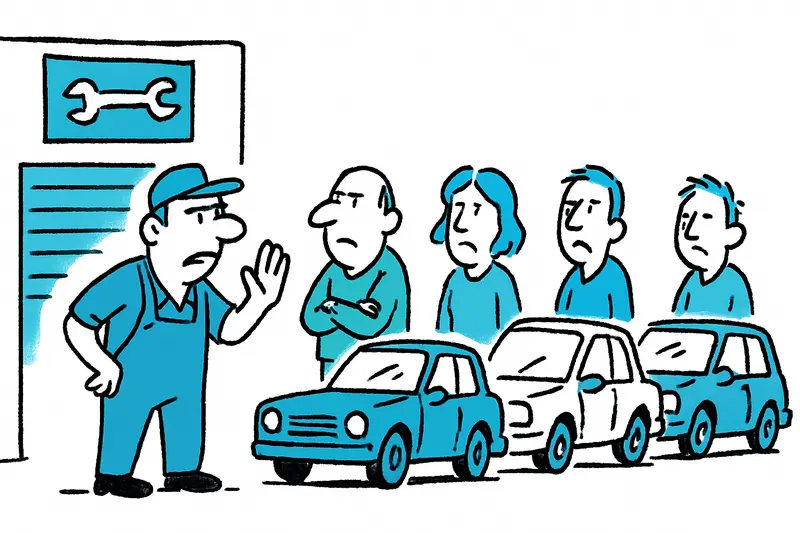
A gray morning at the entrance to Polígono Son Castelló: three vehicles queue in front of a small workshop, the radio antenna of a small van rattles in the wind. The mechanic, in his mid-fifties, wipes his hands on an oil-stained rag and says, "I could start right away, but I'm missing the sensors — for two weeks now." In front of the shop window a young woman leans and scrolls through the booking app: available appointments not until three weeks. Scenes like this are as likely in Pollensa or on Avenida de Gabriel Roca as they are here in Palma.
Concrete Solution Approaches
The situation cannot be eased by appeals alone. Concrete proposal 1: strengthen training. More dual apprenticeships, attractive pay during training, and targeted campaigns at Mallorca schools. Proposal 2: make career paths more visible — cooperation between workshops, vocational schools and the chamber of commerce so young people gain practical experience without immediately moving away. Proposal 3: consolidate spare-part logistics. A "parts hub" at the port of Palma could reduce stalled deliveries and relieve small workshops. Proposal 4: recognition and incentives for foreign specialists — faster recognition procedures, language courses and transitional qualifications with clear quality controls. Proposal 5: mobile mechanic teams and service cooperatives: if several small businesses pool resources and appointments digitally, peaks in demand can be better smoothed. Proposal 6: funding programs for modernization, especially for training in e-mobility and driver-assistance systems — otherwise we will be facing the same problem in five years.
Why Solutions Must Be Local
Mallorca is not part of the mainland; seasonality, port logistics and housing prices interact here. Young people often leave the island because they see no prospects — this also affects the auto-mechanic sector. Practical measures that connect training, housing, mobility and logistics are necessary. Otherwise workshops will remain caught in a loop of overload, and drivers will lose time, money and increasing trust.
Concise Conclusion
It is wrong to dismiss the issue as a pure labor shortage. Much of what leads to long waiting times today can be managed: training policy, port logistics, recognition of foreign qualifications and targeted funding for modernization. Those who only complain do nothing. Those who act now — with locally adapted, practical measures — can relieve Mallorca in the short term and make it more resilient in the long term. Otherwise the workshop will no longer be a place of repair but a queue.
Frequently asked questions
Why do car repairs take so long in Mallorca?
How long is the usual wait for a car workshop appointment in Mallorca?
Is it safe to keep driving an older car in Mallorca?
What should I do if my car repair in Mallorca is delayed because parts are missing?
Why are Mallorca workshops busier during tourist season?
Where in Palma are workshop queues especially noticeable?
Are car repair delays only a Palma problem, or do they affect the whole of Mallorca?
What could help reduce long workshop waiting times in Mallorca?
Similar News
Are the Balearic Islands the Southern Border of Europe? A Reality Check on Immigration
The Balearic Islands are again calling for EU aid after a sharp rise in arrivals by sea. Conflicting priorities between ...

"Expensive chaos" and many open questions: What clients can do when a lawyer suddenly stops responding
Several clients complain that a well-known German lawyer in Mallorca has been unreachable for months. Key question: What...

TV tip: 'The Last Problem' — Mallorca as the setting of a classic crime
A classic whodunit on Mallorca: A new miniseries set in spring 1959 brings storm, an isolated hotel and a dense web of s...

Nipping Sea Creatures: Why Bathers in Cala Major and Elsewhere Should Be Cautious
In Cala Major, bathers have reported being nipped by small fish. What is behind it, how can problems be avoided — and wh...
Forced eviction in Santa Catalina: When a 65-year-old slept in her car and showered on the beach — a question of responsibility
The story of Pilar López from Santa Catalina represents a problem affecting many Mallorcans: How can an island with a bo...
More to explore
Discover more interesting content

Can Cap de Bou

Townhouse Lleo 72
