
Severe crash in Palma: Four times the alcohol limit, no driver's license, no insurance, no ITV — a reality check
In Palma police stopped a car whose driver registered 1.13 mg/l of alcohol on a breath test. He refused a full secondary test and was driving without a license, insurance and a valid ITV. Why such cases recur and what can help prevent them.
Severe crash in Palma: Four times the alcohol limit, no driver's license, no insurance, no ITV — a reality check
An evening in February, two streets, many unanswered questions
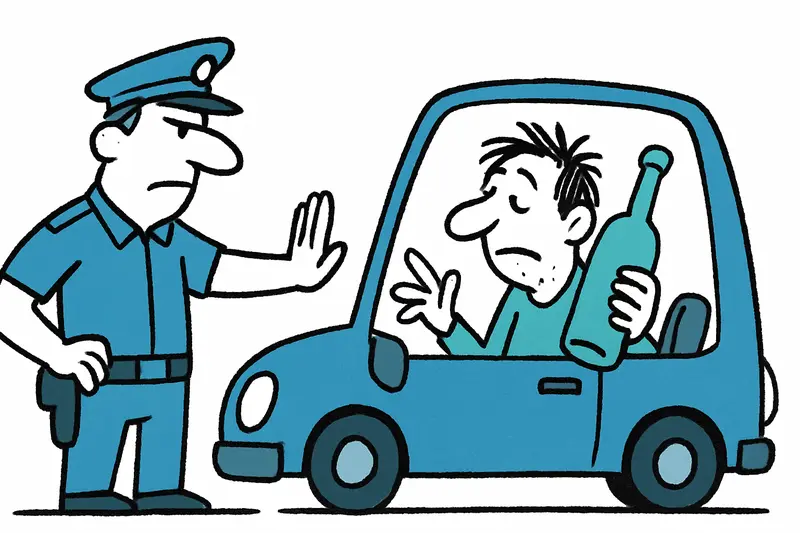
The facts are small and loud: On February 11 at around 11:20 p.m., callers reported a car performing risky maneuvers on Carrer Benet Pons i Fàbregues, running a red light, hitting a parked vehicle and then leaving the scene. Officers from the Immediate Intervention Unit (UII) finally stopped the vehicle on Reis Catòlics street. The officers observed signs of intoxication; a breath test showed 1.13 mg/l — according to the police about four times the permitted limit. The 45-year-old driver then refused the full secondary breathalyzer test. In addition, he was driving without a driver's license, the car had no insurance and did not display a valid ITV sticker. The Accident Vehicle Unit (UVAC) has taken over the investigation and an administrative report was filed.
Key question: Why do cases repeatedly occur in Palma in which alcohol, missing documents and poor vehicle checks converge — and what is missing so that such risks are stopped earlier?
In short: this is not an isolated slip-up on a single night. Similar incidents, such as a crash in Jaume III involving a driver whose licence had been revoked, show a convergence of several problems — drunk driving, insufficient vehicle checks and apparently inadequate deterrence. The police responded. But the episode reads like a textbook example of how gaps in the system interact: an intoxicated driver can continue on the road without a license, insurance or a valid technical inspection until something worse happens.
If you stand on Carrer Benet Pons i Fàbregues late on a Tuesday evening, you hear the leftover bar noises, the bus line, a few taxis, and then suddenly the whirring of police lights. Such scenes here are not exotic — rather everyday; for example, a recent arrest of a 61-year-old for driving the wrong way in Palma illustrates how frequent nighttime infractions can be.
Critical points from the situation assessment: First, the simple combination of no insurance and a skipped ITV facilitates risky behavior. Without insurance there is no immediate financial pressure; without ITV the technical condition of the vehicle remains unchecked. Second, alcohol checks late at night are resource-intensive. Random spot checks are not always sufficient to catch repeat offenders. Third, refusing a secondary test is a known challenge for investigators: it prevents a clear evidential basis and delays sanctions. Past cases where police found multiple offences at once, such as an overloaded vehicle stopped with a driver under the influence of alcohol and drugs, highlight the complexity investigators face.
What is often missing in public debate is the connection between prevention, enforcement and aftercare. We talk about fines and investigations — less about systematic prevention measures that would prevent trips like this from happening in the first place. The perspective of possible victims (a damaged parked car at night, a pregnant woman later crossing the street) barely appears.
Concrete proposals that could actually be implemented on Mallorca:
- More intensive coordinated night patrols: Joint shifts of municipal police, Guardia Civil and UVAC at known hotspots (e.g. access roads to nightlife districts). Visible presence acts as a deterrent and reduces attempts to flee.
- Mobile inspection stations: Targeted checks with quick queries of insurance and ITV via license-plate scanners. A short stop with automatic checks prevents vehicles without documents from staying on the road for long.
- Alcohol ignition interlock concept for serious cases: For drivers with very high values or repeat offenders, temporary requirements to fit alcohol ignition interlocks could be tested — combined with community service or therapy offers.
- Cooperation with the hospitality sector: Training for bars and restaurants and targeted campaigns so that intoxicated guests are not allowed to drive. A small sign at the door cannot solve everything, but on Mallorca social networks matter: staff, taxi drivers, neighbors.
- Harsher sanctions for uninsured vehicles: Immediate towing and significant fees create real economic pressure; this likely reduces the willingness to drive without insurance.
Such measures cost money and personnel; they require political will and a dose of pragmatism. The local administration could start pilot projects — for example in Palma neighborhoods with frequent night incidents — and evaluate the results after six months. Data-driven approaches help: Where do collisions involving alcohol, missing ITV and no insurance occur most often? Those places should be addressed first.
A small everyday moment as a closing image: On Reis Catòlics the dash light of a patrol car still glows, a resident pulls his jacket tighter against the wind. He says nothing, merely shakes his head: “Another one.” This resignation shows that controls are not only police acts but must also restore trust — trust in the streets, in order and in the idea that rules are enforced.
Conclusion: The incident is a warning sign. When alcohol, lack of a driving license and deficient vehicle documents coincide, the danger potential increases sharply. Palma needs both solid controls and preventive offers so that a crash is not always the alarm that wakes people up.
Frequently asked questions
What happens in Mallorca if a driver is caught with a very high alcohol level?
Can you drive in Mallorca without a licence, insurance or ITV?
What should I do if I see a dangerous driver in Palma at night?
Why are alcohol-related crashes still a problem in Palma?
What is ITV in Mallorca and why does it matter?
What can police do after a crash in Palma if the driver flees the scene?
How do police check for drunk driving in Palma?
What can Mallorca do to reduce dangerous driving at night?
Similar News
Carriages Without Horses: Palma Plans E-Carriages – a Reality Check
Palma plans to switch to electric carriages in 2027. The prototype was shown near the cathedral. What is the technology ...
Record season, empty coffers: Who really benefits from the tourism boom?
Full hotels and more flights: the numbers sound impressive — yet many locals feel no benefit. A reality check with an ev...
Pool ordered for €46,000 – €23,000 paid, no work carried out: A fraud case in Palma
A homeowner in Palma transferred €23,000 for the construction of a pool. Weeks later it emerged that no building applica...
Summer greetings from the Pitiusas island: Gottschalk and Krüger enjoy the sun on Ibiza
A friendly photo of Thomas Gottschalk and Mike Krüger on Ibiza evokes memories of their shared film years and shows that...
Occupied in a Few Days: When Property in Mallorca Turns into a Dispute
Six young men were arrested in Palma after homeowners returned and could no longer open their own door. A case that rais...
More to explore
Discover more interesting content

Can Cap de Bou

Townhouse Lleo 72
