
Why the blue glow at the airport must be more than just a photo
The glowing blue at Aeropuerto Son Sant Joan drew attention. Now action is needed: better signage, digital aids and staff training for real accessibility.
A blue morning at Son Sant Joan – gesture or beginning?
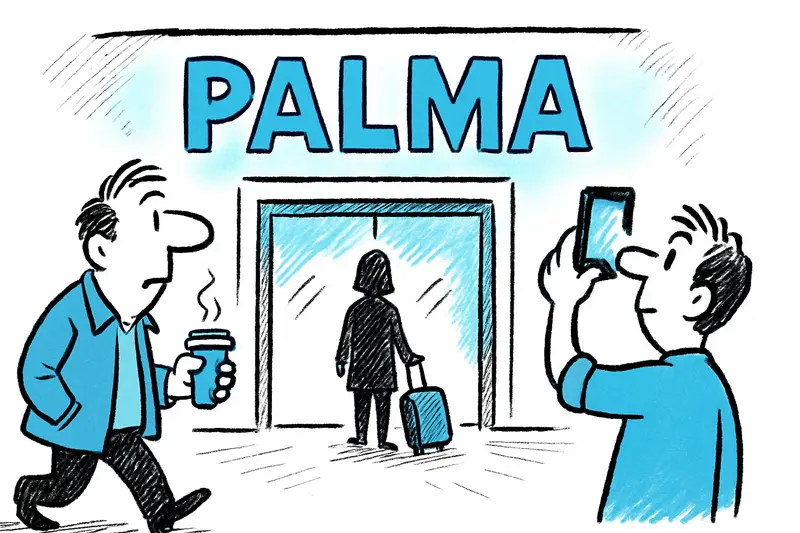
It is early morning, the smell of cortado mixes with the sound of rolling suitcases, seagulls cry above the parking garage and the loudspeakers whisper gate changes. The taxi queue stops in front of the terminal, people pull out phones and snap pictures: a strong blue shines over the airport doors. A beautiful postcard shot. But the key question remains: Is a photogenic light enough to remove real barriers for people with dyslexia?
More than a light show: what it’s really about
The action was officially announced as a visible reminder for International Dyslexia Awareness Day. Mission accomplished, one might say — attention has been raised. But attention is only the first step. In a place like Son Sant Joan, where people from around the world meet and information must be processed in split seconds, it quickly becomes apparent whether a gesture has substance.
Dyslexia is not simply “poor reading.” Many affected people are creative, highly intelligent and find unusual solutions. Yet they often stumble over design, pace and language: flashing info boards, cryptic abbreviations, e-tickets with long terms and conditions — all of these become unnecessary obstacles at the airport.
Often overlooked aspects
1) Design and typography: Much could be gained with fewer experiments. Dyslexia-friendly fonts, appropriate contrasts and larger line spacing on monitors and signs help not only those affected but also stressed travelers, glasses-wearing seniors and parents with children.
2) Digital accessibility: Many booking platforms and information terminals display text in tiny sizes or very formal language styles. Read-aloud functions, simplified reading modes and clearly marked help buttons would be technologically feasible — and are usually cheaper than a new LED display.
3) Staff and service processes: Friendliness often isn’t enough. A short, practice-oriented training for check-in staff, security and boarding pass control can prevent misunderstandings. A calm explanation, a written reminder note or the offer to fill out forms together: small gestures, big impact.
4) Networking with educational institutions: A one-time illumination only has a short effect. If airport management, schools and counseling centers in Mallorca collaborate, sustainable formats can be created: information booths during holiday seasons, regular workshops for pupils or joint pilot projects.
Concrete opportunities for Mallorca
The blue has sparked conversations. Now the island needs concrete steps. Three proposals that can be implemented locally:
- Pilot project at one gate: A test series with dyslexia-friendly displays and alternative reading modes at a heavily used gate for three months. Evaluation through feedback forms and simple user statistics.
- Readability standard for signage: Binding guidelines for font sizes, contrast values and pictograms on information boards; coordinated with education authorities and local designers.
- Short trainings and information cards: Two-hour workshops for frontline staff and multilingual cards with assistance tips that can be handed out when needed.
These measures require time and a bit of money. But they create real benefits: fewer misunderstandings at counters, shorter queues, guests appearing more satisfied. For an island that lives off a good reputation, it’s worth it.
What the blue glow has already achieved
The immediate effect should not be underestimated. Travelers stopped, talked, parents exchanged experiences. Activists used the photo opportunity to draw attention to an issue that has so far rarely been visible. A taxi driver at the exit put it dryly: "Better blue than another sign that nobody understands." A dry joke with a kernel of truth: color alone doesn’t solve problems, but it can open doors — if someone is willing to walk through them.
Conclusion: From gesture to good practice
The blue-lit portal was a successful door opener. It would be more valuable if the energy now flowed into verifiable measures. Not just in Palma, but across the island. If airport management, authorities and civil society groups use the momentum, a photo motif can become a starting signal for real accessibility.
Tip: If you work at or regularly arrive at the airport: ask whether pilot projects are planned. Sometimes a call to the information desk is enough to turn symbolism into practice.
Frequently asked questions
Why was Palma Airport lit up in blue?
How can airports in Mallorca be more accessible for people with dyslexia?
What should I pack or prepare if I am flying from Mallorca and have dyslexia?
Is the airport lighting in Palma just a photo opportunity or a real accessibility step?
What changes would help make Son Sant Joan easier for stressed travelers?
Are there any dyslexia-friendly measures planned for Palma Airport?
Why does airport signage matter so much in Mallorca?
Can schools and airport staff in Mallorca work together on accessibility?
Similar News

Micaela Schäfer: Between Playa de Palma and a Berlin Law Firm — New Calm, an Old Tomcat and Solid Finances
The party artist from the Ballermann scene appears surprisingly down-to-earth: a new relationship with a Berlin lawyer, ...

At Playa de Palma: Fire in Residential Building – six people rescued on the roof, what is missing in prevention?
In the evening a fire broke out on the first floor of a five‑storey building on Calle Trasimé. Six residents fled to the...
New License Requirement for Mini-Boats in Mallorca: Protection Measure or Tourism Brake?
From October 1 renters of small recreational boats in the Balearics must present a boating license. Critical questions r...

After the Storm: Mallorca Breathes Easy — Warm Weekend with Short Showers
The thunderstorm left its mark, but calm returns for the weekend: sun, summer temperatures around 32 °C, isolated shower...
No More 'Just Hop on a Boat': Mallorca, Mandatory Boating License and the Open Questions
From October 1, the Balearic Islands will require a boating license for small rental boats under five meters/15 hp. A tr...
More to explore
Discover more interesting content

Boat Tour with BBQ along Es Trenc Beach
Private transfer from Mallorca Airport (PMI) to Pollensa
