
Fourth Restart: Alice Klotz Opens 'Geheimtipp Heimathafen' in Peguera — Still Awaits Trial
Fourth Restart: Alice Klotz Opens 'Geheimtipp Heimathafen' in Peguera — Still Awaits Trial
After the fire in Arenal, restaurateur Alice Klotz is fighting for a fresh start: on March 15 her 'Geheimtipp Heimathafen' opens in Peguera. The trial over the 2022 fire is still pending — and continues to weigh on her.
Fourth Restart: Alice Klotz Opens 'Geheimtipp Heimathafen' in Peguera — Still Awaits Trial
On a late February afternoon a mild breeze blows along Peguera's boulevard. Set-out chairs clatter, a café around the corner is humming, seagulls are screeching, and the distant chug of an excursion boat can be heard. Right here, on the main street in the second line from the sea, an area recently covered by Kruemel opens "Schatzi": Peguera gets a club-restaurant with a family touch, Alice and her husband Bernd are preparing the opening of their new place: 'Geheimtipp Heimathafen' is set to open on March 15.
Key question
How much trust can a restaurateur win back when, four years after a business-threatening fire, the justice system has still not reached a decision?
Briefly, clearly: What happened
Alice Klotz, formerly the operator of an establishment at the Ballermann, effectively lost her life's work in a fire in May 2022. According to her, material damage amounted to around €60,000, the outdoor terrace remained closed for 133 days, and an auditor estimated lost revenues at just under €200,000. Investigations initially targeted 13 men; five were released, eight returned to Germany after paying bail. The public prosecutor's office states potential prison sentences of up to seven years for eight accused individuals.
Critical analysis
The facts are clear, but the root of the problem is systemic. At tourist hotspots with narrow terraces and many guests, small lapses can quickly become existential crises. Legal processing takes years; in the meantime those affected must bear the economic, administrative, and psychological consequences every day. For Klotz, this has meant ongoing therapy and a heavy strain on daily life – while authorities deliberate, income dries up, insurance matters are resolved slowly, and planning security is lacking.
What is missing in public discourse
There is a lot of talk about guilt and punishment, but too little about prevention, faster victim protection, and business resilience. Hardly discussed is whether municipal control mechanisms for fire safety and waste disposal on popular promenades are sufficient; local debates such as Krümels Schatzi in Peguera: Between boulevard summer and night-time quiet illustrate these tensions. Even less often addressed is how local business owners can be supported psychologically and financially until a court decision is reached.
Everyday scene from Peguera
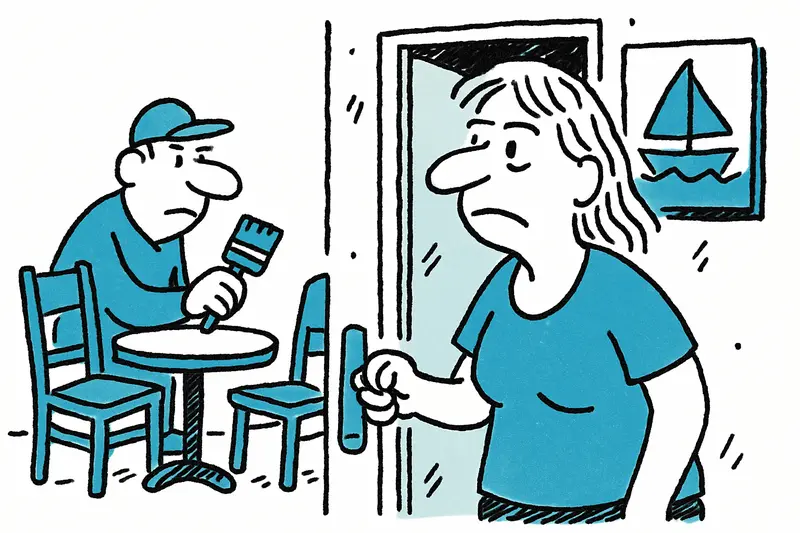
Walking along the main street you see deliveries of bread and rolls from a baker in Santanyí being unloaded, young teams at tables comparing menus, and tradesmen rolling fresh paint on walls. This is how gastronomy is created: quiet hustle, the smell of coffee, the laughter of guests. For Alice, this is the place where she wants to regain a foothold — yet the shadow of the earlier fire remains noticeable.
Concrete solutions
1. Accelerating court proceedings: Cases that threaten the existence of small businesses should be prioritized so that victims do not live in uncertainty for years. 2. Emergency funds for those affected: Local authorities or trade associations could set up short-term bridging funds to cover ongoing costs until insurance and legal matters are resolved. 3. Prevention checks: Regular, easily accessible fire safety and security inspections for promenade businesses — combined with advisory services for structural improvements. 4. Psychosocial support: Mandatory referrals to psychological support for affected entrepreneurs and employees. 5. Clearer liability and insurance standards: Regulations on which coverages should be mandatory for seasonal businesses so that a single lapse does not lead to bankruptcy.
Why the opening matters
Alice relies on familiar strengths: breakfast from six a.m., German classics like her schnitzel in 30 variations, 15 sangría varieties and tapas. She is supported by Peguera restaurateur Kai Weigel, and similar openings are described in Krümel inaugura 'Schatzi': Peguera tendrá un restaurante-club con un toque familiar; artistic evenings are intended to draw crowds. This is not just a business model but a message: continuing to work despite setbacks.
Concise conclusion
The restart in Peguera is courageous and could succeed. But sole proprietors like Alice must not be left alone until courts rule. If politicians, the judiciary and industry representatives do not promptly provide practical help, resilience remains a private matter — and there is a risk that an isolated incident becomes a tragedy for family livelihoods. Alice continues to wait for a trial that might finally allow her to find closure. Until then the practice is: open doors, full plates, and the hope that a better system will stop the next fire.
Frequently asked questions
Why do some restaurant reopenings in Mallorca take place long after a fire or closure?
What makes opening a restaurant in Peguera challenging for local owners?
How does a serious fire affect a small business in Mallorca?
What support do Mallorca business owners need after a major setback?
Is Peguera a good place for breakfast and daytime restaurant trade?
What does the main street in Peguera look like during restaurant season?
Why is fire safety especially important for promenade businesses in Mallorca?
Can a restaurant reopening in Mallorca help a business owner move on after a difficult past?
Similar News

Bendinat as a meeting place: Padel Cup brings together nearly 120 players
Three days of padel at the Bendinat Urban Country Club: organized by El Económico and Borbalán, with around 120 particip...
Large-scale Anti-Tourism Graffiti at Cala Mendia: Protest or Vandalism?
On the morning walkers discovered an approximately 50-meter-long slogan against tourism on the wall above Cala Mendia. W...
Bomb threat before Jet2 flight in Tenerife: A reality check for security protocols
A passenger reported a bomb in luggage shortly before departure in Tenerife. Evacuation, baggage checks, delays — and ma...

Who is stripping Mallorca's coast bare? Why entire slopes are being removed for villas
On Mallorca steep slopes are again being removed to make way for luxury construction sites. Who bears the responsibility...

Robber Falls While Fleeing in Sant Agustí: Who Takes Responsibility?
During a purse-snatching in Sant Agustí, a non-commissioned officer chased the suspect; the man jumped from a bridge and...
More to explore
Discover more interesting content

Can Cap de Bou

Townhouse Lleo 72
