
The American Painter Whose Grave in Sóller Quietly Builds Bridges
The American Painter Whose Grave in Sóller Quietly Builds Bridges
A white military headstone among cypresses tells the story of John H. Whyte: painter, soldier, a life between Pennsylvania and Sóller. Why his story benefits the island.
The American Painter Whose Grave in Sóller Quietly Builds Bridges
How a white military headstone on the cemetery wall of Sóller connects two continents
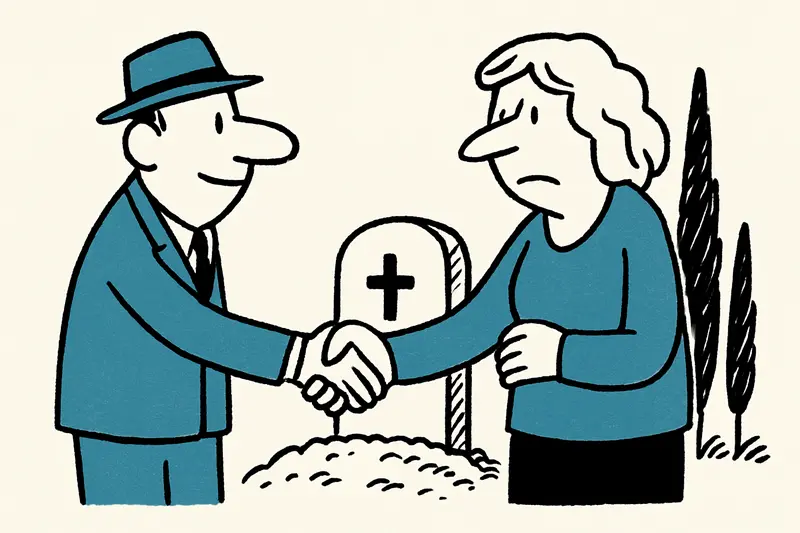
At the edge of the Protestant plot in Sóller, where cypresses cast long fingers over the gravel in the afternoon shade, stands a gravestone that immediately catches the eye. White. Narrow. In a form one would more likely expect on large U.S. military cemeteries. The name on it: John H. Whyte. Beside it a row of abbreviations that sound like a soldier's life: PVT. 133 M.G.B.N. 37 DIV. For us that means: Private, Machine Gun Battalion, 37th Division – a man who served on the Western Front in World War I.
The biography behind the stone reads like a small, remarkable journey. Born in 1887 in Carlisle (Great Britain), Whyte was part of an emigrant family that moved to the United States when he was a small child. In Philadelphia he studied, first at a technical college, then at an art academy. He wanted to paint. Later the war brought him back to Europe; in 1918 he fought in France, suffered severe injuries and lost his right arm. Many would have stopped there. Whyte did not. He learned to work with his left hand. That is one of those details that command respect – not with pathos, but with quiet amazement.
In the 1930s he again sought studio life in Paris. And finally: Sóller. Why this island? Perhaps the light, perhaps the mountains, perhaps the proximity to the sea. In front of the town’s train station he lived for two years in a hotel. I can still picture the small building: the sound of the rusty tram passing through the plaza, the clatter of suitcases, tourists’ voices, and in the mornings the scent of freshly baked ensaimadas drifting to the reception. In that atmosphere Whyte painted the rugged houses, the orange groves, the Tramuntana ridges – pictures that still hang in family albums in the United States today. For a profile of a public figure who sought peace on Mallorca see Robert Redford: The island where he found strength.
In 1933 Whyte died unexpectedly in his hotel room. There is no simple explanation; a telegram from home cited possible causes such as preexisting conditions, war-related effects, or a sudden serious illness. Certain is only that he did not return to America. He was buried as an American soldier. The white stone among the predominantly Catholic graves comes from the United States – a small transplanted culture of remembrance amid Mallorcan soil.
What makes this story valuable for Mallorca? First of all, it shows the island as an intersection of personal memories. Sóller is not just oranges and tourists; it is a place of personal stories that tell of war, art and migration. A single gravestone can attract tourists, yes, but more importantly: it reminds locals that history often lives on here in very personal traces. At the cemetery you see older neighbors arranging flowers; children on their way to school pausing briefly to count the cypresses; and sometimes older artists who meet for coffee at the station and talk about former techniques. These are the small everyday pulses that keep this story alive. For related features on local artists and craftspeople see Joan Aguiló: Portraits, Walls and the Real Mallorca and The Blacksmith of the Finca: When Sparks Tell Stories on Mallorca.
For local cultural preservation Whyte's grave is a gift: it provides an occasion to create connections. One idea would be a small art trail through Sóller linking sites and artists – with an information plaque at the cemetery, a photo in the municipal archive, a display in the library. No big museum is needed, just attention: a map at the tourist office, a commemorative evening in a café, perhaps a reproduction of one of his paintings in the town hall. Such measures cost little but return identity.
And there is a gentle, almost ironic consolation: an American soldier who once lost his right arm and continued to paint with his left rests in a valley where the afternoon sun softens everything a little. That is an image that can also appeal to young people – less reverence, more humanity.
My small observation in closing: on some days, when the train squeaks and the orange blossoms flutter in the wind, locals sit on the wall beside Whyte's grave and look toward the mountains. They do not speak loudly. Often the light, the silence and the certainty that some stories are better kept here because someone tells them and someone else carefully preserves them are enough. If we continue to nurture that, Sóller will work not only as a postcard motif but as a place where memories resonate across borders.
A suggestion to copy: a small "Artists and Remembrance Day" in Sóller, with guided tours to the cemetery, local bakeries baking Whyte's favorite bread (or a modern homage to it), and a display of reproductions of his motifs. No big fuss. Just an invitation to look and connect. That would be a good way to culturally strengthen the island – without much noise, but with real benefit for local community life.
Frequently asked questions
Who was John H. Whyte, and why is his grave in Sóller noteworthy?
Can you visit John H. Whyte’s grave in Sóller cemetery?
What makes Sóller an interesting place for art lovers?
What kind of life did John H. Whyte lead after losing his right arm in World War I?
What is the best time of day to visit the cemetery in Sóller?
Why is John H. Whyte buried in a Protestant cemetery section in Mallorca?
What can visitors notice about John H. Whyte’s grave in Sóller?
Are there ways Sóller could better preserve stories like John H. Whyte’s?
Similar News
Just Bought — Already Trouble: Water Damage in the Heiters' Villa and What Owners in Mallorca Should Know Now
A newly purchased sea-view property — and within days a water damage. What risks lurk in new properties in Mallorca, and...

Rich, Richer, Mallorca? A critical look at the growing super-rich bubble
Numbers: Around 3,600 millionaires in the Balearic Islands hold a combined €27.6 billion. What this concentration of wea...
Chain reaction on the MA-1: Eight injured in rear-end collision near Portopí
On Tuesday morning there was a crash at the Andratx exit to the MA-1 towards Palma: a rear-end collision between a car a...

Happy Couple and Water Damage in Mallorca: A Reality Check for Home Buyers
Just moved in, already water under Mallorca's sun: the case of the influencer couple highlights risks often overlooked w...
Bendinat as a meeting place: Padel Cup brings together nearly 120 players
Three days of padel at the Bendinat Urban Country Club: organized by El Económico and Borbalán, with around 120 particip...
More to explore
Discover more interesting content

Can Cap de Bou

Townhouse Lleo 72
