
What Does the New Anti-Tobacco Law Mean for Mallorca? A Reality Check
What Does the New Anti-Tobacco Law Mean for Mallorca? A Reality Check
The Spanish government has introduced a tightened anti-tobacco law. What specifically changes for Mallorca — and where are the practical answers on the ground?
What Does the New Anti-Tobacco Law Mean for Mallorca? A Reality Check
The central government in Madrid has approved a draft for a tougher anti-tobacco law that legally equates e-cigarettes with cigarettes and extends smoking bans to terraces, beaches, swimming pools, bus stops and other public areas. On Mallorca this reform will be felt in cafés in Palma, on Playa de Palma and in the tourist centres around Port d’Alcúdia. But is that enough — and how will it be implemented in practice?
Key question
How can the ambitious goal of a “tobacco-free generation” be reconciled with the everyday expectations of residents, restaurateurs and holidaymakers on Mallorca?
Critical analysis
The bill sets out clear rules: vaping, nicotine pouches, shisha products and conventional cigarettes are to face the same restrictions; consumption by minors is explicitly prohibited; new products should only be sold in specialist shops. These are important legal steps, but the practical side is complex. On Mallorca the outdoor areas of bars and restaurants are often open, winding and densely occupied. Who will enforce the rules on a busy terrace on a Saturday evening in the Plaça Major? How will guests react when the boundary between allowed and prohibited areas is not clearly visible?
The proposed penalties are high — fines ranging from €200 to €600,000 are mentioned — and operators are given two months to put up information signs. High fines create deterrence but also conflicts. Police and local enforcement services are already burdened here by tourist safety, noise issues and traffic. Without additional resources the law risks being stricter on paper than it is enforceable in everyday life.
What is missing from the public debate
The debate focuses on bans and figures — for example on the estimated deaths from tobacco consumption in Spain — but answers to practical questions are missing: Who pays for signage and controls? How will specialist shops for new nicotine products be certified, especially in smaller towns like Santanyí or Deià? What exceptions, if any, apply to covered but open terraces in strong winds? And how will hospitality businesses be informed and supported before fines are imposed? Local government responses are uneven, as reported in Balearic Islands Reject Central Smoking Ban on Beaches and Terraces and Balearic Islands reject smoking ban on beaches and terraces — what now?
Everyday scene from Mallorca
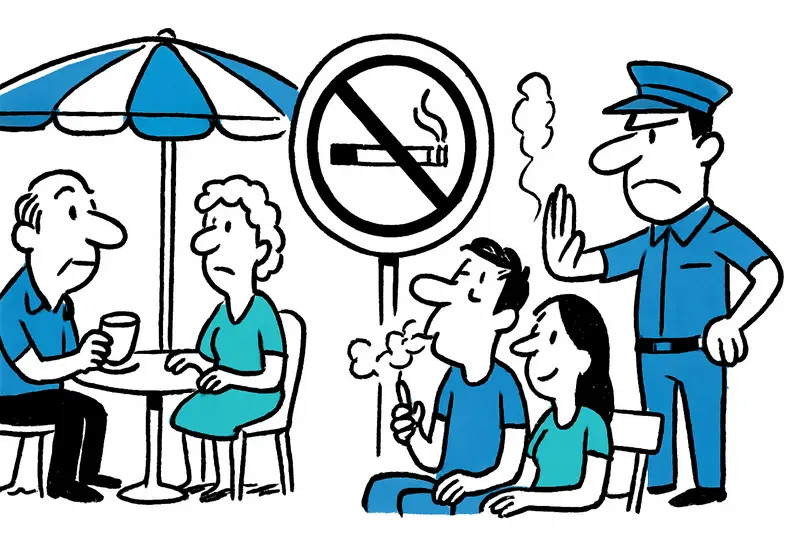
Imagine Avenida Jaime III on a hot morning: tourists, locals on Vespas, heat waves shimmering over the asphalt, and at the edge a café terrace. An older couple drinks café con leche, two young people share an e-cigarette — everything seems harmless. A few metres away children play in the square. Scenes like these are supposed to take place without tobacco smoke in future. But as long as the boundaries between pavement, outdoor terrace and public space remain fluid, friction points arise: desires for clean air meet habits and business models.
Concrete solutions
1) Clear, locally understandable markings: Mallorca’s town halls should work with the hotel and gastronomy sectors to develop binding signage and ground markings. A unified symbol reduces disputes at the door of an establishment.
2) Transitional measures and training: Two months for signs is tight. Graduated measures would be better: first awareness campaigns in several languages, then warnings before fines follow. Mobile info teams could raise awareness in tourist centres.
3) Enhanced designated zones: On heavily frequented beaches like Playa de Palma, clearly delineated “smoke-free areas” could be marked — for example with temporary fences or visually striking markings at accesses, combined with lifeguards serving as contact persons.
4) Support for restaurateurs: Small businesses need sign templates, legal guidance and a municipal hotline. This helps avoid unfounded fines and de-escalate conflicts.
5) Prevention instead of punishment: Schools, universities and youth centres on Mallorca should receive strengthened programmes against nicotine and vaping consumption; parent evenings in municipalities would be a simple local measure.
Concise conclusion
The law has the potential to make the air in Mallorca’s streets, on beaches and on terraces cleaner. Whether it really works will be decided not only in Madrid but on the island: at the bars, in town halls and between the deckchairs. Those who now only order signs and threaten high fines risk trouble without much effect. But those who invest in education, clear markings and local support can achieve the goals — with less coercion and more everyday practicality. The task is therefore practical: create rules that work locally.
Frequently asked questions
What does the new anti-tobacco law mean for outdoor spaces in Mallorca?
How will enforcement work on Mallorca’s busy terraces?
What signage and markings should Mallorca venues use to comply?
Are beaches like Playa de Palma affected by the law?
What are the rules for nicotine products and minors in Mallorca?
Will smaller towns like Santanyí or Deià face certification issues for nicotine shops?
What transitional steps could help hospitality businesses during the rollout?
Will Mallorca’s tobacco rules improve public spaces like streets and beaches in practice?
Similar News
Three Luxury Hotels in Banyalbufar: Lots of Money, Many Questions
A Danish investor plans three exclusive accommodations in Banyalbufar — including the historic Son Valentí. The announce...
2.1 tonnes of cocaine on sailing yacht off Spain's coast – a reality check for the coastguard
A 14-metre yacht was seized with 2.1 tonnes of cocaine. Who monitors the ports, how does the international hunt succeed ...

Heat Bonus in Mallorca: 100 Euros Extra for Outdoor Staff at MarSenses
MarSenses pays employees who worked outdoors in August an extra €100 as recognition. Lighter uniforms, reduced hours for...

Renovating in Mallorca: What You Really Can Do Without Neighbour Consent
Many think they can do whatever they want in their apartment. That's partly true — but only as long as structural elemen...
Cafetería San Siro: A Meeting Place on Schinken Street Since 1966
In the middle of Schinken Street, Cafetería San Siro has been offering Mallorcan hospitality for more than six decades —...
More to explore
Discover more interesting content

Can Cap de Bou

Townhouse Lleo 72
